








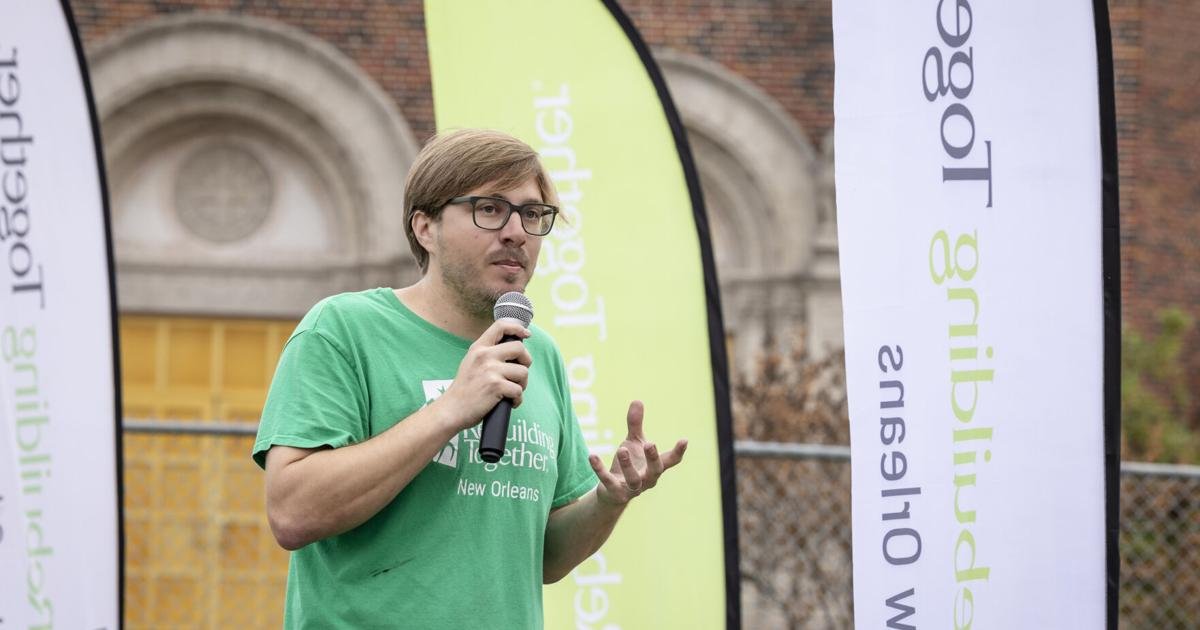
When William Stoudt was in elementary school in the late 1990s, the Preservation Resource Center launched Christmas in October, a program modeled after the national Christmas in April that enabled older and disabled people to stay in their homes by making critical repairs to the structures.
Over the years as a program of the PRC, the local organization grew and changed its name to Rebuilding Together New Orleans. In 2018, it went out on its own as a 501(c)3. Along the way, its mission evolved to focus on helping anyone in need make their homes stronger, safer and better able to withstand catastrophic storms and floods.
Rebuilding Together New Orleans has helped thousands of local residents over the past two decades fix and replace their roofs, weatherize the exteriors of their homes and upgrade their heating and AC equipment, among other things. In 2025 alone, the organization, which is funded by philanthropy and powered mostly by volunteers, fixed up nearly 260 homes in the Greater New Orleans region, about 25% of those on their waiting list.
In August, in conjunction with the 20th anniversary of Hurricane Katrina, the organization with help from the United Way, opened the Resiliency Center, a co-working space on St. Claude Avenue in the Bywater that brings together nearly a dozen nonprofits under one roof, all focused on aspects of creating stronger, safer communities.
In this week’s Talking Business, Stoudt, now the Rebuilding Together New Orleans executive director, explains why the mission of these organizations should be at the top of the mind for business leaders across the state.
Interview has been edited for length and clarity.
There are so many needs that your organization addresses. What is the root of the problem?
I think it’s affordability. The insurance crisis is still very much a conversation — not just for the homeowners that we serve, but pretty much everyone. We’ve all gotten used to what the new normal is. It’s like we’re in that pot, and the heat’s been turned up on the frog and no one realizes it.
Just because premiums didn’t go up 23% again last year doesn’t mean that the prices are sustainable. And as a result of this, our area is losing population. People are leaving.
So how does this play into what Rebuilding Together does?
If we’re losing population, then we’re losing tax bases. And we’re losing people who work here and support our businesses. We’re losing schools. And the more people we lose, the harder it is to insure those of us who are left because the pool is smaller.
So, we have to find a way to get out of the tailspin. And part of that is making homes more affordable and not just building them the same way but making them safer and stronger.
Specifically, how do y’all do that?
We’re not going to just put lipstick on these houses. We are not just going to patch roofs, because they’re going to fail in the next storm. So, we are replacing them with fortified roofs or at least roofs that are built to fortified standards.
We have put more than 500 of these stronger roofs on houses since Ida. That means 500 fewer people displaced by a disaster next time around, 500 people who are able to get back to work sooner, which enables other people also to get back to work.
What kind of demand exists for your services?
We have more than 1,000 people on our waiting list. Of those, about 400 need roofs.
How do you fund this? How do you make the numbers work?
The numbers don’t really work at this point, but we have a lot of federal and city funding that we layer with local and private philanthropy. The big box stores, local oil and gas companies, utility companies. It takes a village of companies that are doing the right thing. We leverage as many different revenue streams as possible.
What is your budget at Rebuilding?
We have an annual operating budget of $6.2 million, about $4.5 million of which goes to construction costs alone. We spend 91 cents of every dollar on construction.
Tell me about the Resiliency Center, this new space you share with 10 other nonprofits, and how it came about?
So, the concept was, while so many people were talking about Katrina 20 years later, we as an organization, and other partners, wanted it to be about the next 20 years. What is it that we need to do to make sure that our community continues to thrive? We didn’t want it to be a looking back. We wanted the Resiliency Center to be about looking forward.
Resilience is one of those words that a lot of us have come to resent. I think in New Orleans, it’s sort of a triggering word. But we still opened it as the Resiliency Center, because we want it to be about reclaiming the narrative around resilience, and not a forced opportunity, not something that we have to do. We want everyone to have the opportunity to be resilient, whether it’s financially or physically or in the way they get to work every day.
Why should business leaders and those who live in prosperity care about the work you and your fellow organizations in the Resiliency Center are doing?
I mean if we don’t have people that can afford to live here, then we don’t have people that shop in stores, or go to restaurants, or work in hotels. And we can’t just think more tourists will save us. A city needs population.
Why wouldn’t you care about how your neighbor lives or the person down the street? New Orleans is a community because of the people that live here.
The architecture is beautiful, but what makes New Orleans special is the people and if we don’t have a place that people can afford to live and live safely with dignity, then we have nothing.
Editor’s Note: This story has been revised to correct that the Preservation Resource Center launched the local Christmas in October and grew the organization until it went out on its own in 2018.