





WELLINGTON – Memories of Manchester came flooding back to the New Zealand dressing room on Saturday as the Black Caps found themselves entangled in a familiar, suffocating web woven by the Indian bowling attack. At the Hnry Stadium, in the second ODI of the series, the hosts endured a nightmarish opening spell that bore a haunting resemblance to their 2019 World Cup semifinal collapse, leaving spectators and pundits alike stunned by the sheer clinical dominance on display from the tourists.
The conditions in Wellington, often conducive to swing and movement, were expertly harnessed by India’s new-ball pairing. Captain Shubman Gill, showing tactical acumen that belied his tenure at the helm, won the toss and had no hesitation in inserting New Zealand into bat under overcast skies. By the time the fifth over concluded, the scoreboard read a dismal 7/1—a statistical echo of the very same score New Zealand posted against India at that same juncture during the 2019 World Cup semifinal showdown.
Arshdeep Singh: The Architect of Instability
The tone for the innings was established in the very first over, bowled by the seasoned left-arm pacer Arshdeep Singh. With the ball singing through the air and finding subtle deviation off the seam, Will Young was subjected to a masterclass in pressure-building. Arshdeep hit his lengths with ruthless consistency, moving the ball away from the right-hander and forcing him to play and miss repeatedly.
The maiden over to start the game served as more than just a dot-ball sequence; it set the psychological tempo for the match. Young, typically a stabilizer for the Kiwi top order, was relegated to a bystander, unable to rotate the strike or find the gaps in a field set with aggressive intent. Arshdeep’s ability to extract movement from a pitch that initially offered little to the eye was the primary catalyst for the early collapse.
Auqib Nabi Strikes Gold
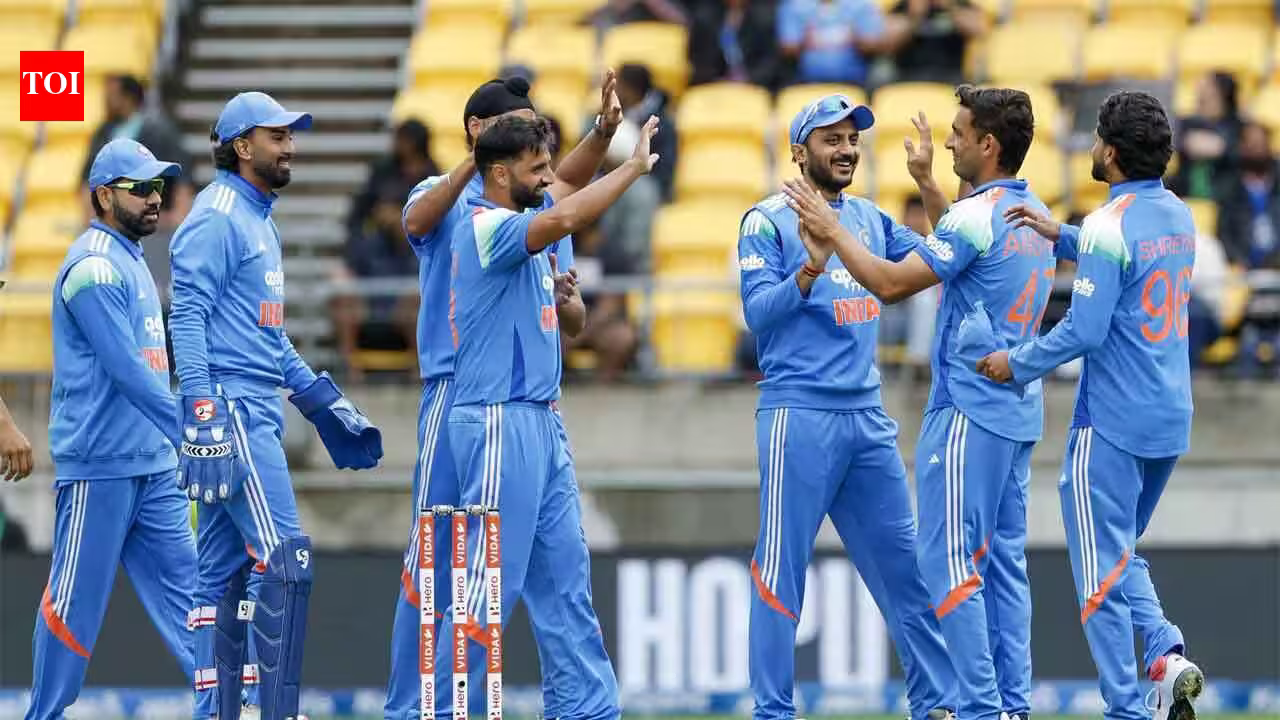
If Arshdeep was the anchor of the pressure, Auqib Nabi was the dagger. Sharing the new ball in what proved to be a dream opening spell for the youngster, Nabi struck in his very first over to shatter the New Zealand rhythm. Tim Seifert, looking to find his footing, faced five balls without managing a single run before falling victim to his own eagerness.
Attempting to drive a full, tempting delivery, Seifert played the shot fractions of a second too early. The ball sat up just enough, ballooning toward mid-on where Anshul Kamboj was positioned perfectly. Kamboj dove forward to complete a sharp, athletic catch, sending Seifert back to the pavilion and handing Nabi his maiden ODI wicket. It was a moment of pure vindication for the debutant and a crushing blow to the Kiwi momentum, leaving them reeling at 2/1.
A Siege of Dots
As Henry Nicholls strode to the crease to join Young, the expectation was a steady consolidation effort. However, the Indian attack refused to yield an inch. Nabi, buoyed by his breakthrough, continued to pepper the left-handed Nicholls with deliveries that nipped back into the pads, leaving the batsman constantly fighting for his survival.
The crowd at the Hnry Stadium watched in pin-drop silence as the overs ticked by with near-zero scoring. The third over saw just two runs added, and the fourth provided another two, as the Indian fielders swarmed the inner ring, cutting off singles and putting the Kiwi batters in a state of paralysis.
A Psychological Milestone
The significance of the 7/1 scoreline after five overs cannot be overstated. It is a benchmark of defensive dominance. In the world of modern ODI cricket, where powerplays are designed to provide teams with explosive starts, being restricted to seven runs is an anomaly that suggests a total breakdown in batting strategy—or, more accurately, a total victory in bowling execution.
By forcing New Zealand into such a restrictive start, India has effectively dictated the terms of engagement for the remainder of the contest. The Black Caps are now faced with the arduous task of rebuilding an innings that has already lost its shape. For India, the early stranglehold provides the luxury of maintaining attacking fields and rotating their bowlers to keep the pressure mounting on a middle order that must now step up against a buoyant Indian bowling unit.
As the players headed for the drinks break following the powerplay, the narrative was clear: India’s bowlers have arrived in Wellington with a specific goal in mind—to prove that the discipline they showed in 2019 was not a one-off performance, but a blueprint for international excellence. Whether New Zealand can claw their way back from this early wreckage remains the burning question of the day, but for now, the momentum belongs entirely to the men in blue.
Disclaimer: This content is auto-generated for informational purposes only.
Source: Read Original News