






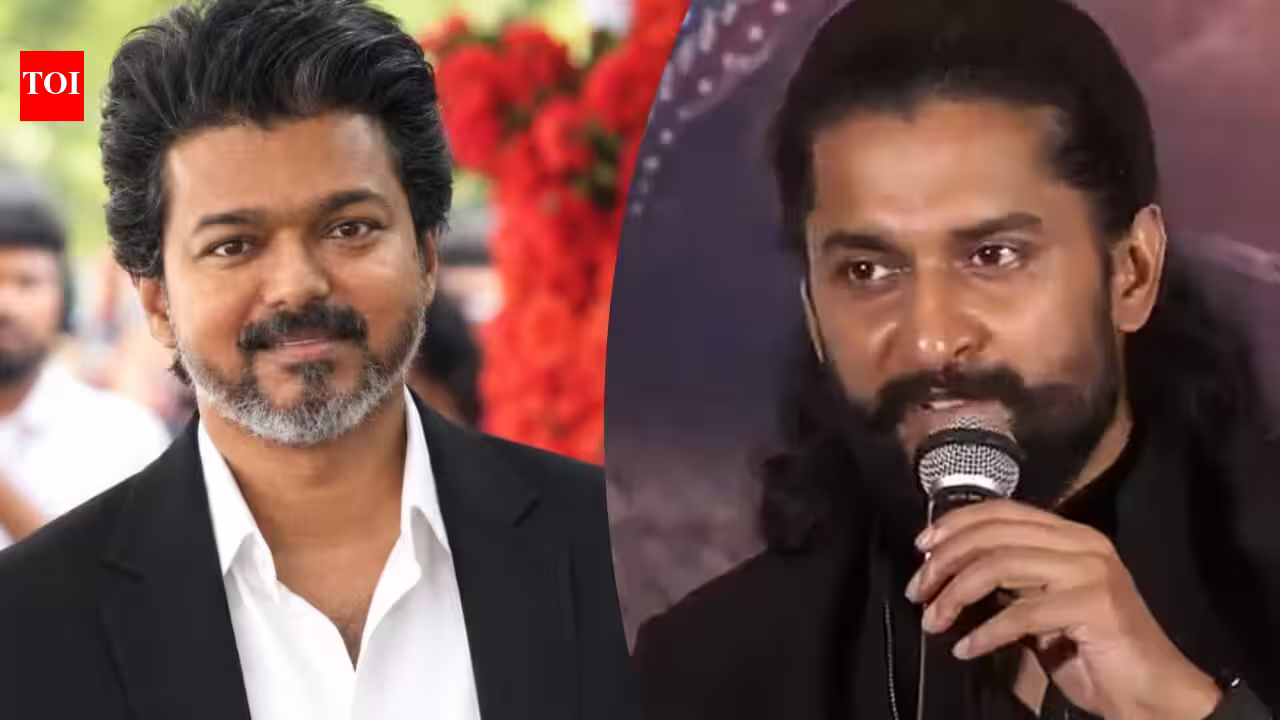
The lines between the reel and the real have rarely been as blurred as they are in the current landscape of Indian cinema. In the heart of Chennai, amidst the whirlwind promotional tour for his upcoming project The Paradise, Telugu superstar Nani took a momentary detour from talking about scripts and box-office projections to discuss something far more seismic: the political transformation of Tamil icon Vijay.
Nani, known as a “Natural Star” in the Telugu industry for his grounded performances and candid public persona, arrived in Chennai with a refreshingly unfiltered perspective. While the industry is often a hive of PR-managed soundbites, Nani chose to engage in a deeper dialogue about what happens when a cinematic idol steps into the legislative arena.
Beyond the Stardom: Unpacking the Vijay Phenomenon
For decades, the standard playbook for film stars entering politics was predictable—leveraging fan clubs into vote banks. But Nani views Vijay’s ascent to the Tamil Nadu Assembly through a different, more nuanced lens. According to Nani, reducing Vijay’s political footprint to mere “stardom” or “box-office statistics” is a grave miscalculation.
“It’s not just about his stardom or box-office success,” Nani remarked during the press interaction. “The people of Tamil Nadu have built trust with Vijay sir over the years. They feel like they know him; they feel like he is part of their family.”
This “family” connection, Nani suggests, is the secret sauce that separates a celebrity politician from a genuine leader. In an era where political discourse is often fragmented and polarized, Nani’s observation touches on a fundamental truth: voters aren’t just looking for a performance; they are looking for a sense of belonging. Nani didn’t stop at the grassroots level, either. Having kept a close eye on the recent legislative sessions, he noted that Vijay is “rocking the show” in the Assembly, expressing a genuine, neighborly wish that the actor-turned-politician’s tenure brings tangible prosperity to the state.
The “Underdog” Narrative and Mutual Respect
This wasn’t the first time Nani has tipped his hat to his Tamil counterpart. Following the 2026 Tamil Nadu Assembly election results, Nani took to social media to celebrate the victory, framing it as a quintessential “underdog” triumph.
In the hyper-competitive world of Indian film industries, where cross-border praise is often guarded or performative, Nani’s consistent support for Vijay feels remarkably organic. By framing Vijay’s political victory as a win for the underdog, Nani signaled a shift in how the next generation of pan-regional stars views political accountability. It is an acknowledgment that the stature one earns on the silver screen acts as a mandate, and the real test lies in the translation of that screen-presence into effective governance.
Deconstructing the “Pan-India” Myth
While the political discourse provided the headlines, Nani’s critique of industry terminology proved equally thought-provoking. For the past several years, the Indian film industry has been obsessed with the “Pan-India” tag. It is a marketing term applied to almost every big-budget release coming out of the South, designed to signify that a film has transcended its linguistic boundaries to capture the national imagination.
However, Nani has finally said what many in the creative community have been whispering: the label is inherently lopsided.
“When a Hindi film works well, we call it a Hindi film,” Nani noted. “But when a South Indian film works, we call it a Pan-India film. So, I don’t want to call my films Pan-Indian films.”
It is a subtle but sharp critique of the industry’s internal hierarchy. By labeling a Tamil or Telugu hit as “Pan-India,” the industry inadvertently suggests that such success is an outlier—a phenomenon that needs a special tag to justify its reach. Conversely, when a Mumbai-based film succeeds, it is simply treated as the “default” cinema of India. Nani’s refusal to adopt the label is a bid for normalcy. He is arguing for a future where a film is judged by its storytelling, emotional resonance, and cinematic craft, not by a geographical tag used to categorize “outside” success.
The Road to ‘The Paradise’
Amidst the heavy lifting of political commentary and industry critique, one shouldn’t forget the project that brought Nani to Chennai in the first place. The Paradise, his reunion with Dasara director Srikanth Odela, is shaping up to be one of the most anticipated releases of the year.
After the raw, rustic intensity of Dasara, audiences are eager to see what this creative duo has cooked up next. With a high-caliber ensemble cast that includes the veteran Mohan Babu, along with Kayadu Lohar, Sonali Kulkarni, and the multi-talented Raghav Juyal, the film promises a complex narrative texture. Coupled with the musical sensibilities of Anirudh Ravichander—who has become the heartbeat of blockbuster cinema across South India—The Paradise is clearly positioning itself as a prestige project rather than a generic mass entertainer.
As the September 24 release date approaches, the buzz surrounding the film isn’t just about the trailer or the music; it’s about the actor behind it. Nani has proven that he is an artist who occupies a rare middle ground—he is accessible enough to hold the attention of the masses, yet sharp enough to challenge the industry’s status quo. Whether he is analyzing the political landscape of a neighboring state or demanding a fairer vocabulary for his craft, Nani continues to position himself as a star who values substance over slogans. If The Paradise manages to capture even a fraction of the thoughtful energy he brought to his promotional tour, September 24 will be a day to watch.
Disclaimer: This content is auto-generated for informational purposes only.
Source: Read Original News