









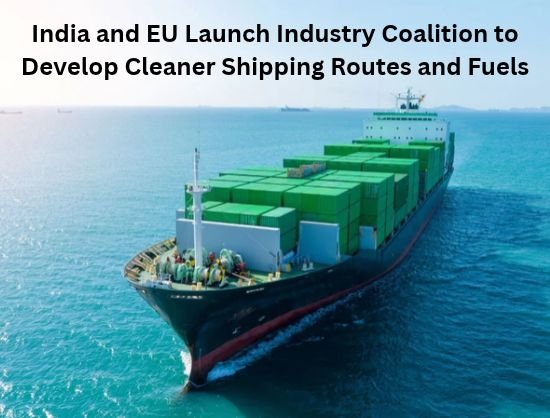
India and EU Join Forces to Forge Green Shipping Corridor
October 08, 2026. By EI News Network
In a significant stride toward global maritime decarbonization, India and the European Union have formally launched an industry-led coalition aimed at establishing a “Green Shipping Corridor.” The partnership, unveiled during the third edition of the prestigious Sagar Manthan summit, seeks to overhaul trade routes between the two regions by fostering the adoption of low-emission fuels and sustainable maritime technologies.
Shipping Secretary Vijay Kumar, while announcing the initiative, emphasized that the platform is designed to transition maritime sustainability from a conceptual framework into tangible industrial action. “Let Sagar Manthan 2026 be a platform where ideas become partnerships and partnerships become action,” Kumar stated, highlighting the urgency of aligning global shipping practices with environmental mandates.
Addressing Global Maritime Challenges
The maritime sector is currently navigating a period of unprecedented volatility, characterized by fragile supply chains, geopolitical tensions, and the rapid pace of technological disruption. The India-EU coalition serves as a strategic intervention, providing a collaborative forum for private and public stakeholders to synchronize their decarbonization efforts. By pooling resources and expertise, the coalition aims to mobilize the private investment necessary to upgrade aging maritime infrastructure while ensuring that emerging economies are not left behind in the global energy transition.
Beyond the immediate goal of emission reduction, the coalition is expected to enhance supply-chain resilience. By establishing cleaner transit corridors, both India and the EU hope to create a more predictable and sustainable framework for international trade, mitigating the risks associated with traditional, carbon-intensive shipping methods.
Transforming India’s Port Infrastructure
India’s commitment to this coalition is rooted in an ambitious domestic strategy to modernize its major ports. The government has set rigorous targets for renewable energy integration, aiming to power its primary port operations with more than 60 percent renewable energy by 2030, escalating to over 90 percent by 2047. This green shift is already visible on the water, with the systematic replacement of diesel-powered harbor tugs with modern, eco-friendly vessels.
Central to this effort is the designation of three critical nodes—Deendayal Port in Kandla, Paradip Port, and V.O. Chidambaranar Port in Tuticorin—as dedicated green hydrogen hubs. These sites are being prepared to serve as primary facilities for the production, storage, and bunkering of cleaner fuels, effectively positioning India as a vital refueling station for the new generation of green maritime vessels.
Scaling for a Sustainable Future
The push for green shipping coincides with an aggressive expansion of India’s overall maritime capacity. As the nation prepares for a future of increased global trade, the government is targeting an annual port capacity of 10 billion tonnes by 2047. The progress is already stark: major ports handled over 915 million tonnes of cargo in the 2025-26 fiscal year, a massive leap from the 581 million tonnes recorded in 2014-15. Furthermore, the utilization of national waterways has witnessed exponential growth, with cargo movement rising to 218 million tonnes from just 18 million tonnes over the last decade.
By integrating large-scale infrastructure expansion with a commitment to low-emission operations, India is signaling its intent to lead the global maritime sector into a cleaner, more efficient era. The partnership with the European Union serves as a vital catalyst, ensuring that the next generation of maritime trade is defined not just by volume, but by sustainability.
Disclaimer: This content is auto-generated for informational purposes only.
Source: Read Original News