








RBI Proposes Sweeping Changes to Loan Rate Setting, Aiming for Greater Transparency and Fairness
MUMBAI – In a significant move set to reshape the landscape of lending, the Reserve Bank of India (RBI) has unveiled draft rules aimed at standardizing interest-rate setting across a wide array of financial institutions. These proposed regulations are designed to curb practices that allow lenders to arbitrarily adjust loan spreads, ensuring a more equitable and transparent environment for borrowers.
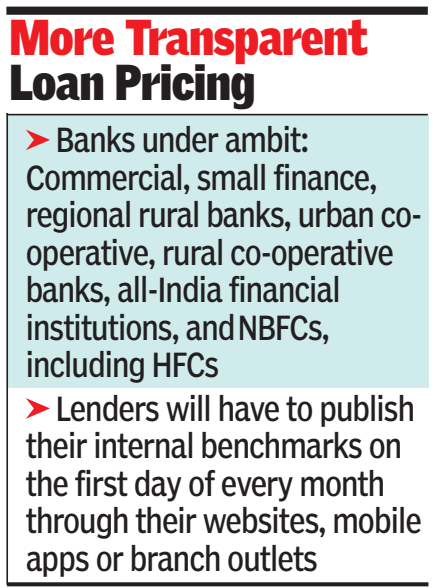
The methodology used to calculate internal benchmarks will also have to be made publicly available
A cornerstone of the new framework is the directive that lenders must maintain the spread between the benchmark rate and the final loan rate for a minimum period of three years. This crucial measure is intended to prevent institutions from offering preferential terms to new customers while leaving existing borrowers with less favorable rates.
Standardized Calculation and Monthly Rests
The draft rules introduce a universal standard for interest calculation. All advances, with the exception of specified agricultural loans, will now be subject to interest charged on monthly rests. Furthermore, interest will be computed on a daily reducing balance basis, adhering to the actual/actual day-count convention. This standardization aims to bring uniformity and clarity to how interest accrues on loans.
Smaller lenders will get exemptions from some of the requirements.
Fixed Benchmark Reset Frequency and Spread Components
For floating-rate loans, the RBI proposes a maximum benchmark reset frequency of three months for major lenders, a frequency that must remain consistent throughout the loan’s tenor. The draft also establishes common parameters for various spread components, mandating that non-credit risk components remain unaltered for three years from the initial disbursement or the last revision. This ensures stability in the loan’s overall pricing structure.
While a credit risk premium can be adjusted, this is only permissible following a documented change in the borrower’s credit profile and a comprehensive review. Lenders may, however, reduce other spread components earlier for customer retention, provided such reductions are applied on a non-discriminatory basis. A critical safeguard introduced is that no loan can be priced below its applicable benchmark, preventing predatory pricing practices.
External Benchmarks for Commercial Banks and MSMEs
Commercial banks will continue to link floating-rate personal loans and loans to Micro, Small, and Medium Enterprises (MSMEs) to external benchmarks. Permissible benchmarks include the repo rate, treasury-bill yields, the Secured Overnight Financing Rate (SORR), or benchmarks published by the Financial Benchmarks India Pvt Ltd (FBIL).
Stricter Rules for Internal Benchmarks
For financial institutions utilizing internal benchmarks such as the Marginal Cost of Funds Based Lending Rate (MCLR), the RBI is imposing a stricter methodology. MCLR will now be calculated based on a three-month moving average of the annualized weighted average cost of fresh domestic deposits and borrowings. This calculation must be system-generated and independently verifiable, enhancing transparency and reducing the scope for manipulation.
Flexibility for Smaller Lenders and Cooperatives
Recognizing the diverse nature of the financial sector, the RBI offers some flexibility for smaller institutions. For Non-Banking Financial Companies (NBFCs), cooperative banks, Regional Rural Banks (RRBs), and All-India Financial Institutions (AIFIs), linking floating-rate loans to an external benchmark will remain optional. These entities will retain the choice to link such loans to either internal or external benchmarks.
Furthermore, certain smaller lenders will be exempt from specific requirements. Regional Cooperative Banks (RCBs) with deposits up to Rs 1,000 crore, Base Layer NBFCs, and Tier 1 and Tier 2 Urban Cooperative Banks (UCBs) will not be required to comply with the three-month maximum reset frequency or the three-year freeze on revisions to non-credit risk components of spreads.
Enhanced Transparency and Disclosure
In a move towards greater public transparency, the methodology used to calculate internal benchmarks will have to be publicly available. Loan agreements will also be mandated to clearly specify the benchmark used, the reset periodicity, and the exact reset dates, empowering borrowers with crucial information about their loan terms.
These draft rules, once finalized, are expected to foster a more level playing field in the lending market, promoting fairness, transparency, and consumer protection across the Indian financial system.
Source: Times of India