








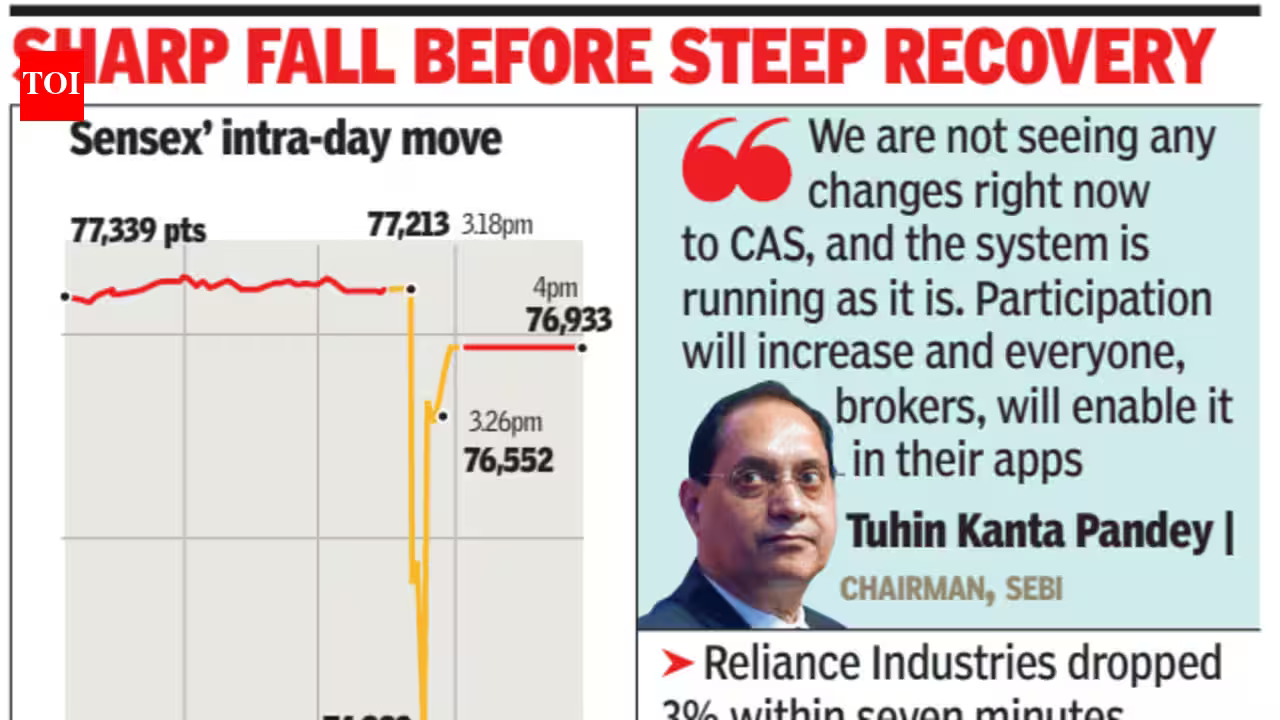
Market Turmoil: Sensex Sees Wild Swings During Closing Auction Session
MUMBAI: The introduction of the Closing Auction Session (CAS) on the BSE has sparked a firestorm of controversy following the latest monthly derivatives expiry. Traders and market participants took to social media to voice their concerns after the benchmark indices experienced extreme, high-speed volatility that wiped out and restored billions in market value within minutes.
A Turbulent Closing Window
The volatility centers on the new CAS mechanism, which was implemented by the Securities and Exchange Board of India (SEBI) on August 3. Designed to modernize price discovery and curb manipulation by aligning with global standards, the system is now mandatory for the approximately 200 stocks that feature in the equity derivatives segment.
However, the transition has been far from smooth. On Thursday, during the monthly F&O expiry, the Sensex experienced a dramatic “flash crash.” Between 3:18 PM and 3:23 PM—shortly after the CAS commenced—the index plummeted over 2,200 points. In a startling reversal, it regained nearly 2,000 points in the subsequent seven minutes, eventually closing at 76,934, down 539 points from the previous day’s close.
The impact was felt across major index heavyweights. Reliance Industries, the Sensex’s most influential constituent, saw its share price drop 3% from Rs 1,289 to Rs 1,250 within minutes, only to recover to Rs 1,286 by the close. Similar erratic price behavior was observed in HDFC Bank, ITC, and Bharti Airtel. In contrast, the National Stock Exchange (NSE) remained relatively stable, with the Nifty experiencing more muted fluctuations.
Traders Cry Foul
The sudden price movements have led to widespread allegations of market manipulation. On social media platform X (formerly Twitter), traders highlighted the extreme potential for windfall gains—or devastating losses—during the brief window. One user calculated that a tactical trade involving 76,500-strike Sensex put options could have yielded a profit of Rs 44 lakh on a Rs 1 lakh investment in just five minutes, underscoring the dangers the current volatility poses to retail participants.
Industry experts note that while the CAS is intended to prevent manipulation, the current implementation has created a unique environment where sharp, synchronized movements in the closing period trigger outcry online regarding the fairness of the Closing Auction Session.
Regulatory Scrutiny
The unease in the market comes on the heels of active enforcement by SEBI against manipulative practices. Just last week, the regulator penalized Copthall Mauritius, an arm of JP Morgan, and domestic firm Mansi Stock & Share Broking. SEBI alleged that the entities engaged in manipulative strategies to influence the Sensex and its constituents for illegal gains. Both entities have been banned from the market, with orders to disgorge roughly Rs 3.8 crore in ill-gotten profits.
As market participants continue to demand clarity, the focus now turns to whether regulators will adjust the CAS parameters to mitigate the extreme volatility that has characterized the recent expiry sessions.