









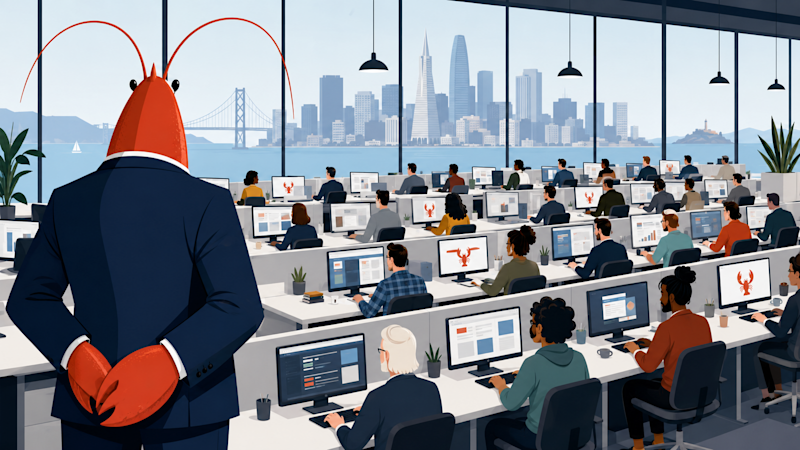
OpenClaw 2.0: Transforming AI Agents from Individual Tools to Enterprise Infrastructure
The viral excitement that surrounded OpenClaw earlier this year has evolved from a consumer-focused curiosity into a sophisticated push for corporate adoption. After a period of cooling interest since its peak in March 2026, the open-source AI harness is back in the spotlight with the release of OpenClaw 2.0, an update that fundamentally shifts the platform’s scope from a personal coding assistant to a collaborative, enterprise-grade operating layer.
From Personal Harness to Team Infrastructure
Historically, AI agents have been solitary experiences. A developer would run an agent in a local terminal or IDE, granting it temporary access to a repository to perform specific tasks. OpenClaw 2.0 renders that model a “relic of the past” by introducing a persistent, multiplayer environment.
By implementing shared cloud sessions and a centralized web interface, OpenClaw 2.0 allows teams to collaborate within the same “agent workspace.” Colleagues can now jump into ongoing sessions, share context, and pick up work exactly where another user left off, without the need for cumbersome handoff documentation. As Peter Steinberger, the project’s creator, noted on X, the team successfully utilized OpenClaw to build the 2.0 update itself, effectively replacing individual coding harnesses with a shared agent environment.
A Unified Control Plane
A significant barrier to enterprise AI adoption is the “terminal gap”—the fact that most powerful agent frameworks require deep technical configuration that alienates non-engineering staff.
OpenClaw 2.0 bridges this by introducing a redesigned Control UI. By moving conversations to the center of the workspace and integrating file management, approvals, and live dashboard activity into a single browser-based interface, the platform mimics the ease-of-use seen in tools like ChatGPT or Claude. However, it refuses to hide the technical reality beneath; administrators and engineers still have full visibility into command activity, Git-backed changes, and terminal logs.
Security: Moving Toward “Enterprise-Hardened”
One of the most pressing questions facing the project is whether it can match the security rigors of specialized rivals like NanoClaw.
While NanoClaw focuses on “security-by-default” via strict Docker containerization, OpenClaw 2.0 takes a different, more flexible approach. It provides a robust suite of security primitives—including role-based permissions, granular approval controls, sandboxed execution, and an audited Secret Store—but leaves these features configurable rather than enforcing them out of the box.
For enterprises, this means that while OpenClaw is not automatically “secure” upon installation, it now provides the necessary architecture to be hardened into a compliant system. Organizations can define specific roles, mandate sandboxing for certain users, and implement rigorous auditing, effectively choosing their own balance between agility and strict isolation.
The Role of the OpenClaw Foundation
Despite Peter Steinberger’s high-profile move to OpenAI in 2026, the project remains independent. Stewarded by the OpenClaw Foundation—an independent 501(c)(3) entity—the platform maintains its open-source roots while receiving substantial backing from a consortium of industry titans, including OpenAI, Microsoft, NVIDIA, and Atlassian. This ensures that while the project benefits from top-tier research, it remains an ecosystem-neutral utility rather than a walled-garden product of any single company.
The Bottom Line
OpenClaw 2.0 represents a significant pivot. It recognizes that for AI to truly permeate the enterprise, it must stop functioning as a series of isolated “personal bots” and start operating as a shared, persistent infrastructure. By providing the tools for collaboration, observability, and granular control, the platform is betting that companies are ready to move beyond simple chat interfaces and toward a future where agents act as permanent, team-aware components of the digital workplace.