








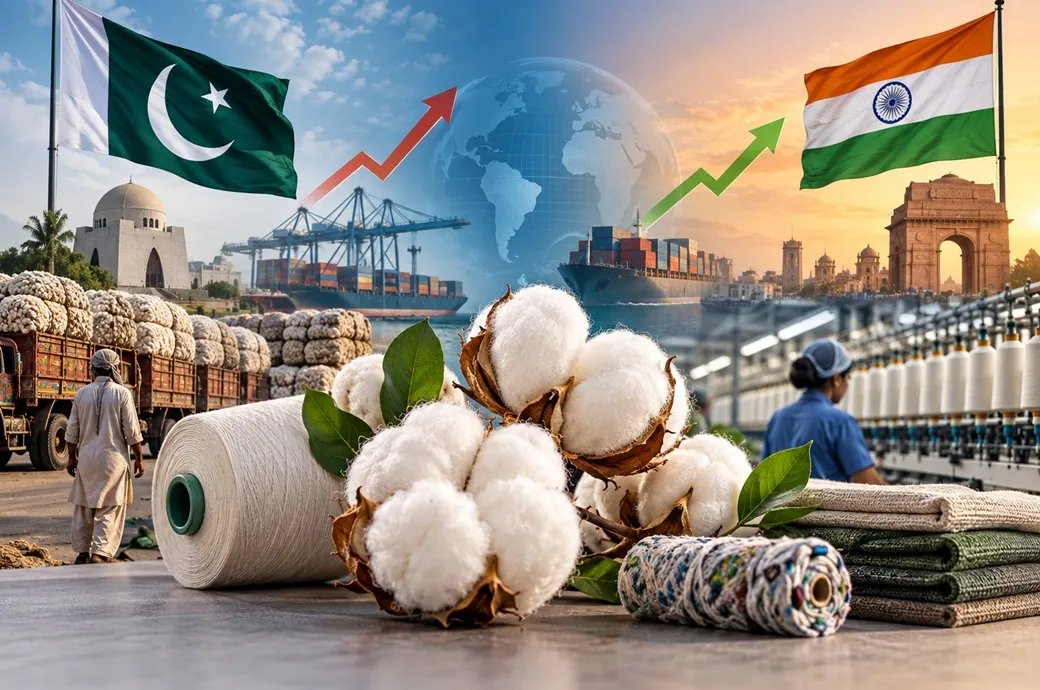
Divergent Trends: Pakistan’s Cotton Market Surges While Indian Benchmarks Remain Stable
The South Asian textile landscape is witnessing a notable case of market decoupling, as data from the past week reveals a sharp contrast between the cotton pricing trajectories in Pakistan and India. While Pakistani organic cotton experienced its most aggressive weekly movement in the region, Indian benchmarks maintained a state of equilibrium, ignoring the volatility seen in neighboring markets and the broader global price reversals.
Pakistan’s Sharp Price Correction
The week began with a significant shift in Pakistan’s organic cotton sector. According to reports from the Karachi Cotton Association (KCA), the spot rate for the Above-28 mm grade recorded a marked increase on Tuesday, September 17. The price rose by 2.61 per cent, reaching PKR 18,200/kg (approximately $1.85/kg).
Following this surge, the market demonstrated a lack of further movement, holding firm at the elevated price level through Friday. Industry analysts monitoring the data via TexPro suggest that this upward adjustment reflects specific local supply-chain dynamics. When calculated against prevailing exchange rates, the Friday closing price for Pakistani cotton stood at roughly $1.85/kg, or approximately $0.84/lb, signaling a tightening of local supplies or an adjustment in the domestic procurement costs for high-grade organic fibers.
Stability Across the Border
In contrast to the turbulence observed in the Pakistani markets, India’s cotton sector displayed resilience and stability. The benchmarks for Shankar-6 organic cotton remained fixed at ₹44,500 per candy (approximately $1.76/kg), translating to roughly $0.80/lb. Similarly, the market for pre-consumer recycled cotton—an increasingly vital component of India’s sustainable textile export portfolio—stayed steady at ₹43,000 per candy (~$1.70/kg).
This consistency in India underscores a divergence in the regional textile economy. While Pakistani producers are grappling with localized price hikes, Indian exporters and ginners have managed to keep prices insulated from the sudden shifts seen elsewhere. This stability is particularly significant given that global cotton prices experienced a sharp reversal toward the end of the week, a factor that typically exerts downward pressure on regional markets. India’s ability to resist both the domestic surge seen in Pakistan and the global decline highlights the unique supply-demand balance currently defining the Indian textile ecosystem.
Implications for the Textile Supply Chain
The widening gap between these two major Asian hubs suggests that buyers and global textile brands sourcing from South Asia may face a more complex procurement environment in the coming weeks. The price variance between Shankar-6 organic cotton and its Pakistani counterparts creates a distinct competitive landscape for apparel manufacturers who rely on steady raw material costs to maintain margins.
Market observers are now watching closely to see if the Pakistani price level will sustain its premium or if the global cooling of cotton prices will eventually force a correction. For now, the “clear divergence” persists, placing the focus on how regional demand for organic and recycled fibers will react to these contrasting pricing structures. As the industry looks toward the next quarter, the stability in Indian markets offers a baseline of predictability, while the volatility in Pakistan reflects a market currently navigating its own localized supply challenges.
Disclaimer: This content is auto-generated for informational purposes only.
Source: Read Original News