









July 2026 – a remarkable month in the south, less so in the north
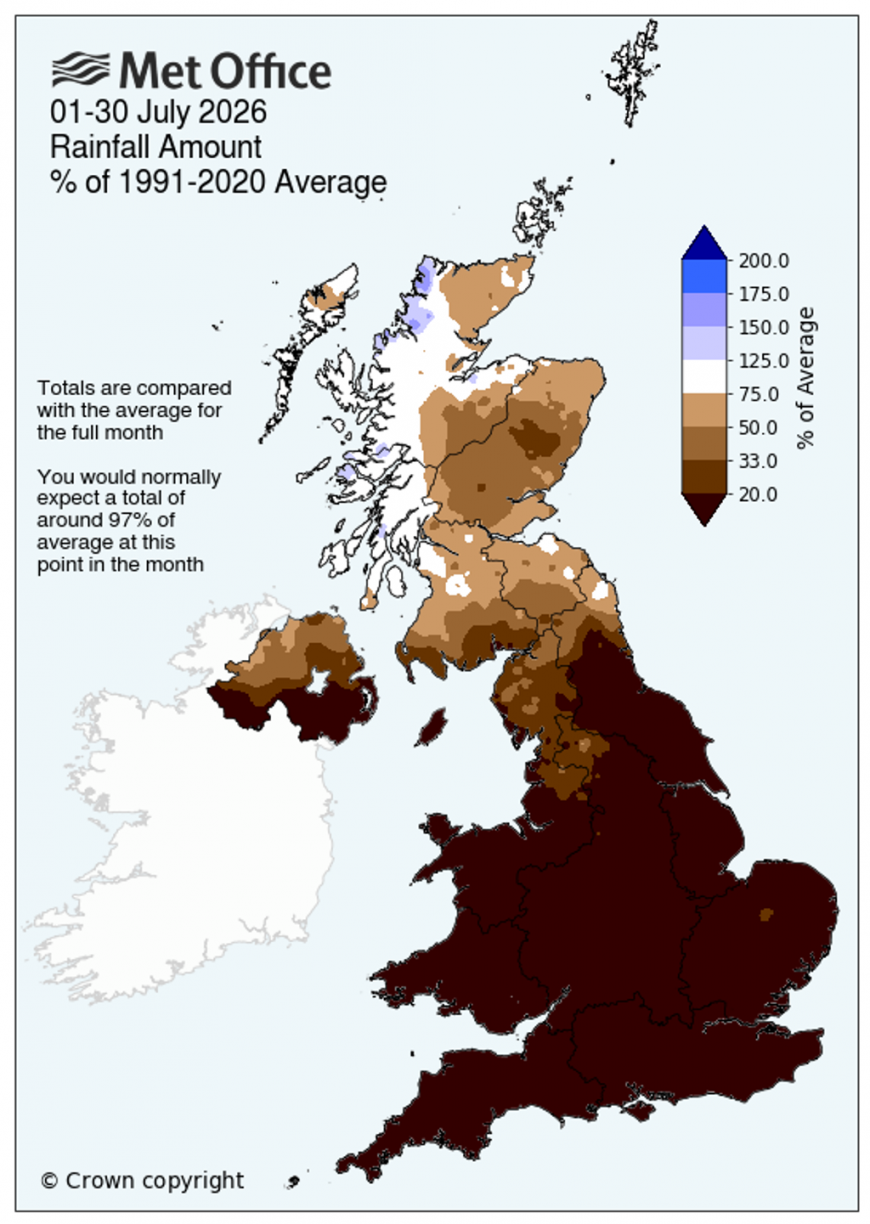
July has been record warm, dry and/or sunny in parts of England and Wales, especially the south, but less remarkable in Scotland and Northern Ireland. The provisional statistics that I discuss next come from Starlings Roost Weather and have data for 1-30 July, so there is still one day of data still to go.
The warmest and/or driest July on record for some areas of England and Wales
Large areas of England had less than 1mm of rain for the period 1-30 July, and with nothing more than a few well-scattered showers on 31 July, it is probable that many of these sites will stay below 1mm for the whole month of July. Some sites have recorded no measurable rain (0.2mm or more). Across Wales, too, rainfall totals for 1-30 July were widely below 5mm, and locally below 1mm. Most regions have had a drier than average July with the exception of north-west Scotland.
The Central England Temperature, which corresponds roughly to the English Midlands, is looking set to be in the top 3 hottest Julys on record, behind 2006 and about level with 1983, but not quite a record breaker. However, a number of sites in southern England have had a record warm July, especially in south-west England. Exeter Airport’s mean maximum temperature for 1-30 July was 27.8C.
The sunniest July on record for parts of the south, but unremarkable sunshine wise in the north
As in many recent summer months, there has been a marked north-south split in the sunshine anomalies. Parts of Scotland and the north of Northern Ireland had a cloudy month, but sunshine totals were record high in parts of southern England, especially the south-west. Totals for 1-30 July have included 372.1 hours at Hurn near Southampton, 330.7 hours at Exeter Airport and 321.6 hours at Heathrow Airport (London). Parts of the Republic of Ireland also had record sunshine totals, with 308 hours at Cork Airport.
All of these were recorded using the modern Kipp-Zonen sunshine sensors, which typically record about 10% less sunshine than the Campbell-Stokes recorders that were used for most of the historical record. Due to this and the fact that there is still another day of data to come in, there is thus a fair chance that some long-standing sunshine records from July 1911, including the UK’s maximum of 384 hours at Eastbourne, and London’s 334 hours, have been broken this month.
After a relatively cool and cloudy start with westerly winds, July 2026 had an exceptional heatwave, especially in the south, during the first half, with temperatures of around 35C locally on several days, and widely reaching between 32 and 34C in the south. Britain lay on the periphery of another exceptional heatwave over France and Spain, which resulted in the hottest weather mainly affecting the south. It was hot and sunny in the north at times as well, but not as exceptional. Frequent easterly winds meant that the hottest weather relative to the long-term normal was often concentrated in south-western Britain.
After midmonth, highest pressure sat to the west of Britain for a long time, delivering relatively cool and cloudy weather to northern and eastern Britain, but dry and sunny weather persisted in the south-west, and while it was not as hot as earlier, temperatures in the south and south-west remained well above the long-term average. While low pressure arrived towards the month’s end, it did not produce much rain for the majority of England and Wales. However, the beginning and end of the month were quite wet in most parts of Scotland, especially north-west Scotland, resulting in Scotland’s rainfall for the month being less remarkable.
Will there be rain in early August?
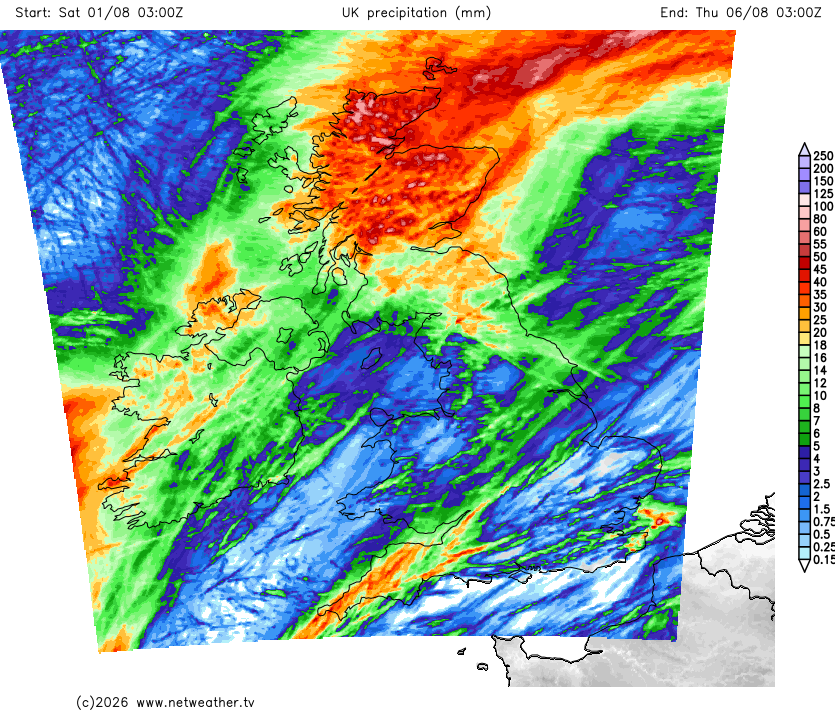
Many people have been asking me if it will rain soon, as the ground is very parched over much of England and Wales, and crops and plants have been suffering. It does look probable that most of Britain will see substantial rainfall between 4 and 7 August, as a slow-moving depression will push in from the south-west. This will bring bands of rain north-eastwards, followed by brighter weather with showers. However, many model runs are suggesting that the majority of the rain may miss a large area of southern and eastern England, where there is potential for rainfall totals to only be around 2 to 5mm. This means that not all of us are guaranteed to see anywhere near enough rain to alleviate the recent water shortage, but some parts of England and Wales will probably see some relief from the drought.