









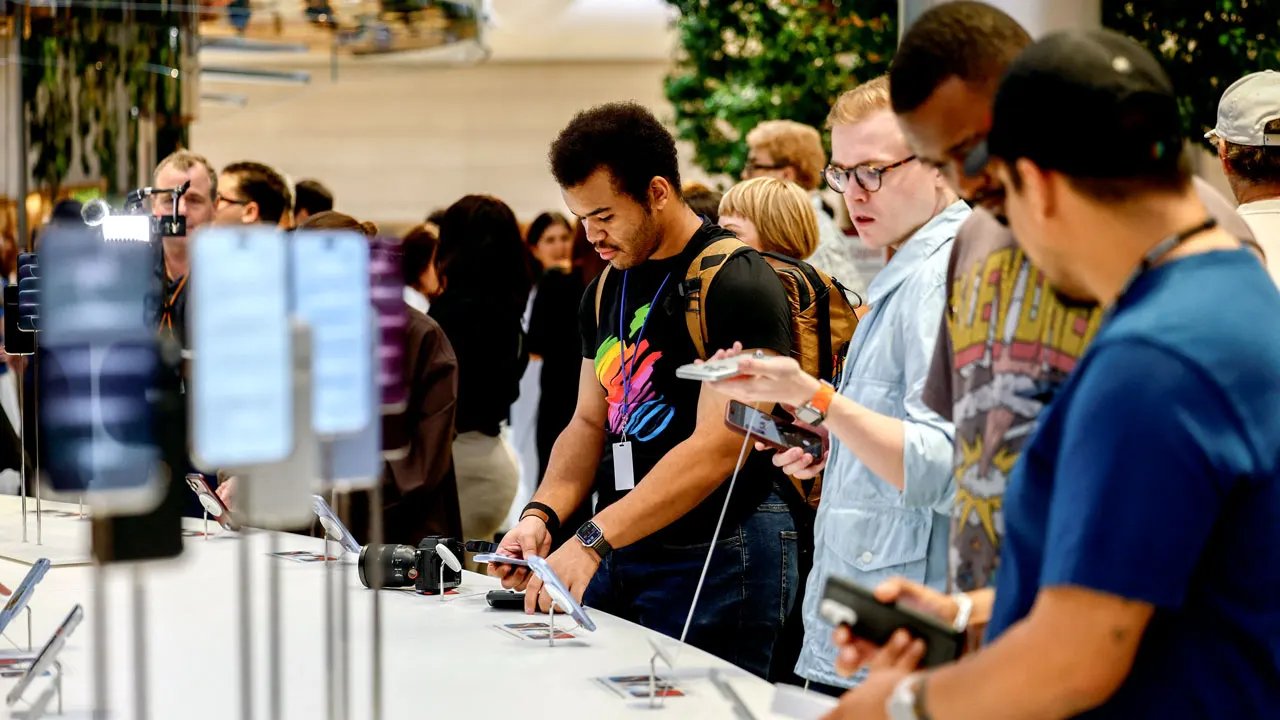
Apple has officially entered a new era of mobile hardware with the launch of the iPhone 18 series and its first foldable entry, the iPhone Duo. Under the leadership of newly appointed CEO John Ternus, the company held its annual launch event to showcase a significant shift in design language and computational capability. The release, which saw massive crowds gather at retail locations globally, marks the most ambitious technical overhaul in the history of the iPhone lineup.
The Emergence of the iPhone Duo
The headline release is the iPhone Duo, Apple’s foray into the foldable smartphone market. Designed as a premium luxury device, the phone features a form factor that maximizes screen real estate while maintaining an impressively thin chassis. Apple has optimized the device for multitasking, allowing users to leverage the expanded display for professional workflows, media consumption, and split-screen productivity.
Positioned at the highest end of the market, the iPhone Duo carries a price tag reaching up to $3,000 depending on storage configurations. This device targets power users who prioritize screen size and portability. The engineering behind the hinge mechanism and the display material represents a departure from traditional rigid-screen designs, focusing on durability and seamless integration with the iOS ecosystem.
Advanced Camera Systems in the 18 Pro Lineup
Alongside the foldable, Apple introduced the iPhone 18 Pro and Pro Max models, which focus on significant hardware enhancements in mobile photography. The standout feature is a reimagined camera array that incorporates a DSLR-like aperture. This architectural change allows for superior light intake, resulting in improved performance in low-light conditions and more natural, optical depth-of-field effects without the need for aggressive computational post-processing.
For photographers and videographers, these technical adjustments mean more granular control over image capture. By physically mimicking the aperture settings found in professional-grade camera lenses, the iPhone 18 Pro lineup effectively reduces sensor noise and enhances focus precision. This shift emphasizes Apple’s goal of merging the convenience of a pocket-sized device with the image quality expected from professional cinematography equipment.
Siri AI and Google Gemini Integration
The software foundation of the new lineup is built on the latest iteration of Siri, now powered by comprehensive artificial intelligence tools. Known as Siri AI, this updated assistant was refined to ensure reliability and depth of functionality before its public release. By integrating Google Gemini models, the new Siri has gained the ability to synthesize information across disparate applications, including messages, emails, and photo galleries.
The impact on user experience is substantial. Users can perform complex tasks such as drafting sophisticated emails based on email threads, organizing schedules by pulling dates from text conversations, or searching through photo libraries using natural language queries. The integration of large language models directly into the iOS environment provides a more proactive assistant that understands context and can execute multi-step requests that were previously beyond the scope of digital assistants.
Authenticity and Verification in the AI Era
As generative AI becomes more prevalent in daily media consumption, Apple has implemented a security feature designed to uphold image integrity. The iPhone 18 series now includes a verification system that detects AI-generated content. When an image is manipulated through AI, the software creates an unalterable Reference Image that is stored alongside the edited file.
This technical safeguard addresses concerns regarding the proliferation of deepfakes and manipulated photography. By ensuring that an original, unaltered source image remains tethered to the metadata of the edited version, Apple is providing a mechanism for content creators and consumers to distinguish between authentic captures and synthetic imagery. This feature is expected to become a standard in digital forensics and media verification as generative models become increasingly proficient at creating photorealistic content.
Market Strategy and Future Outlook
The transition in leadership to John Ternus coincides with this pivot toward foldable hardware and advanced AI services. The retail response indicates that there is significant consumer appetite for these high-end, technologically dense devices, despite the premium pricing. With starting prices of $1,199 for the iPhone 18 Pro and $1,299 for the Pro Max, the company is betting on the necessity of integrated AI and professional-grade camera hardware to justify hardware upgrades.
The rollout of these products highlights a strategic decision to position the iPhone as a central node in a user’s creative and professional life. By balancing the physical innovation of the foldable iPhone Duo with the invisible, yet potent, intelligence of the new Siri and image verification tools, Apple is attempting to secure its position in the next decade of personal computing. As these devices enter the hands of consumers, the industry will be watching how well this integration performs in real-world scenarios and whether the shift toward foldable displays becomes the new standard for the brand.
Disclaimer: This content is auto-generated for informational purposes only.
Source: Read Original News