







ROGUN, Tajikistan – The EU is to become a major funder of Tajikistan’s strategic Rogun dam project as Russia is elbowed out of Central Asia, one of Moscow’s key spheres of influence.
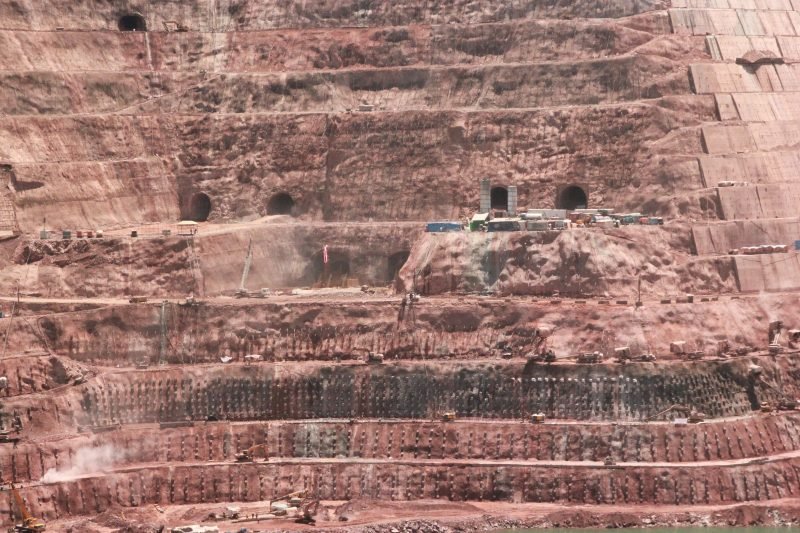
Deep in Tajikistan’s Pamir mountains, the dam’s construction site resembles a giant anthill, where hundreds of trucks disappear into a network of tunnels carved beneath the mountain.
“This is where the Vakhsh River flows,” said Anvar Rahmonov, production director at Rogun HPP OJSC – the Tajik state-controlled company coordinating the project –, pointing from a ridge overlooking the future dam. Below, the river winds through the mountains before being diverted into underground galleries feeding two 600-megawatt turbines.
“Tajikistan will be able to supply electricity to the entire country and also export power,” said the chief engineer, who has worked on the project since 2012. Four additional turbines are under construction, bringing total capacity to 3,600 MW – roughly equivalent to a nuclear power plant.
But beyond its sheer engineering scale, Rogun has also become a major test of the EU’s ability to fund and influence strategic infrastructure beyond its immediate neighbourhood, in a region long dominated by Russia and increasingly courted by China.
The world’s tallest dam
Originally launched under the Soviet Union, construction of the Rogun dam resumed in 2008, turning it into one of Central Asia’s most expensive infrastructure projects.
For Tajikistan – often dubbed Central Asia’s “water tower” because of the Pamir glaciers – the stakes are high. The country of 10 million already generates nearly 90% of its electricity from hydropower, yet still faces chronic shortages and winter blackouts.
Rogun has therefore become both a national symbol and a flagship project for President Emomali Rahmon, who has ruled since 1992 and calls it the “construction project of the century”.
Located 100 kilometres east of Dushanbe at an altitude of more than 1,300 metres, the dam employs nearly 19,000 workers in a rugged mountainous environment prone to rockfalls.
Now standing at 140 metres, Rogun is expected to reach 335 metres when completed, making it the world’s tallest dam.
Despite repeated delays, construction continues. Full reservoir filling, initially expected in the 2020s, is now projected around 2036.
Funding remains a major challenge. More than $3 billion has already been invested in the first two turbines, with total costs expected to approach $9 billion.
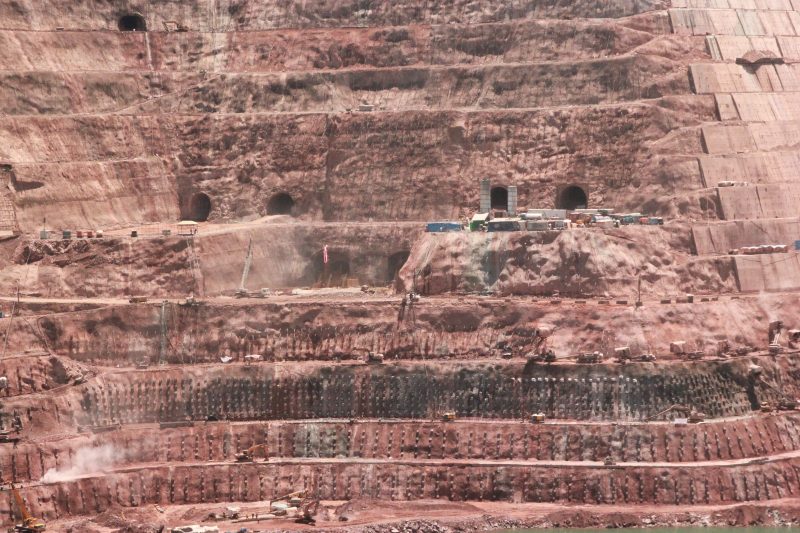
Tunnel building in the dam. (Credits: Emma Collet)
Europe’s green gamble
The year 2024 marked a turning point for Rogun.
After endorsing the dam’s feasibility and environmental impact studies, the World Bank approved a $350-million development grant. The resolution has attracted other financial institutions such as the European Investment Bank, which plans to be a major contributor alongside the Asian Infrastructure Investments Bank with a loan of up to $550 million.
So far, the EU has committed at least €142 million in bilateral assistance for infrastructure-related programmes under its 2021-2027 budget cycle.
“This would be the largest hydropower project supported by the EU anywhere in the world,” an EU delegation official in Dushanbe told Euractiv.
“It still depends on the Commission, but the final decision should not take much longer.”
The European funding would support remaining works on the right bank of the dam, including high-level discharge structures, spillways, hydraulic steel structures, an energy dissipation basin, and injection and consolidation galleries
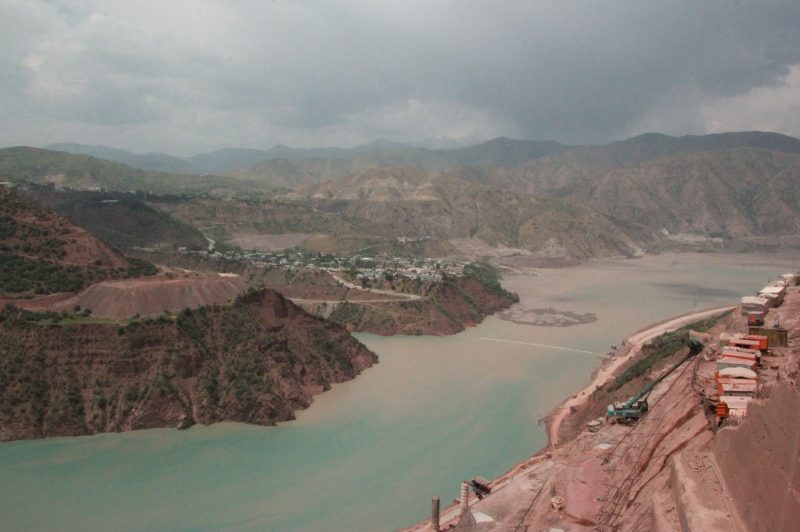
Rogun dam. View from the dam. (Credits: Emma Collet)
A geopolitical opening for Europe
Rogun is increasingly viewed as a test of the EU’s ability to back major infrastructure projects in Central Asia, as Russia’s influence wanes and China’s presence grows.
Moscow is notably absent from the project’s financing, amid sanctions and shifting regional dynamics following the war in Ukraine.
“It’s reasonable to think that the World Bank was also motivated by keeping Moscow out,” said Artemy Kalinovsky, professor of History and Political Science at Temple University.
Several European firms are already involved. Italy’s Webuild has led construction since 2016, while Belgian-French engineering group Tractebel and Germany’s Siemens have supplied key expertise and equipment.
“The World Bank’s approval was decisive,” says Andres Ricaldi, an engineer with Tractebel, adding that the project also benefits from its classification as “green infrastructure”.
“In downstream countries, electricity is mainly generated from coal and oil, major sources of greenhouse gas emissions. Replacing it with hydropower could cut emissions by one million tonnes,” said Rustam Abdullaiev, head of water and energy policy at Tajikistan’s Ministry of Energy and Water Resources.
He added that Tajikistan would eventually be able to export surplus clean electricity once the dam is completed.
Water, climate and regional tension
Rogun’s future is far from guaranteed.
Climate change, glacier retreat and declining river flows are raising concerns about the dam’s long-term viability. By 2050, up to half of Central Asia’s glaciers could disappear, potentially reducing the river flows that feed the project.
“That is why we are building a cascade of reservoirs rather than a single one. It will allow us to reduce the effects of climate change,” said Abdullaiev.
The dam also remains politically sensitive beyond Tajikistan’s borders.
“We cannot use this water however we want,” acknowledged Andres Ricaldi, an engineer at Tractebel, referring to regional water-sharing arrangements.
For more than two decades, neighbouring downstream Uzbekistan opposed the project, fearing it would reduce water flows in the Amu Darya basin, a lifeline for its water-intensive agriculture. While relations have improved, water management remains one of Central Asia’s most delicate geopolitical issues.
Yet despite the environmental and geopolitical concerns, construction continues at full pace.
“By 1 July, the reservoir level should be raised by another 30 metres,” Ricaldi shouts above the noise of the construction site.
A milestone that will be watched closely not only across Central Asia, but also in European capitals weighing their role in the project’s future.
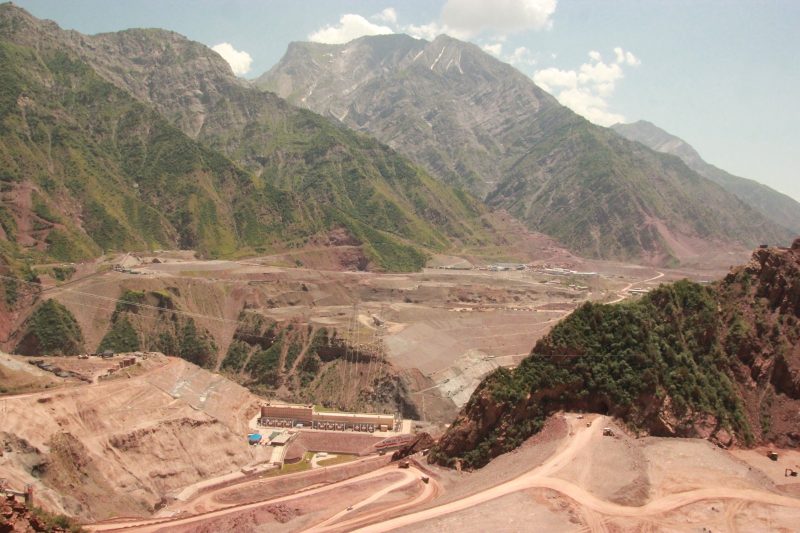
Rogun dam, view on the Vakhch river and a reservoir. (Credits: Emma Collet)
(cs, bw)