







The “mountain of discarded food” generated daily across the globe has emerged as a silent engine of the climate crisis. According to the United Nations Environment Programme (UNEP), more than one billion meals go uneaten every single day, with 60 percent of this waste originating in households. While the loss of food represents an economic and ethical failure, its environmental impact—specifically regarding climate change—is increasingly viewed as a critical emergency that requires immediate intervention.
The most severe environmental toll of food waste occurs when organic matter reaches a landfill. Once buried and deprived of oxygen, rotting food undergoes a process of anaerobic decomposition, interacting with microorganisms to release methane. This greenhouse gas is significantly more potent than carbon dioxide, trapping 86 times more heat in the atmosphere over a 20-year period. Consequently, decaying food has become a primary driver of global methane emissions; in the United States alone, municipal landfills rank as the third-largest source of human-related methane.
The scale of the problem extends far beyond the landfill site. When we waste food, we also waste the vast resources required to produce it. Data from the UN Food and Agriculture Organization (FAO) reveals that approximately 1.4 billion hectares of land—nearly 28 percent of the world’s total agricultural area—is dedicated to producing food that is never consumed. Furthermore, this systemic inefficiency exacerbates deforestation, as agricultural expansion often clears forests that would otherwise serve as vital carbon sinks. By wasting food, humanity is effectively stripping the planet of trees that are needed to regulate the climate, only to generate methane-producing waste that accelerates warming.
Despite these sobering statistics, there is a clear strategic advantage to prioritizing food waste reduction. Methane is a short-lived climate pollutant, meaning it breaks down in the atmosphere much faster than carbon dioxide. Therefore, substantial cuts in methane emissions today can yield tangible, rapid climate benefits within just a few decades. Martin Krause, a UNEP official, characterizes this as one of the most immediate and cost-effective solutions in the global climate arsenal.
However, progress remains stalled. Since 2015, there has been little tangible movement toward reducing food loss, leaving the international community far behind the Sustainable Development Goal of halving per capita global food waste by 2030. “We have to move faster,” Mr. Krause warned.
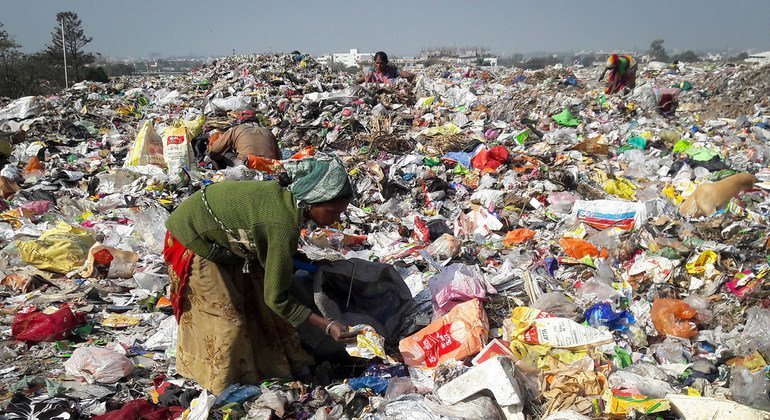
In response, innovative, localized solutions are beginning to take root. In Africa, eleven governments have launched initiatives to integrate informal waste pickers into formal waste management systems. Supported by the Climate and Clean Air Coalition, these programs train workers to sort and compost organic matter, simultaneously improving livelihoods and diverting waste from landfills.
In other regions, the solution is biological. Specialized facilities are breeding black soldier flies to recycle organic material. These insects, already being utilized in urban and rural centers from Malawi to Uganda, act as a high-efficiency mechanism for processing waste, turning discarded organic matter into compost or animal feed rather than allowing it to decompose into methane.
As the world searches for practical ways to slow global warming, the path forward appears increasingly clear: tackling food waste is not merely a matter of efficiency, but a frontline strategy for climate survival. Whether through grassroots waste-picking cooperatives or insect-based recycling, the tools for change are available—the challenge now lies in scaling these solutions before the ticking clock of the methane crisis runs out.
Disclaimer: This content is auto-generated for informational purposes only.
Source: Read Original News