







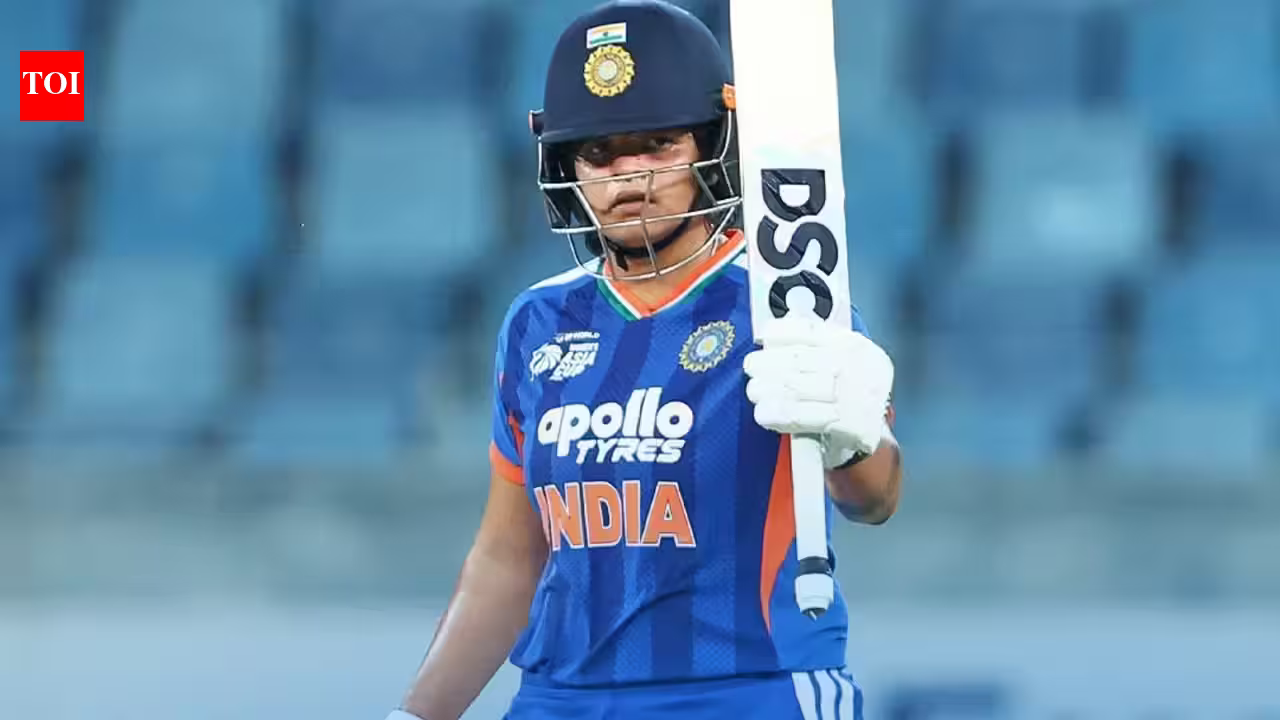
Dubai’s premier cricket stadium played host to an exhibition of pure, unadulterated power-hitting as India’s dynamic opener Shafali Verma dismantled the Sri Lankan bowling attack in the final of the 2026 Women’s T20 Asia Cup. In a performance that will be etched into the annals of cricket history, the 22-year-old dynamo reached her half-century in a staggering 24 balls, etching her name at the top of the record books as the fastest player to reach the milestone in the history of the tournament.
The atmosphere was electric as Verma took center stage, immediately signaling her intent. With a bat that seemed to have the gravitational pull of a magnet, she dispatched the ball to all corners of the ground, leaving the Sri Lankan bowlers searching for answers that never came.
Shafali rewrites Asia Cup record
The previous benchmark for the fastest fifty in the Women’s T20 Asia Cup had been held by her longtime opening partner, Smriti Mandhana, who achieved the feat in 25 balls against the same opponent—Sri Lanka—during the 2022 edition in Sylhet. Verma’s masterclass in Dubai saw her shave a crucial ball off that record, setting a new standard for aggressive intent in the powerplay.
This innings wasn’t a fluke; it was the culmination of a tournament defined by Verma’s relentless boundary-hitting. Her ability to capitalize on field restrictions turned a high-stakes final into a statement of intent, putting India in a position of absolute dominance early on. The statistical significance of this knock is bolstered by the list of those she surpassed: joining the 26-ball fifty club are stalwarts like Richa Ghosh and Verma herself, highlighting just how significant the move to 24 balls is in the context of T20 history.
Equaling the legend: Leveling with Athapaththu
Beyond the raw speed of her half-century, Verma’s 68-run outing was a testament to her consistency. By hitting this score, she logged her third 50-plus total of the 2026 tournament, drawing her level with the legendary Sri Lankan captain, Chamari Athapaththu.
Athapaththu, who remains one of the most formidable figures in the women’s game, set this record during Sri Lanka’s championship-winning run in 2024. For Verma to match such a prolific record in a single edition is a clear indicator of her maturation as a world-class batter. Even as the final stages of the match unfolded, the comparison between the young Indian prodigy and the seasoned Sri Lankan icon was the central talking point among commentators and fans alike. It is a rare feat to see such sustained dominance in a format as volatile as T20, yet Verma made it look effortless.
A partnership for the ages
While Verma provided the pyrotechnics, the synergy between her and Smriti Mandhana provided the foundation for a total that will haunt the opposition. Together, the pair stitched together a colossal 129-run stand, setting a new record for the highest partnership for any wicket in the history of the Women’s T20 Asia Cup.
They eclipsed the previous record of 128 runs, set by teammates Jemimah Rodrigues and Deepti Sharma against the UAE back in 2022. The 129-run association was a masterclass in rotation of strike and boundary accumulation. Mandhana, playing the role of the anchor to Verma’s aggression, ensured that the momentum never dipped. Their partnership was not just about the numbers; it was about the psychological pressure they exerted on the Sri Lankan fielders. With every passing over, the scoreboard pressure mounted, and the Lankan bowlers, initially looking to strike early, found themselves retreating into defensive lines to prevent the hemorrhage of runs.
The impact on the future
As the tournament draws to a close, this match will undoubtedly be remembered as the night Shafali Verma truly came into her own on the continental stage. While the final result remains the ultimate goal, the individual records broken—fastest fifty, equaling the most 50-plus scores, and the record partnership—highlight a generational talent at the peak of her powers.
The Indian camp will be thrilled with the composure shown by their opening pair. For a team that has often looked to build steadily, the aggressive template set by Verma and Mandhana in this final provides a blueprint for how they intend to approach the next generation of global T20 tournaments. As the dust settles on the Dubai pitch, one thing is certain: the record books have been rewritten, and the rest of the cricketing world has been put on notice. The “Shafali Storm” is no longer just a trend—it is a force of nature.
Disclaimer: This content is auto-generated for informational purposes only.
Source: Read Original News