









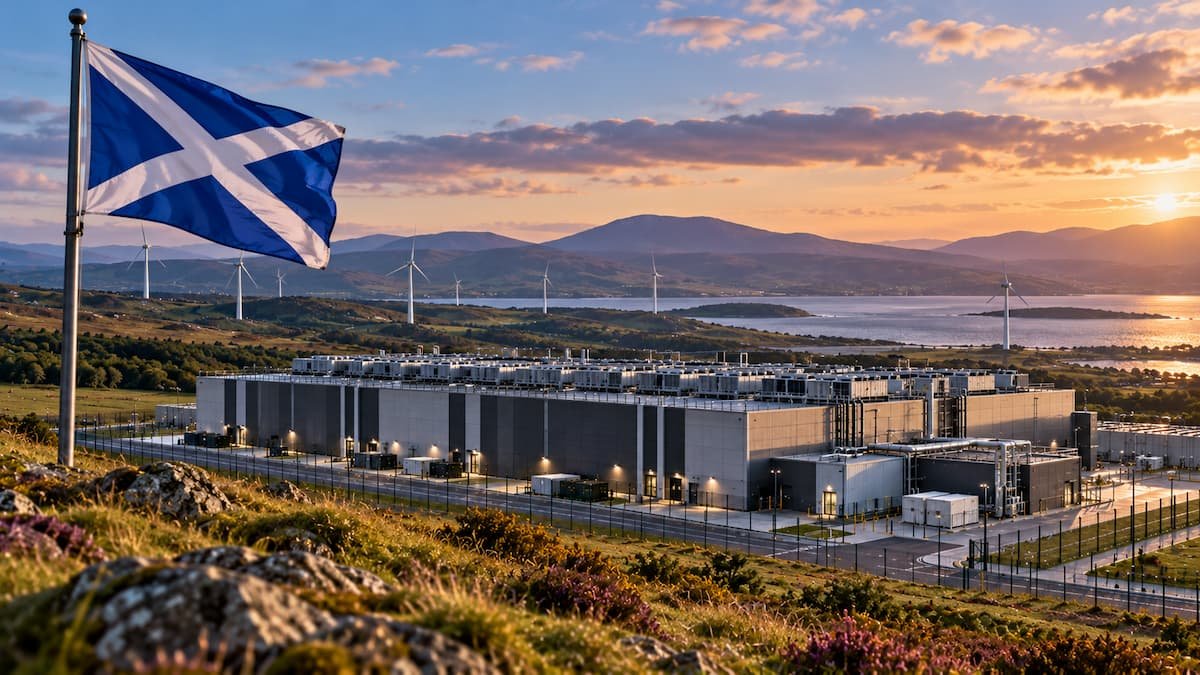
Scotland is currently at the center of a burgeoning environmental debate as it weighs the economic allure of a global AI revolution against the stark physical realities of resource management. With at least 23 large-scale hyperscale data center projects proposed across the country, policymakers are grappling with a fundamental question: how to balance the nation’s digital ambitions with the preservation of its natural landscape, water security, and energy stability.
The scale of the proposed facilities marks a radical departure from the existing digital infrastructure. While Scotland’s current largest data center operates at roughly 12 megawatts (MW), new proposals are reaching unprecedented levels. A development planned for Chapelcross in Dumfries and Galloway, for example, has been scoped at a staggering 1,000 MW, while a project in Auchtertool, Fife, is slated to cover approximately 60 hectares with a 600 MW capacity. To put this in perspective, these individual projects are industrial-sized undertakings that require power equivalent to that of small cities.
These proposals have surfaced at a time when Scotland’s renewable energy resources—particularly its wind power—have made it a highly attractive destination for global tech giants. However, the intersection of renewable energy and continuous computing demand remains a point of friction. Data centers require a steady “baseload” of electricity to function 24/7. Because wind and solar are inherently variable, renewable generation alone cannot guarantee the uptime these facilities demand. This necessitates a complex relationship with the electricity grid, raising concerns among environmentalists about how these facilities might rely on non-renewable backstops or put unsustainable pressure on national infrastructure.
Beyond energy, the physical and environmental footprint of these centers is triggering local alarm. Hyperscale facilities require significant volumes of water for cooling purposes, a resource that must be managed carefully to ensure it does not compromise local supply or aquatic ecosystems. Additionally, the constant drone of industrial cooling equipment and servers presents a noise pollution challenge for neighboring rural communities, while the sheer spatial footprint of these complexes poses questions regarding land-use policy and the preservation of Scotland’s scenery.
The Scottish government has responded to these pressures with a tightening of regulatory oversight. As of August, ministers must be notified of any proposed data center exceeding 50 MW. While the government has rejected calls for a total moratorium on new developments—choosing instead to embrace projects like the “AI Growth Zone” in Lanarkshire, which promises £8 billion in investment and over 3,000 jobs—it has mandated rigorous environmental impact assessments for all such projects. Furthermore, the development of comprehensive national planning guidance is underway, expected to be finalized by the end of 2026.
This situation reflects a global trend: data center policy is no longer just a subset of digital or economic strategy. It has rapidly evolved into a complex matrix of energy, water, and land-use governance. As governments worldwide race to secure the computing capacity necessary for the AI era, Scotland serves as a critical test case. The challenge is to ensure that the drive for digital growth does not bypass environmental safeguards or undermine the very infrastructure—clean water and stable energy—upon which local communities rely.
As the debate intensifies, the primary focus for authorities will remain on where these facilities are built, how their massive resource consumption is managed, and what safeguards can be implemented to ensure that the infrastructure of the future does not come at an unacceptable cost to the environment of today.
Disclaimer: This content is auto-generated for informational purposes only.
Source: Read Original News