






Bridging AI Autonomy and Hardware Control
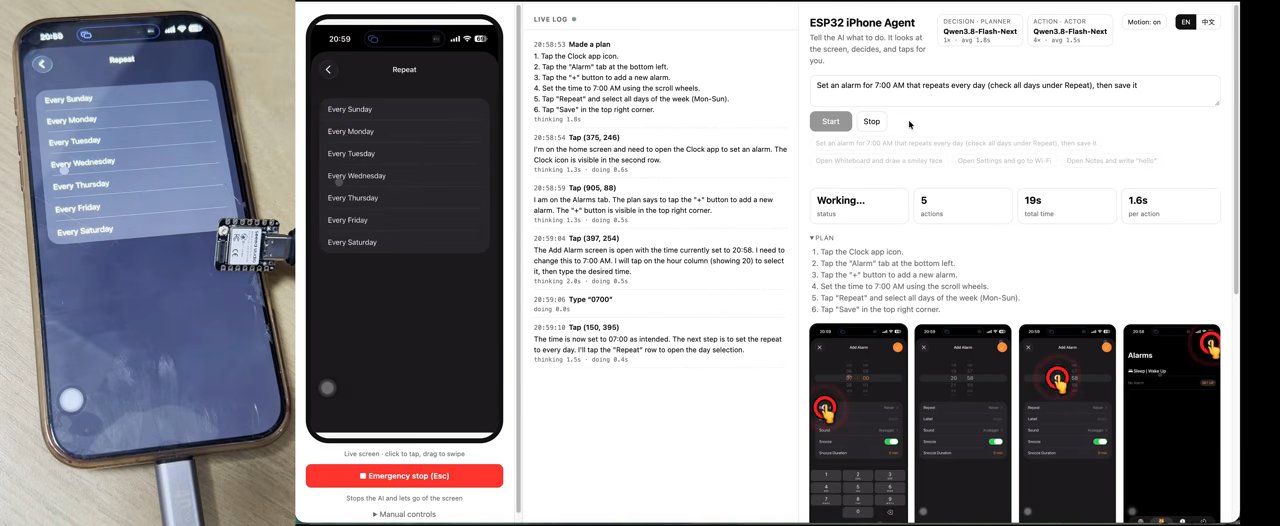
The intersection of artificial intelligence and physical hardware interaction is shifting away from software-locked ecosystems toward modular, external interfaces. A recent project developed by Henry Yuan demonstrates a method to integrate autonomous AI agents with an iPhone, bypassing the constraints of Apple’s walled garden. By utilizing an ESP32-S3 microcontroller, the system creates a hardware-level bridge that allows an AI to observe and manipulate a mobile device as if it were a human user. This approach sidesteps the need for complex software exploits, jailbreaking, or official developer certifications, providing a clean interface for automation.
The technical architecture relies on two distinct streams of data: visual feedback and input control. To enable the AI to “see” the interface, the system utilizes AirPlay screen mirroring combined with UxPlay, an open-source AirPlay server. This setup captures the iPhone’s display and directs it through a Gstreamer pipeline. By converting the screen output into a continuous JPEG stream, the system provides the AI agent with a visual representation of the device’s state. This allows the agent to analyze icons, menus, and text, effectively giving it the same visual data a human operator would utilize during manual interaction.
Hardware Interaction Through HID Emulation
While visual data ingestion provides the perception, the ability to act on that information requires an input method that the operating system trusts. The ESP32-S3 serves as the bridge for this requirement. Because the iPhone supports Human Interface Device (HID) profiles over USB, the microcontroller is programmed to emulate standard peripherals—specifically, a USB mouse and keyboard. When connected to the iPhone via a USB-C adapter, the device registers the ESP32 as a standard input device.
To translate these digital inputs into meaningful interface actions, the project relies on the iPhone’s built-in AssistiveTouch feature. By enabling this accessibility setting, the AI can trigger virtual buttons and swipes via the HID-emulated cursor. When the AI agent determines that a task requires a specific action—such as opening an application, scrolling through a list, or inputting text—it sends commands to the ESP32. The microcontroller then maps these requests to physical mouse movements or keystrokes, which the iPhone interprets as legitimate user interaction.
Streamlined Development Without Corporate Barriers
A significant advantage of this hardware-centric methodology is the removal of typical barriers to entry. Traditionally, automating tasks on an iPhone requires the use of Apple’s official development environment, XCode, or the possession of a Mac to handle provisioning profiles and app signing. For researchers or hobbyists, these requirements create a high barrier to entry and a considerable administrative burden. Furthermore, the “walled garden” architecture of iOS strictly limits how apps communicate with one another, often making deep system-level automation impossible for third-party scripts.
By utilizing an external microcontroller, this project effectively creates a “black box” solution. The iPhone does not recognize the ESP32 as an autonomous agent; it only sees a standard keyboard and mouse. Consequently, the agent can operate without a formal Apple Developer account or the need to sideload experimental software. This decoupling of the AI from the OS environment means the agent can run on any hardware platform, including a PC or a dedicated server, leaving the iPhone as a passive display and execution device.
Use Cases and Potential Applications
The potential use cases for this hardware-bridged automation range from productivity testing to accessibility research. For developers looking to perform automated regression testing, this setup allows for cross-platform consistency. Because the AI interacts with the screen as a visual environment rather than through API calls, it can test UI elements across different versions of iOS without modification to the application code.
Beyond testing, the technology holds promise for accessibility. If an AI agent can effectively navigate a mobile interface through simple HID commands, it can serve as a powerful assistant for users who struggle with traditional touch interfaces. By integrating voice-to-text or specialized sensor data into the agent’s logic, a user could theoretically control their device by speaking requests, with the ESP32 acting as the translator between their intent and the physical hardware of the phone.
Considerations for Scaling and Reliability
While the project demonstrates a novel proof of concept, scaling such a system involves addressing latency and error handling. Because the visual stream is handled through AirPlay mirroring and Gstreamer processing, there is a perceptible delay between the action taken by the AI and the visual confirmation on the screen. For complex, multi-step operations, the AI must be robust enough to handle these latency intervals and the possibility of missed inputs.
Additionally, the reliance on AssistiveTouch limits the granularity of the control. While a cursor can handle most basic tasks, rapid or high-precision gestures might prove challenging. However, the modular nature of the ESP32-S3 allows for iterative improvements. Future iterations could incorporate more sophisticated HID profiles or integrate better feedback loops where the AI can verify the completion of a task based on visual changes on the screen. As hardware-based automation continues to mature, this model serves as an important blueprint for how external devices can interface with mobile platforms in an era where software-level access remains increasingly restricted.
Disclaimer: This content is auto-generated for informational purposes only.
Source: Read Original News