







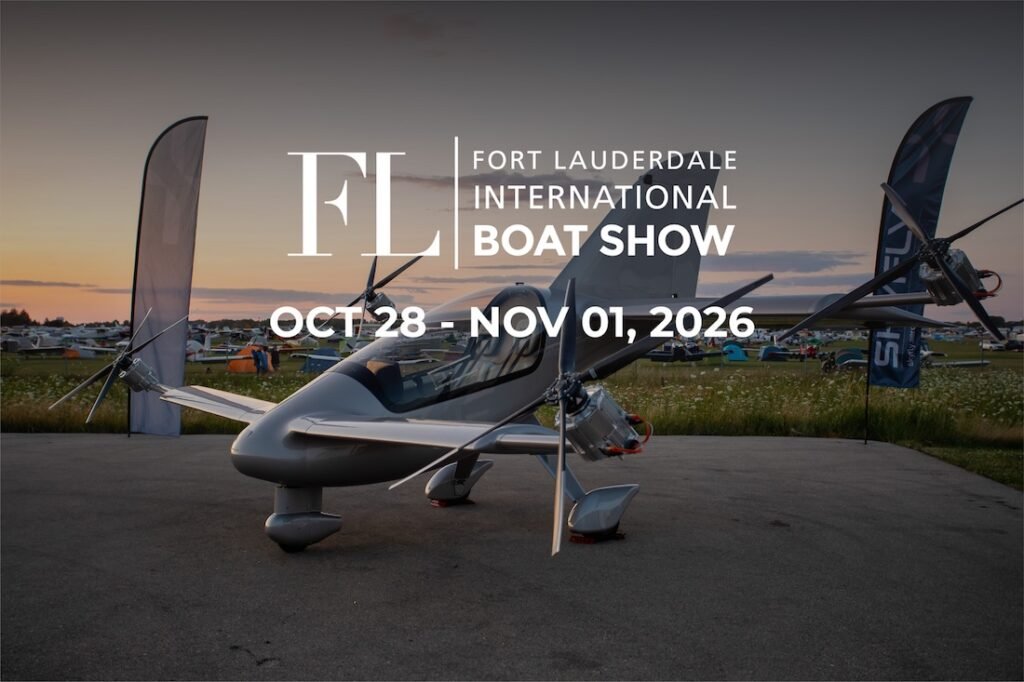
The Fort Lauderdale International Boat Show (FLIBS) is set to host a groundbreaking debut this year, as Skyfly Technologies brings its “Axe” electric Vertically Capable Aircraft (eVCA) to the world of superyachting. Running from October 28 to November 1, 2026, the event serves as a high-profile stage for the company to demonstrate how its personal flight technology can solve the “last-mile” connectivity problem that often limits the freedom of luxury yacht owners.
For those who spend millions on vessel autonomy, the transition from ship to shore remains a major bottleneck, often relying on fixed-schedule helicopter charters or cumbersome ground transport. Skyfly aims to disrupt this by positioning the Axe as an integrated, organic part of a yacht’s suite of tenders.
## Redefining Luxury Mobility with eVTOL Technology
The Axe is a sophisticated, two-seat electric aircraft designed to prioritize both efficiency and ease of operation. With a projected cruising speed of 100 mph and a flight time of up to 90 minutes, it offers a seamless way to bypass traditional infrastructure. What makes the Axe particularly attractive for the marine sector is its lack of reliance on runways. By utilizing its eight fixed-angle electric motors for vertical take-off and landing, the aircraft can transition directly from a superyacht deck to land, providing a level of privacy and autonomy that traditional logistics cannot match.
Operationally, the aircraft is engineered for sustainability and simplicity. With an estimated running cost of roughly $90 per flight hour, it is significantly more affordable than conventional helicopter travel. Skyfly has also built the airframe to be technology-agnostic, meaning the platform can integrate future advancements in battery energy density and motor performance as those sectors of the tech industry evolve.
## Engineering Efficiency and Safety
Unlike many personal eVTOL concepts that rely solely on multi-rotor hovering, the Axe utilizes a unique winged architecture. By employing fixed wings for forward flight, the aircraft achieves significantly higher energy efficiency during transit. In typical rotor-only designs, energy consumption spikes during cruise; however, the Axe’s hybrid approach allows it to “glide” on its wings, reducing power draw by as much as four times compared to pure-rotor alternatives.
Safety is a core pillar of the design, which consciously avoids the complexity of tilting motors or rotating wings. These mechanical systems are notorious for adding weight and creating potential failure points. By relying on a fixed-motor setup, Skyfly has simplified the flight dynamics. In the event of a total power loss, the aircraft retains its ability to glide, offering a safety margin that is vital for private owners. Under current FAA Light Sport Aircraft regulations, the Axe is classified as a two-seat light aircraft, lowering the threshold for pilot qualification and making private ownership a more accessible reality.
## Expanding the US Foothold
The presence of the Axe at FLIBS represents more than just a product showcase; it marks a strategic expansion for Skyfly within the United States. Following recent momentum at EAA AirVenture Oshkosh and a significant partnership with the Florida Department of Transportation to develop a hub at the SunTrax testing facility, Skyfly is rapidly establishing its operational footprint in America.
“Yacht owners invest heavily in the vessel, then hand the journey ashore to someone else’s schedule,” said Michael Thompson, CEO of Skyfly. “The Axe operates from the deck and needs no runway, so the owner decides how and when they move.” As the industry moves toward 2027 and the first scheduled deliveries, this showcase at the Super Yacht Village serves as a pivotal move to capture the attention of high-net-worth individuals who value the intersection of aviation tech, mobility, and absolute freedom.
Visitors at FLIBS can view the Axe at stand SYVL1.
Disclaimer: This content is auto-generated for informational purposes only.
Source: Read Original News