







Delhi’s Diwali Pollution Undercounted by Nearly 50%, Reveals CREA Analysis
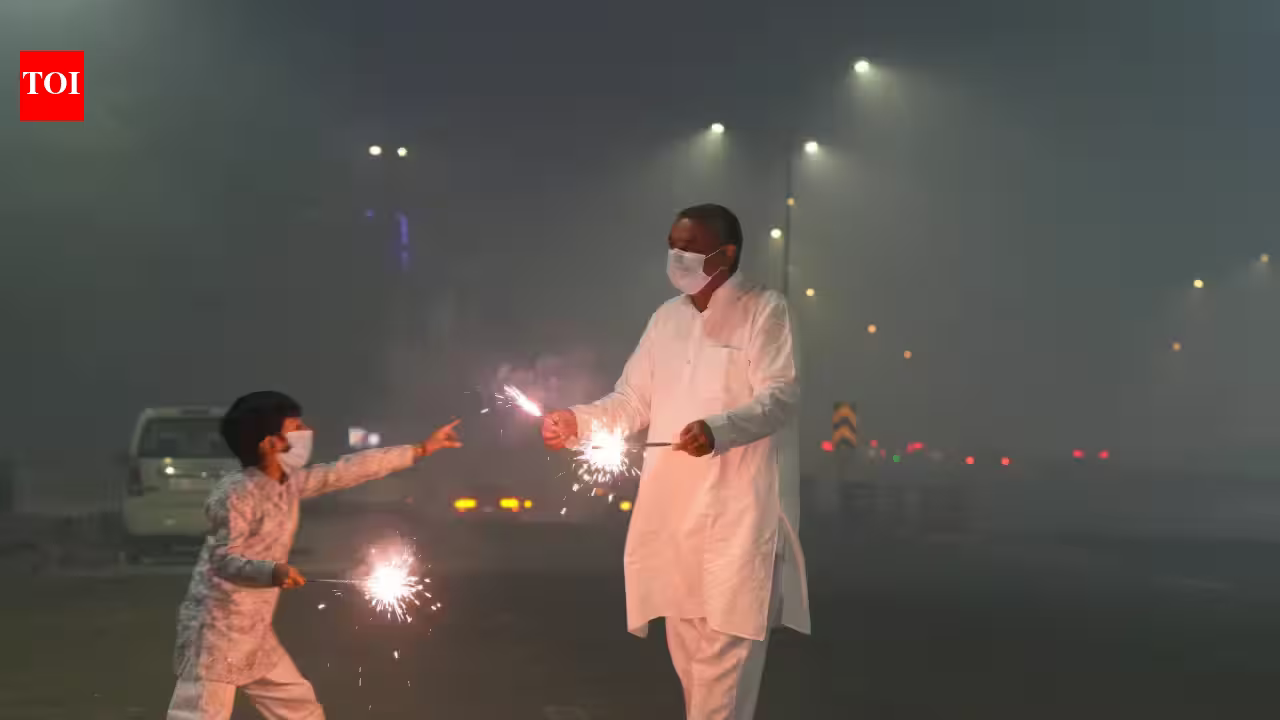
New Delhi: The true extent of Delhi’s hazardous air quality during the recent Diwali festivities may have been significantly downplayed due to a large volume of missing data from official monitoring stations. According to a fresh analysis by the Centre for Research on Energy and Clean Air (CREA), the capital’s average PM2.5 levels could have surged by 49% had the missing readings been properly accounted for.
The report suggests that if the blank entries in the monitoring network had been recorded at the upper measurement limit of 1,000 micrograms per cubic metre (µg/m³), the city’s average PM2.5 concentration would have spiked from a reported 269 µg/m³ to a staggering 400 µg/m³. To put this in perspective, the national daily safety standard is 60 µg/m³, while the World Health Organization (WHO) recommends a limit of just 15 µg/m³.
The 1,000 µg/m³ Ceiling Controversy
The discrepancy stems from an admission by the Central Pollution Control Board (CPCB), which revealed that its monitoring devices are calibrated to record particulate matter only up to 1,000 µg/m³. During the peak of Diwali night, pollution levels at several locations surged well beyond this limit, causing the sensors to stop displaying readings. These periods of data unavailability were subsequently excluded from the calculations used to determine the daily Air Quality Index (AQI).
CREA’s sensitivity analysis highlights the impact of these gaps. By examining hourly data from 59 monitoring stations over a 24-hour period, researchers found that 18% of expected observations were missing. When these gaps were filled with the 1,000 µg/m³ threshold for the sake of calculation, the city’s AQI shifted from a “very poor” rating of 344 to a level nearing the “severe” category.
Divergent Data Streams
While the CPCB’s integrated data output omitted these high-intensity readings, the Delhi Pollution Control Committee (DPCC) provided a different picture. The DPCC, which manages 43 of the city’s 60 stations, recorded hourly PM2.5 concentrations exceeding 1,000 µg/m³ across multiple sites. In four specific locations, levels were observed to have crossed 3,000 µg/m³, with one station in Mundka reportedly reaching an alarming 3,744 µg/m³ at 2:00 am.
Despite this, the CPCB failed to incorporate Mundka’s data into its bulletin between midnight and 4:00 am, effectively smoothing over the most dangerous hours of the night.
Sensitivity Analysis as a Benchmark
CREA researchers clarified that their analysis does not definitively claim that every missing data point was caused by pollution exceeding 1,000 µg/m³. Rather, the study serves as an illustrative exercise to demonstrate how the omission of data points during extreme pollution events misrepresents the public health reality.
“The peak PM2.5 levels for Delhi were reported as 584 µg/m³ at 1:00 am on November 9,” the CREA report noted. “However, by adjusting the missing data to the 1,000 µg/m³ cap, the peak concentration instead shifts to over 800 µg/m³ in the subsequent hours.”
As environmental experts call for more robust monitoring infrastructure capable of measuring extreme pollution spikes, the findings raise serious questions about the transparency and accuracy of the data used to inform Delhi’s public health policy during the smog season.
Disclaimer: This content is auto-generated for informational purposes only.
Source: Read Original News