





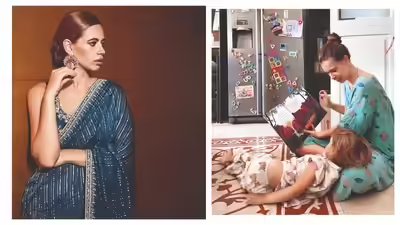
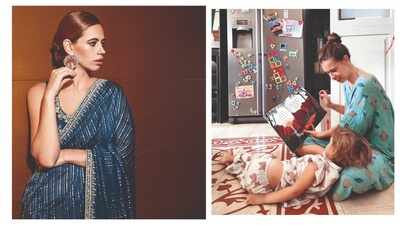
Kalki Koechlin returns to the stage with Aadyam Theatre’s Belly of the Beast, a play adapted from the book The Elephant in the Womb (penned by her), that takes an unflinching look at motherhood, bodily autonomy and the invisible labour of caregiving. Staying true to her reputation for taking on layered and uncomfortable subjects, the actor-writer uses the production to challenge the idealised narratives often attached to women and motherhood. In a conversation with Bombay Times, she reflects on why society remains uneasy with the harsher truths of parenting and how becoming a mother transformed her in ways that are still difficult to put into words. Excerpts…Do you feel the stage today allows women to tell more complex and uncomfortable stories than mainstream cinema does?I think a stage like cinema has mainstream theatre, independent original theatre, alternative theatre. So, it’s similar. You have wonderful indie films that portray complex, uncomfortable stories about women, and similarly, the same for theatre. It’s just a different medium for expression and I think theatre allows for community in the sense that it’s not really one person on stage, it’s usually quite a few people and that makes it much more sort of collaborative. And it’s just, yeah, it’s a very fantastic medium for bringing up subjects that are complicated because you have so many more people and so many more opinions contributing to the performance.One of the recurring themes in your work is how a woman’s identity can disappear behind the role of mother. Do you feel mothers get enough support and recognition for the work they do raising children?I think the unpaid labour part is the most striking and unjust thing about this whole experience. We are somehow supposed to give up everything else and not be paid for this, and that leaves us with less independence and less autonomy to be able to make choices for ourselves. It is a big problem, and we have a long way to go in terms of, for example, paternity leave. That would be a wonderful way in which fathers could take time off from work and contribute very much to raising the child, and experience this side, where you also get something back from being around your child. Your writing has never shied away from conversations about reproductive rights and bodily autonomy. At a time when debates around women’s choices, from childbirth to abortion, remain politicised worldwide, do you think artists and storytellers have a responsibility to challenge these narratives, even at the risk of alienating audiences?Well, I think one of the positive things is that we still have abortion rights in India. Of course, there’s a lot of cultural taboo, but at least legally, we have the right over our bodies, which is really wonderful. And I think these things, the more we talk about them, the less taboo they’ll become, and the more sort of stories we will hear. I think it’s one of those things where the silence around it makes it much bigger and worse than it is. And if people spoke about it more often, it would sort of break down these taboos quicker.Was there any stage of motherhood that you found difficult to portray honestly, either as a writer or as a performer? I think one of the things I found hard to portray, I don’t know about honestly, but I just found it hard to describe, was the sort of way your child changes you. Of course, you have changes in your body, you have changes psychologically, you’re finding it hard to be the person you were before, but what this child gives back to you and how you fundamentally change as a human because of it, that’s hard to articulate. Motherhood is portrayed as instinctive, joyous, and almost sacred. Your work often highlights its messier realities. Why do you think society remains uncomfortable with stories that acknowledge the exhaustion, resentment, fear, and loss of identity that many mothers experience? I think society is uncomfortable acknowledging the exhaustion, resentment, fear, and loss of identity that mothers experience because society would fall apart without mothers, if mothers quit, if mothers revolted. So, this is kind of like tying a bow around the whole experience in order to sort of make it important. But I don’t think we allow for mothers to really vent, let go, or hand over these jobs to other people. And I think the system that we have in modern society is to sort of separate the domestic space from everything else. And I think that’s very, very difficult for mothers.