







As the global gaming community stands on the precipice of the November 19 launch of Grand Theft Auto 6, a unique preview has emerged from an unexpected source. The Weather Channel recently published a series of images detailing the environmental mechanics of Leonida, the fictional state serving as the setting for the highly anticipated title. By presenting these screenshots through the lens of a meteorological report, the collaboration highlights the technical sophistication of the game’s environmental simulation, setting a new benchmark for open-world fidelity.
Advancing Environmental Realism
The core of modern open-world development lies in the ability to create dynamic environments that feel alive. In the case of GTA 6, the imagery provided confirms that Rockstar Games has placed a heavy emphasis on localized weather systems. Each screenshot displays a distinct atmospheric condition, ranging from heavy urban precipitation to subtle, low-lying humidity. The technical achievement here is not merely in the rendering of the weather itself, but in the interaction between these systems and the environment.
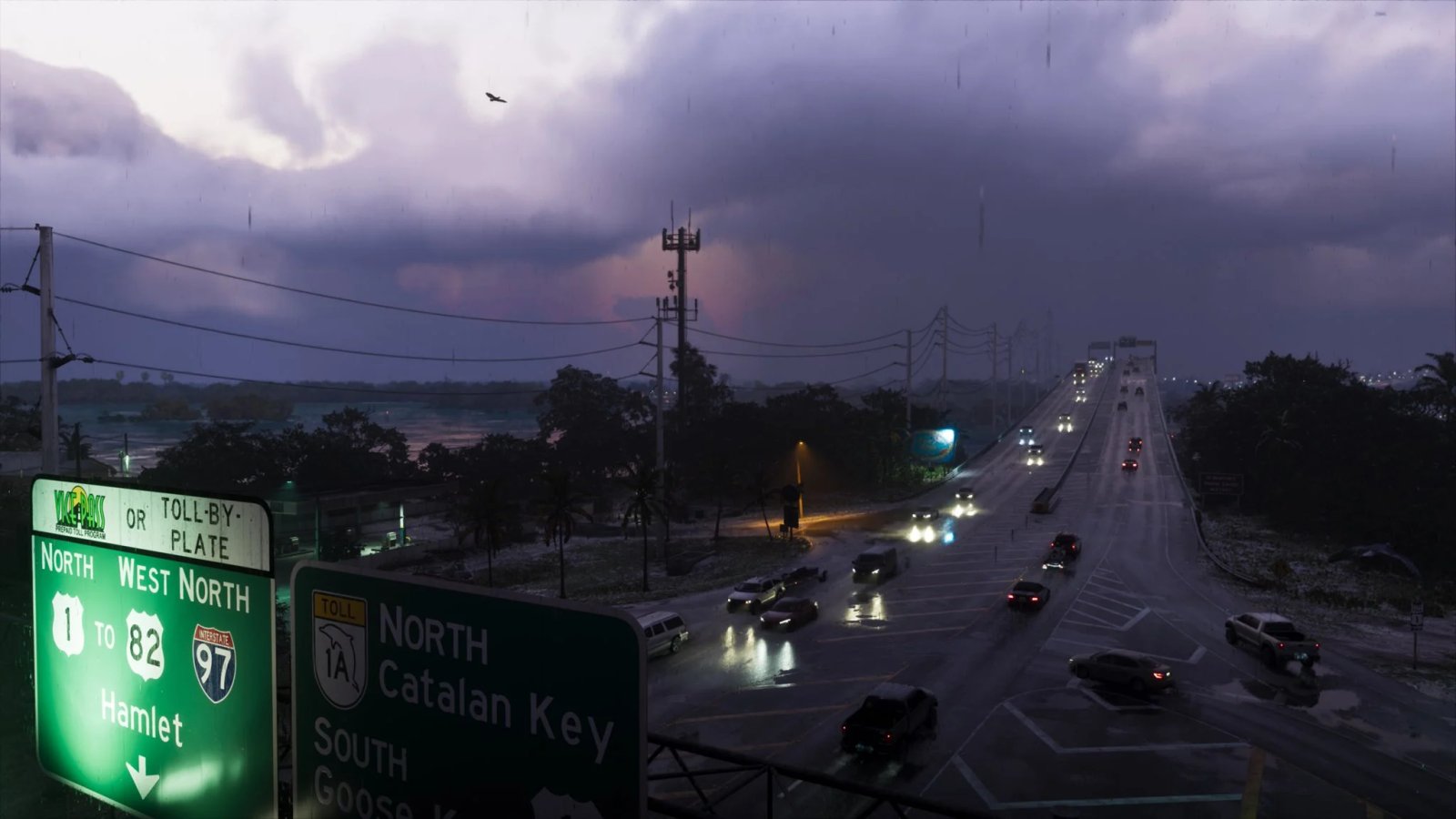
In the urban setting depicted, torrential rain does more than obstruct visibility; it alters the surface properties of the map. The reflections on the asphalt, driven by complex lighting calculations and surface material shaders, indicate a move toward high-fidelity material interaction. When rain meets the road, the transition from dry to wet surfaces appears calculated to provide a tangible sense of mass and depth, a stark contrast to static weather presets often found in less ambitious titles.
Dynamic Volumetric Lighting and Fog
A significant portion of the visual depth shown in the recent preview comes from the handling of light through atmospheric particles. The inclusion of sea fog rolling in off the ocean near the Vice City skyline serves as a primary example. By utilizing volumetric fog, the engine creates a soft, diffused light effect that reacts to the position of the sun. This technique adds an necessary layer of density to the air, preventing distant objects from appearing too sharp and contributing to the overall sense of scale within the world.
Furthermore, the imagery captured near the Rusty Anchor location demonstrates sophisticated volumetric cloud technology. These clouds do not act as a static skybox; instead, they possess depth and granularity, allowing for complex light scattering during storm cycles. This lighting behavior, where sunbeams pierce through heavy cloud cover, adds a layer of realism that is crucial for maintaining immersion in a vast, open landscape.
Humidity and Terrestrial Effects
Beyond standard rain and wind, the preview highlights how localized geography affects weather perception. The shot from Gambit Bay, which showcases low-lying sheets of mist, suggests that the game tracks humidity and ground temperature to determine where and when fog should manifest. This is reminiscent of advanced simulation techniques seen in previous titles developed by the same studio, yet it appears refined for the current hardware generation.
The mist in the Gambit Bay shot acts as a spatial separator, masking distant objects and providing a sense of dampness that directly impacts the color palette of the scene. By shifting the environment from high-contrast daylight to a muted, misty atmosphere, the game demonstrates how weather can be used to control the player’s perception of distance and mood. These localized effects ensure that the world of Leonida feels regionally distinct rather than monolithic.
Impact on Player Experience
The technical implications of these weather systems extend far beyond aesthetic appeal. In an open-world title, the environment serves as a constant companion to the player’s activities. The windy, rainy conditions shown in the Key Lento region reveal how weather can influence navigation and environmental interaction. When roads and vehicles are drenched, it implies a change in surface friction, suggesting that the game’s physics engine is deeply integrated with its meteorological systems.
The ability for players to encounter these varying conditions creates a persistent need to adapt. Whether it is managing vehicle handling on slick roads or navigating through low-visibility fog during a mission, these environmental variables introduce a layer of organic gameplay. This shift away from static environmental states toward a dynamic, breathing ecosystem is a hallmark of current-generation design, ensuring that no two sessions in Leonida feel identical.
The Technological Leap
As the industry moves toward more complex simulations, the role of environmental design becomes increasingly critical. The collaboration between a major entertainment franchise and a professional weather organization underscores the level of detail present in GTA 6. By focusing on atmospheric interaction, volumetric depth, and moisture-based physics, the developers are signaling that the world is intended to function as a coherent, reactive space.
This level of precision requires substantial processing power, highlighting the optimization necessary to run such a dense, reactive world at scale. With the release date now only hours away, the focus shifts to how these systems perform in a live, multiplayer-compatible environment. If the visual fidelity shown in these screenshots is representative of the final product, GTA 6 is poised to set a new technical standard for how virtual environments are constructed, simulated, and experienced.
Disclaimer: This content is auto-generated for informational purposes only.
Source: Read Original News