








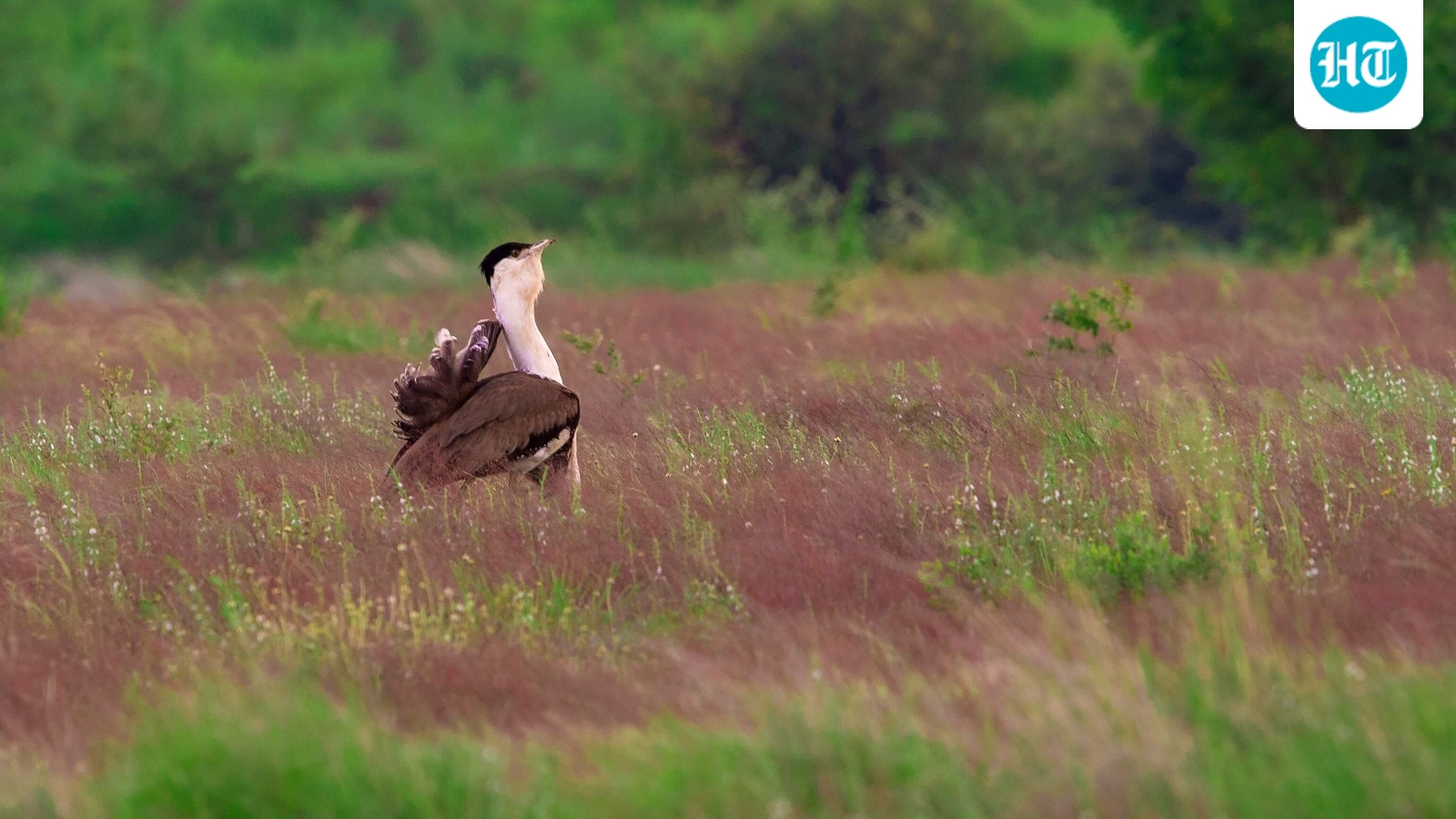
A New Hope for the Great Indian Bustard: Captive-Bred Birds Released into the Wild
The critically endangered Great Indian Bustard (GIB), once a common sight across the vast plains of India from Punjab to Tamil Nadu, is fighting a desperate battle for survival. With fewer than 150 individuals left in the wild, the species is now restricted to fragmented territories in Rajasthan’s Jaisalmer and Gujarat’s Kutch region. In a landmark effort to pull the majestic bird back from the brink of extinction, conservationists have entered a pivotal new phase: the release of captive-bred bustards into their natural desert habitat.
The Dual Crisis: Habitat Loss and Power Lines
The catastrophic decline of the GIB is primarily attributed to two systemic factors. For decades, the bird’s natural home—dry grasslands—was wrongly labeled as “wasteland,” facilitating land encroachment and government-led infrastructure projects. This degradation led to a severe reduction in natural prey and water resources.
More recently, the rapid industrialization of these regions with high-voltage power lines and wind turbines has proved fatal. The GIB, which possesses excellent peripheral vision to spot predators but poor frontal sight, often fails to notice power lines while in flight. Collisions with these overhead cables remain a leading cause of mortality. While the Supreme Court once mandated the burial of these lines, recent relaxations in regulations—limiting the protected zone to 14,000 square kilometers—have sparked concerns among conservationists who fear the infrastructure continues to pose a deadly threat.
A Breakthrough in Captive Breeding
Initiated in 2016, the government’s recovery project has yielded significant results. By June 2026, the captive population had grown to 98 birds, with 38 successfully hatched through artificial insemination. This milestone culminated this past Sunday at the Desert National Park in Jaisalmer, where two captive-bred individuals were released into the wild.
“With this, we have entered a new era of GIB conservation,” stated Ashok Singh, assistant conservator of forest at Jaisalmer.
To prepare these birds for life outside, the Wildlife Institute of India (WII) subjected them to rigorous rewilding training at a ₹9.25 crore facility in Ramdevra. The training ensured the birds could withstand natural temperature fluctuations, locate water sources, and hunt for insects, effectively transitioning them from human-managed environments to the harsh reality of the desert.
The Path to Recovery
The success of these two pioneers will determine the trajectory of future conservation efforts. Scientists are closely monitoring the birds to see if they can thrive without constant human intervention. Success in this experiment could trigger a broader expansion plan, potentially seeing the introduction of the GIB to restored habitats in states like Maharashtra and Madhya Pradesh.
In Gujarat, restoration efforts are already gaining momentum. At Naliya, officials have successfully cleared 11 square kilometers of invasive Prosopis juliflora and installed predator-proof fencing. The local action plan aims to release 30 birds into an improved landscape of up to 500 square kilometers.
However, experts remain cautious. Sumer Singh Bhati, a seasoned observer of the species, emphasizes that captive breeding is merely the first step. “The real test is not just producing birds in captivity,” Bhati noted. “There is an urgent need to create a secure, landscape-scale environment. Improving habitat quality and ensuring all transmission lines are placed underground are the absolute keys to the long-term survival and flourishing of the population.”
As these birds take their first flight into the wild, the eyes of the conservation world remain fixed on the grasslands of Rajasthan, hoping that this desperate effort is enough to rewrite the fate of one of India’s most iconic, yet vulnerable, avian species.
Disclaimer: This content is auto-generated for informational purposes only.
Source: Read Original News