








Legal Correspondence and the Pressure on Independent Journalism
The landscape of modern games journalism often involves navigating complex intersections of corporate power, legal maneuvering, and the responsibility to maintain objective reporting. In early 2025, an incident involving a demand for editorial changes highlighted the increasingly aggressive tactics used by high-profile figures to influence media coverage. Bobby Kotick, the former CEO of Activision Blizzard, has utilized the services of the law firm Clare Locke to address how his tenure and the subsequent acquisition by Microsoft are portrayed in the press.
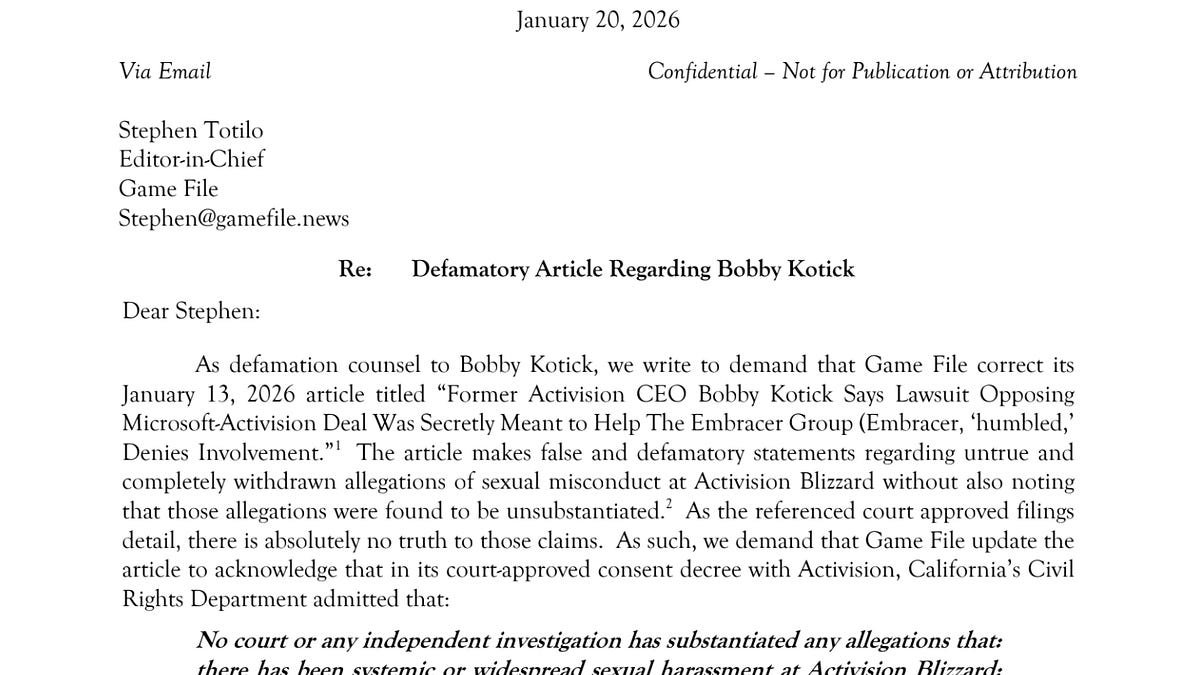
In January, a letter from the firm arrived with the subject line “Legal Correspondence re Bobby Kotick.” The communication was framed as a formal demand to modify a specific report published by Game File regarding a lawsuit brought by the Swedish pension fund AP7. The fund’s legal action contended that the acquisition of Activision Blizzard was expedited to mitigate the fallout from internal workplace misconduct scandals. Kotick, through his representatives, has consistently refuted these characterizations, arguing that the transaction was handled in the best interest of shareholders and that narratives surrounding his leadership were skewed by a coordinated effort among media, unions, and government agencies.
The Mechanics of a Demanded Correction
The legal demand centered on a specific request: the inclusion of language from a 2023 settlement between the California Civil Rights Department and Activision Blizzard. This settlement, which concluded litigation regarding alleged sexual discrimination, contained a statement declaring that no court or independent investigation had substantiated claims of systemic sexual harassment or that senior leadership had ignored such conduct.
The strategy employed by the firm involved reaching out to various media outlets to ensure this specific excerpt was appended to any reporting discussing the 2021 misconduct allegations. However, the situation reached a point of absurdity when the firm sent a formal threat to Game File regarding an article that already contained the exact text they were demanding. The irony of being threatened with “actual malice”—a legal standard for libel—for failing to include a paragraph that was explicitly present in the original publication underscored a disconnect between the legal team’s aggressive outreach and the actual content being produced.
Transparency and the Assertion of Editorial Independence
The attempt to label the communication as “confidential” added another layer of contention. In the realm of journalism, confidentiality is a mutual agreement rather than a unilateral declaration. By refusing to be bound by the terms of the letter, the journalist in question highlighted a critical principle: independent outlets cannot be compelled to shroud interactions with powerful entities in secrecy.
Transparency remains the primary defense against intimidation. When a legal firm demands that a publication retroactively alter its work based on a review of an “incomplete version” of a story—likely due to failing to navigate past a paywall—the integrity of the reporting is reaffirmed by the refusal to yield. This incident serves as a practical demonstration of how independent journalists must navigate the pressure of potential litigation. It emphasizes that standing behind one’s research and maintaining a clear line of communication with readers is essential for journalistic survival in an era where wealthy individuals can employ legal firms to challenge unfavourable narratives.
The Broader Impact on Games Media
The tactics used by Clare Locke are part of a larger trend affecting the gaming industry. Reports have surfaced indicating that various outlets have responded to these pressures in different ways. Some organizations have quietly updated their content to include the requested language, while others have faced more direct scrutiny. Mikhail Klimentov, a journalist who investigated these patterns, provided a detailed look at how these legal letters have influenced media outlets, with some choosing to modify their stories to avoid the costs of potential legal disputes.
The public disclosure of these tactics is vital for understanding how the industry is covered. When outlets choose to modify or delete content under pressure, it changes the historical record of major corporate events. Conversely, when journalists document these encounters, they provide readers with a clearer picture of the environment in which industry news is generated. The resolution of the situation—where the legal firm eventually acknowledged their mistake and claimed the matter was closed—served as a victory for editorial autonomy, but it also highlighted the time and resources that must be diverted away from core reporting to address these external threats.
Maintaining Accountability in Independent Reporting
For independent journalists, the challenge is not just about producing high-quality news but also about sustaining an infrastructure that can withstand the demands of those who prefer to control the narrative. As digital journalism moves toward subscription-based models, the financial support from readers becomes the bedrock of this independence. It allows for a buffer against the costs associated with legal posturing and enables reporters to prioritize their audience over the demands of high-priced legal counsel.
Ultimately, the goal of such reporting is to provide context and truth, allowing readers to judge the credibility of various claims for themselves. While the experience of dealing with a legal threat is taxing, it underscores the necessity of a fearless press. By documenting these interactions and maintaining a commitment to transparency, independent outlets ensure that their work remains a reliable source of information, regardless of the pressure exerted by those attempting to reshape their own public image.
Disclaimer: This content is auto-generated for informational purposes only.
Source: Read Original News