







The DIY Virtual Reality Paradigm
The landscape of consumer virtual reality has historically been dominated by high-cost, closed-ecosystem hardware. Companies invest millions into ergonomic research, weight distribution, and sensor fusion to ensure that a user can remain immersed for hours without physical strain. However, a growing subculture of hobbyists is challenging this model by building functional VR headsets from scratch using low-cost components, 3D-printed housings, and open-source software libraries.
At its core, a DIY headset project attempts to replicate the essential functions of a commercial unit: high-resolution display projection, low-latency motion tracking, and lens-based optics for depth perception. By sourcing individual LCD panels, microcontrollers, and inertial measurement units (IMUs), builders can construct a device for significantly less than the sticker price of mass-market alternatives. Yet, the transition from individual parts to a cohesive, wearable piece of technology reveals exactly why the major manufacturers command premium pricing. The journey from assembly to a usable experience is fraught with technical hurdles, specifically concerning physical comfort and sensor accuracy.
Hardware Constraints and Sensor Performance
Building a VR headset requires balancing the resolution of the displays with the speed of the tracking sensors. Most DIY enthusiasts opt for small, high-density LCD panels originally designed for smartphones or specialized tablets. While these screens provide sufficient pixel density to prevent the “screen door effect,” they often lack the global dimming or high refresh rates of custom VR-specific panels.
The more significant technical challenge lies in sensor drift. In a professional headset, sophisticated algorithms correlate visual data from onboard cameras with the movement registered by high-precision gyroscopes and accelerometers. In a DIY build, one often relies on an entry-level IMU. Without complex sensor fusion, these components suffer from “drift,” where the virtual horizon slowly creeps or rotates even when the user remains perfectly still. This discrepancy between physical movement and visual feedback is the primary cause of motion sickness. Mitigating this requires rigorous software calibration and potentially upgrading to high-fidelity sensors, such as the MinIMU-9, which provides vastly superior resolution and stability, albeit at a higher cost.
The Ergonomics of Wearable Computing
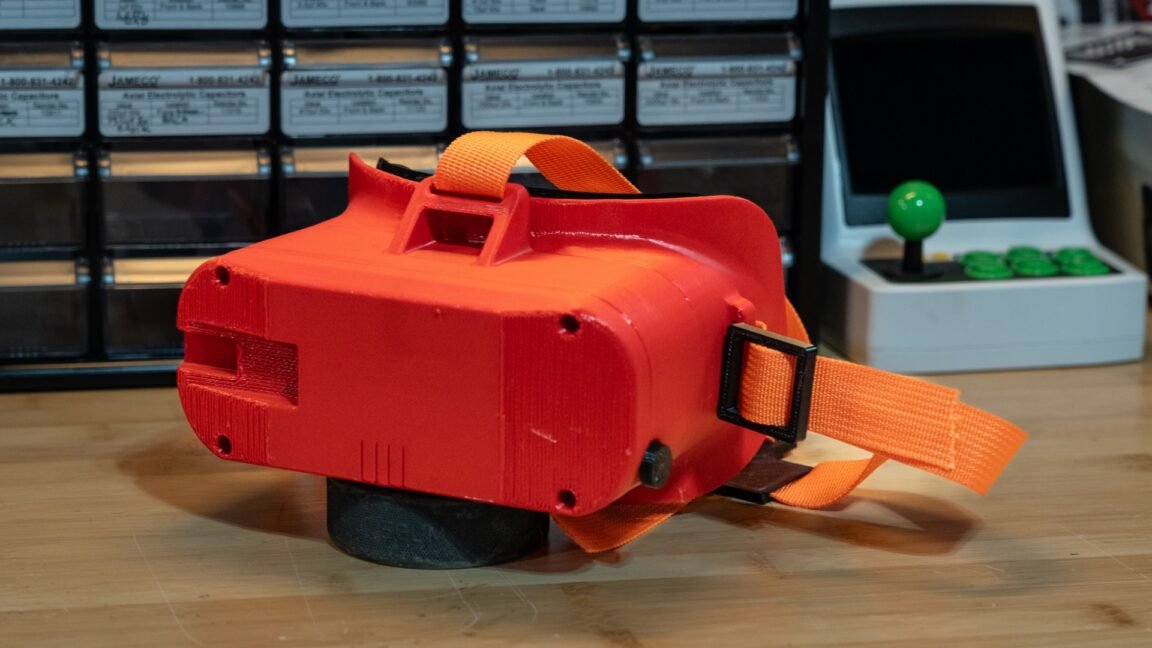
A significant portion of a headset’s R&D budget is dedicated to industrial design. The human face is sensitive, and supporting the weight of a display assembly, optics, and internal wiring requires precision engineering. My recent prototype demonstrated that mechanical design is where DIY projects most often falter.
Without a proper cable-routing solution, the physical weight of the tether—the cable connecting the headset to the processing unit—exerts constant pressure on the device, dragging it to one side. This introduces structural imbalance, leading to the headset crushing the user’s nose or cheekbones. Despite the inclusion of synthetic padding, the structural integrity of a 3D-printed frame rarely matches the lightweight, load-bearing materials found in commercial devices. After fifteen minutes of use, the accumulation of pressure points becomes prohibitive. Endurance activities, such as long-form simulation racing or extended exploration in virtual spaces, become physically unsustainable with a poorly balanced chassis.
Cost-Efficiency Versus User Experience
Financial analysis of the project presents an interesting dilemma. My total expenditure was roughly $240, though this figure was inflated by a secondary purchase to correct a hardware failure. A streamlined build can be completed for approximately $180. Compared to the $300 to $400 entry price of a commercial mass-market headset, the savings are substantial. However, the comparison is not binary.
When you factor in the cost of high-quality panels, specialized IMUs, and batteries to ensure wireless performance, the price gap closes rapidly. At that point, the builder is paying nearly the same amount as a mass-produced device that includes mature software support, polished tracking, and integrated controllers. The market-ready hardware effectively “disappears” during use, allowing the user to focus on the software, whereas the DIY hardware constantly demands attention due to its technical flaws and physical discomfort. The decision to build is therefore rarely about finding a cheaper way to access gaming; it is an exploration of the fundamental constraints that define the limits of current virtual reality technology.
Learning Through Iteration
Despite the frustrations of flickering displays, sensor drift, and inadequate facial padding, the project serves as a profound masterclass in hardware engineering. It forces the builder to grapple with the realities of optical alignment, heat dissipation, and latency minimization. When you assemble these components manually, you gain a deep appreciation for the complex interactions between hardware and firmware that make modern immersive devices possible.
While this DIY unit is unlikely to replace a standardized headset for long-duration racing or professional tasks, its value lies in the technical insights gained. It provides a platform for further experimentation, whether through the integration of advanced OLED panels for better contrast or the design of a more ergonomic head-strap system. For those interested in the underlying architecture of wearables, the exercise is an excellent educational endeavor. Ultimately, the project highlights the gap between “functional” technology and “refined” technology—a gap that costs thousands of engineering hours to bridge, yet offers an invaluable learning experience for those willing to pick up a soldering iron and start building.
Disclaimer: This content is auto-generated for informational purposes only.
Source: Read Original News