









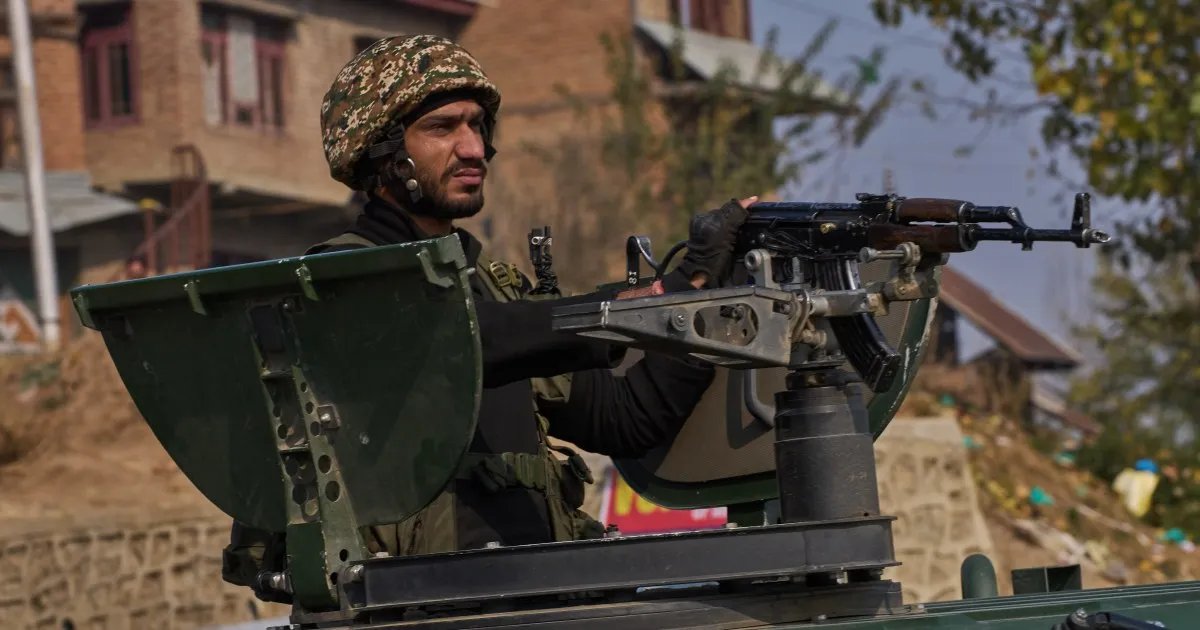
Security Milestone in Kashmir: Death of Last Local Militant Sparks Debate on Future of Conflict
Kulgam and Srinagar — Following a week-long intelligence-led operation, Indian security forces neutralized Mohammad Lateef Bhat in a mosque located in Zangalpora village, Kulgam district, on November 18. Bhat, identified as a commander for the Pakistan-based group Lashkar-e-Taiba (LeT), was sought in connection to a recent assault on Central Reserve Police Force (CRPF) personnel that left three soldiers wounded.
The elimination of Bhat has been framed by New Delhi as a watershed moment in the region’s three-decade-old insurgency. Union Home Minister Amit Shah hailed the operation as a significant triumph, asserting that Bhat was the final local Kashmiri youth involved in militant activities. “This development marks a significant change in the security situation in the valley. It is a matter of pride for us,” Shah stated, declaring that the valley is currently free of local active militants. Local police corroborate this claim, marking the first instance since 1989 that the LeT’s ranks are devoid of local recruits.
The ‘Hybrid’ Militant Challenge
Despite the official narrative of a decisive victory, security experts and former law enforcement officials caution that the nature of the conflict is evolving rather than disappearing. Israr Khan, a former deputy inspector general of the Jammu and Kashmir Police, noted that while the death of a commander is a tactical win, it does not necessarily signal the end of the insurgency.
Central to this concern is the phenomenon of “hybrid militants.” Emerging around 2020, this term refers to individuals who remain off the official security radar, living ostensibly normal civilian lives while maintaining clandestine connections to militant networks. These operatives often receive localized training and carry out sporadic attacks before returning to their daily routines, a methodology that significantly complicates surveillance and counter-insurgency operations. Analysts argue that because these individuals do not appear in police databases, the claim that there are no remaining local fighters is difficult to verify conclusively.
Adaptation and Changing Geography
Security agencies have also faced a persistent threat from militant groups utilizing new monikers to bypass international scrutiny, such as The Resistance Front (TRF) and the People’s Anti-Fascist Front (PAFF). Formed in the wake of the 2019 revocation of the region’s special constitutional status, these groups are viewed by intelligence agencies as proxies for established organizations looking to project a localized image while evading global oversight mechanisms like the FATF.
Furthermore, the focus of unrest appears to be migrating. Political scientists like Noor Ahmad Baba point out that while recruitment within the Kashmir Valley may have plateaued, there is a marked increase in militant activity in the Jammu division. The dense forests of Jammu have become an operational stronghold for insurgents, benefiting from a thinner security footprint caused by troop redeployments toward the Ladakh border.
Equipped with encrypted communication tools and satellite technology, these fighters rely less on local networks and more on established infiltration routes through the rugged terrain of the south. As security forces grapple with these “shapeshifting” groups, analysts maintain that the coming months will be a litmus test for whether the current decline in local militancy represents a permanent shift or merely a strategic adaptation by armed groups to a more hostile environment.
Disclaimer: This content is auto-generated for informational purposes only.
Source: Read Original News