









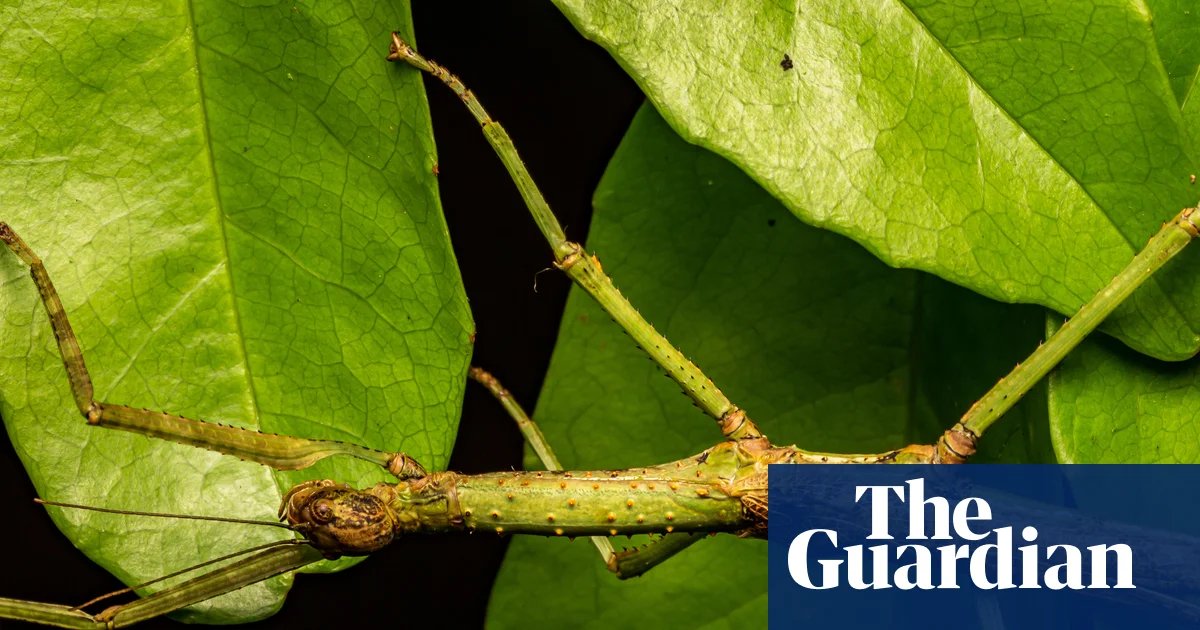
In a striking reminder of how much remains to be discovered in the natural world, Australian researchers have identified two new species of large stick insects in the tropical forests of far north Queensland. The findings, published in the journal Austral Entomology, suggest that even the most well-documented insects may still hold secrets from science.
The research team, led by Dr. Braxton Jones of the University of Sydney, utilized a combination of DNA analysis, museum specimen examinations, and crowdsourced data from citizen science platforms to unravel a complex evolutionary puzzle. What was once believed to be just two species, the team has discovered, is actually a group of five distinct species ranging from northern New South Wales to the tropical north.
One of the new species, Anchiale robusta, was effectively hiding in plain sight. Long a favorite among insect enthusiasts and researchers, the insect had been misidentified for decades.
“When we went out into the field and we saw a whole bunch of different individuals that looked morphologically different, and they were also living in different habitats, that was our first hint that there was a bit more of a complicated story here,” Dr. Jones said.
Anchiale robusta females are impressive in size, reaching lengths of 12 to 16 centimeters, while males measure 9 to 10 centimeters. While males are capable of flight, females are typically grounded by their heavy bodies, which are filled with eggs. They are easily recognizable by their mostly black wings, occasionally accented with a subtle purple hue on the underside of the hindwing.
The second new species, Anchiale mabiensis, makes its home in the critically endangered Mabi rainforest of Queensland’s Atherton Tablelands. Reaching 11 to 12 centimeters in length, this species features a unique structural “lid” on its eggs that detaches during hatching.
The discovery carries significant conservation implications. Because the research shows these insects occupy much smaller, fragmented habitat ranges than previously assumed, they may be more vulnerable to environmental changes than scientists previously thought.
Even with these new additions to the taxonomy, the mystery remains far from solved. The researchers have already identified a probable third new species located in Cape York, though further specimens are required to confirm its status.
This discovery follows a banner year for entomology in Queensland. In 2025, scientists in the Atherton Tablelands identified Acrophylla alta, a 40-centimeter-long behemoth that weighs nearly as much as a golf ball and is currently considered a candidate for Australia’s heaviest insect.
“There’s so much we don’t know about them,” Dr. Jones noted, emphasizing that even within the Anchiale genus—some of the most photographed and tracked insects on citizen science apps—biodiversity remains vastly underestimated. As researchers continue to dig into the genetics of the region, it is likely that Australia’s dense northern forests still hold many more insects waiting to be identified.
Disclaimer: This content is auto-generated for informational purposes only.
Source: Read Original News