








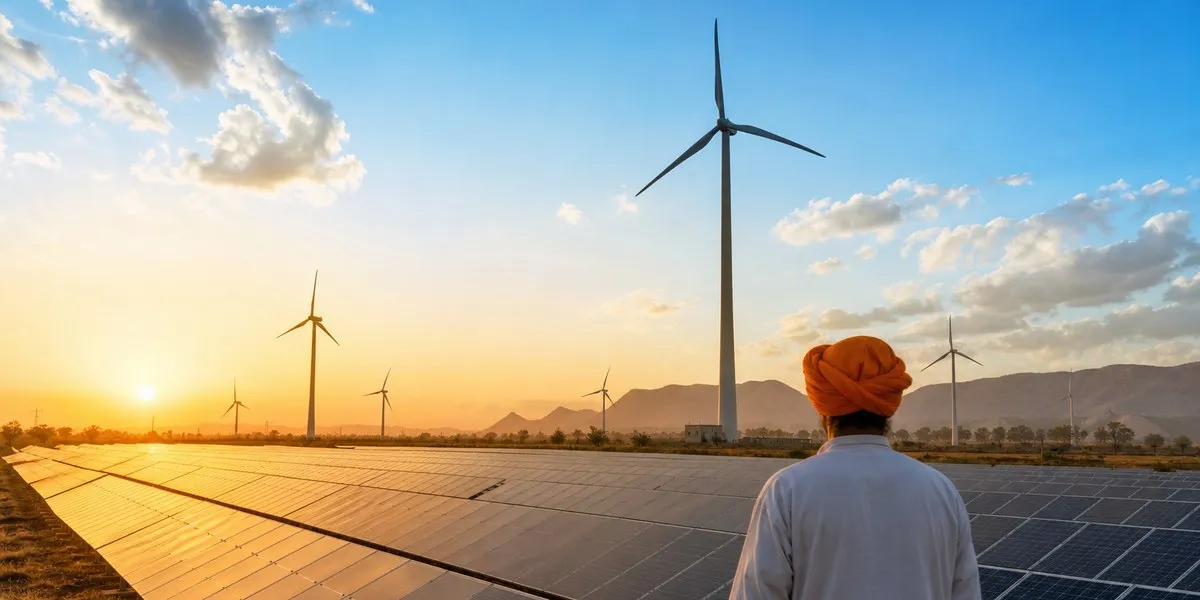
Renewable Surge Saves India Over $100 Billion in Fuel Import Costs
India’s aggressive transition toward clean energy has yielded massive economic dividends, shielding the national exchequer from the volatile fluctuations of global fossil fuel markets. According to a landmark report by the International Energy Agency (IEA), the country’s strategic shift toward solar, wind, and bioenergy has resulted in savings exceeding $100 billion in coal and natural gas import costs between 2011 and 2025.
This significant financial cushion highlights the success of India’s long-term energy policy, which has prioritized domestic renewable generation to reduce dependence on expensive foreign energy supplies.
Reducing Reliance on Foreign Coal
The data provided by the IEA paints a clear picture of how renewable infrastructure serves as a hedge against global energy uncertainty. The agency estimates that, had India not invested in its massive clean energy capacity since 2010, the country would have been forced to import an additional 110 million tonnes of coal in 2025 alone to keep pace with its booming economic demand.
By offsetting this massive volume of fuel, India has not only preserved its foreign exchange reserves but has also insulated its industrial and domestic power sectors from the inflationary pressures of imported commodities. Looking ahead, the IEA projections are even more optimistic, suggesting that these cumulative fuel import savings are on track to more than double by 2030, reinforcing the long-term fiscal prudence of the green energy roadmap.
Strengthening Energy Security
Fatih Birol, Executive Director of the IEA, lauded India’s progress, emphasizing that the scaling of renewable capacity is a cornerstone of the nation’s energy security strategy. Amid a complex global landscape marked by supply chain disruptions and market volatility, India’s ability to generate its own power through sun and wind has become a critical strategic asset.
“Consistent and clear policy frameworks remain the most effective tool in reducing the cost of renewable technologies while simultaneously attracting the private investment necessary to sustain this momentum,” Birol stated. By fostering a predictable environment for investors, India has effectively quadrupled its clean energy footprint over the last decade, positioning itself as a leader in the global energy transition.
The Path to 2030: Challenges and Opportunities
As India eyes its ambitious goal of doubling the share of renewable sources in its energy mix to 35% by 2030, experts warn that the next phase of growth requires more than just building panels and turbines. The IEA report explicitly calls for an urgent acceleration in investments directed toward power grids, advanced energy storage systems, and greater flexibility in national power systems.
To maintain the current trajectory, the agency points to several priority areas. These include strengthening the financial stability of state-owned energy distribution companies and streamlining bureaucratic processes to reduce delays in project execution. Addressing these bottlenecks will be essential for integrating higher levels of variable renewable energy into the grid.
By refining these structural elements, India is well-positioned to meet its 2030 targets while further cementing its role as a stable, self-reliant energy giant in the global market. The transition is no longer just an environmental mandate; it has evolved into a vital pillar of the nation’s macroeconomic growth.
Disclaimer: This content is auto-generated for informational purposes only.
Source: Read Original News