





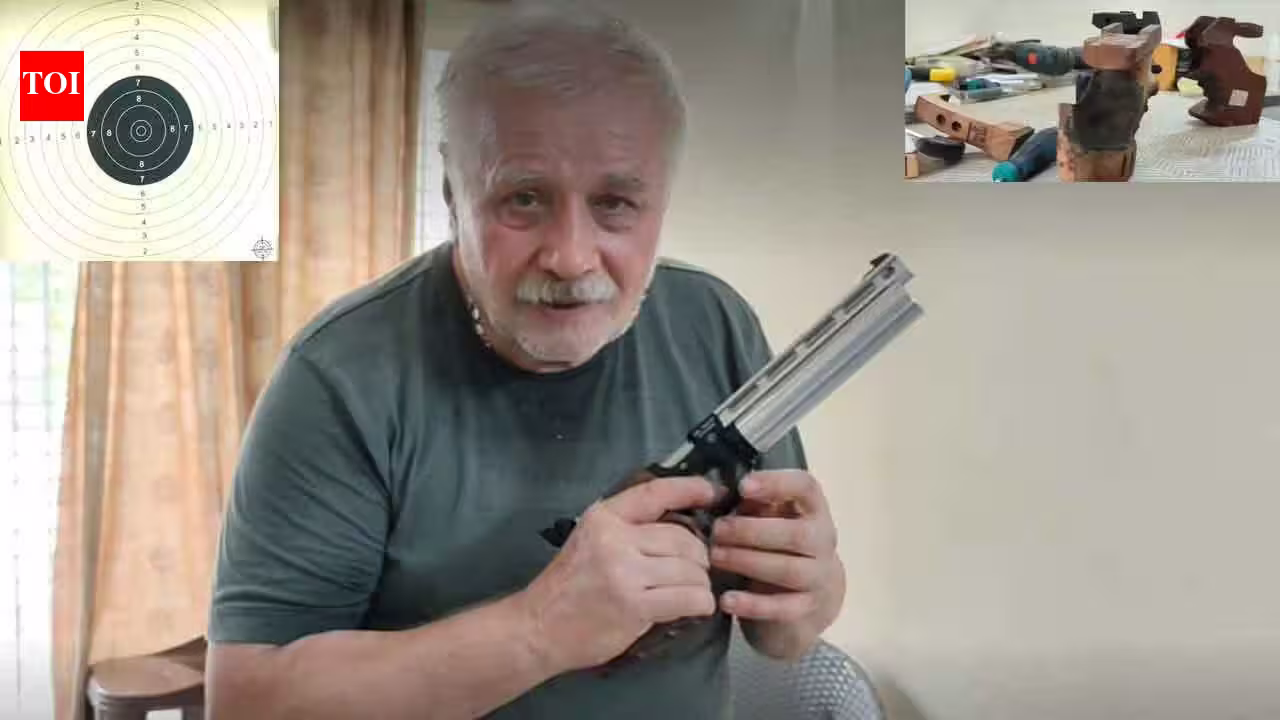
GREATER NOIDA: A fine layer of wooden dust clings to the T-shirt of Yury Lisichko, and bits of sawdust rest on his eyelashes. On his workbench, tools of precision lie scattered alongside freshly carved blocks of wood and disassembled pistol grips. In the corner, a couple of cats weave through the chaos, unbothered by the intense focus of the man sitting at the center of this makeshift laboratory.
This is the sanctuary where India’s elite shooters arrive when they hit the ultimate wall: a weapon that simply refuses to cooperate. For top-tier athletes, the difference between gold and fourth place is measured in millimeters, and Lisichko, the quiet craftsman of Greater Noida, is the man who bridges that gap.
## The Art of the Perfect Fit
When a shooter brings their pistol to Lisichko, they aren’t looking for a quick fix; they are looking for a transformation. The process is intimate and painstaking. Lisichko observes the shooter’s hand, studies the tension in their wrist, and critiques their natural hold. He then goes to work with his wood, shaping, sanding, and refining.
“I know the mentality of every shooter. I speak to them for one or two minutes… that’s it. I get the problem,” Lisichko says, his voice steady over the ambient noise of his workshop. “First, I need to be satisfied and then them. I make grips with a fresh piece of wood. I don’t use old wood or just paste material onto the existing grip. I want these shooters to do well.”
The cycle is relentless: Lisichko modifies the wood, the shooter tests the weapon at a target in an adjoining room, and they return for further adjustments. It is a dialogue between the artisan and the athlete that continues until the grip feels like an extension of the shooter’s own body. It is this dedication that has made him the go-to specialist for some of India’s biggest names, including Manu Bhaker, Anish Bhanwala, Jitu Rai, and Sarabjot Singh.
## From Moscow to Mhow: An Unlikely Journey
Lisichko’s presence in India was never part of a plan to become a grip artisan. His journey began in 2009, when he arrived as a high-level foreign shooting coach. His path to India was as unconventional as his current profession. Following a stint at the European Championships in St. Petersburg in 2007, peers questioned why he wasn’t applying his expertise on the international stage.
Taking the suggestion to heart, he compiled a 200-page CV detailing his education, his technical background from the Moscow Aviation University, and his vast coaching resume. Two years later, a phone call from the Indian Army changed everything.
“That was the first time I heard Indian English,” Lisichko recalls with a laugh. “It was absolutely not understandable. I remember the conversation; I could not understand the accent much. I told them to call me back with someone who speaks good English.”
Eventually, the logistics were sorted. The Indian Defence Ministry signed off on his appointment, and Lisichko found himself in the cantonment town of Mhow, Madhya Pradesh. He admits that his early expectations were colored by stereotypes about wild animals and snakes, but those fears quickly dissolved into a deep appreciation for the country. Over the years, the language barrier—which initially felt like a wall—began to crumble. He picked up Hindi, adapted to local life, and found a rhythm that bridged his Ukrainian heritage, his Russian professional background, and his new Indian reality.
## The Grip Specialist
Lisichko’s transition into “the grip man” was a natural evolution of his technical background. Having studied technology, he found that working with wood to improve shooting ergonomics was the perfect marriage of engineering and sport. His early attempts were disastrous, resulting in ruined grips, but he persisted, learning the nuances of grain, pressure, and anatomy.
“You can buy the same rifle as Abhinav Bindra. You can buy the same pistol as Manu Bhaker or Jitu Rai. You can use the same pellets, the same gloves, everything,” Lisichko explains. “But you can’t shoot with the same grip. Every human hand and the ability to hold something are different. That is why a grip is something that makes a shooter uncomfortable and destroys their focus.”
The demand for his expertise is so high that shooters often stay in his vicinity during the lead-up to major tournaments. Anish Bhanwala, for instance, famously spent an entire day at the workshop ahead of the Asian Games, eventually opting to stay nearby to minimize travel time while Lisichko refined his gear.
For Lisichko, the reward isn’t the public recognition; it is the quiet satisfaction of seeing his work perform on the world stage. “When they win, I silently pat my back, too,” he says. As he brushes the wood dust from his clothes and reaches for another tool, it is clear that for Yury Lisichko, the work is never really done. As long as there are shooters chasing perfection, the light will remain on in his workshop, and the wood will continue to take shape under his expert hand.
Disclaimer: This content is auto-generated for informational purposes only.
Source: Read Original News