









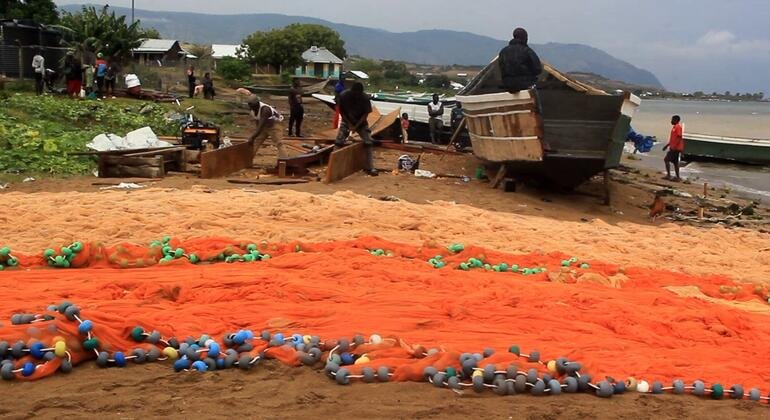
Lake Albert’s Silent Crisis: Community and Government Unite Against Plastic Pollution
KIKUUBE, UGANDA – As the world observes World Lake Day, a sobering reality hangs over the shores of Lake Albert: what is a vital source of life is increasingly becoming a repository for waste. Local leaders and fishing communities are sounding the alarm, warning that unchecked plastic pollution and environmental degradation threaten to collapse the very ecosystem that sustains millions.
For those whose livelihoods are tied to the water, the growing presence of plastic debris is not merely an eyesore—it is an existential threat. Solomon Wamara, chairperson for fishers on Lake Albert, believes the time for complacency has passed.
“It is a good time to highlight the threats facing this lake that is our lifeline,” Mr. Wamara told UN News. “The community cannot continue to view the lake as a source of livelihood while allowing it to be filled with waste.”
The Plastic Scourge
The impact of pollution on Lake Albert is profound. Beyond the visible litter on the beaches, plastic waste enters the water, where it infiltrates delicate fish breeding grounds. The contamination is exacerbated by industrial and agricultural runoff flowing through the Wambaya, Waki, and Nguse rivers, which feed directly into the lake.
According to a 2024 report by the UN Environment Programme (UNEP) and UN-Water, the global situation is dire. Freshwater systems are in decline, with surface water bodies shrinking or disappearing in regions home to over 93 million people. Perhaps most alarmingly, more than a quarter of these water sources are becoming increasingly turbid due to pollution.
A Shared Responsibility
To combat this, Mr. Wamara is calling for a fundamental shift in community behavior. He advocates for the expansion of local sanitation campaigns and urges residents to cease dumping waste directly into water systems. However, he also emphasizes that conservation must be approached with empathy for the local economy.
“Rather than excessively taxing traditional fishers, authorities should help them continue fishing sustainably and within the law,” Mr. Wamara said, noting that conservation efforts are only effective when they support, rather than penalize, those who depend on the lake for survival.
Government Intervention
Godwin Angalia, the Kikuube District Commissioner, recognizes the urgency of the situation. As someone from a fishing background, he views the lake as a pillar of the local economy.
“As a government, we value lakes because they enable the lives of millions of citizens,” Mr. Angalia said. He noted that the administration is actively working to shield critical catchment areas, such as the Bugoma Forest, which plays a vital role in maintaining the lake’s health.
The government has begun establishing indigenous community committees to assist in fisheries management. By empowering those who know the water best, officials hope to curb illegal practices—such as harvesting juvenile fish—and implement more environmentally friendly fishing methods.
Guardians of the Future
Ultimately, the survival of Lake Albert lies in a collaborative model where fishers are treated as partners in conservation rather than mere subjects of regulation. Mr. Angalia emphasized that the community’s intimate knowledge of the lake makes them the most effective guardians of its resources.
As the pressures of human activity mount, the message from the shores of Lake Albert is clear: if the region fails to act, it risks losing its most precious asset.
“If we protect the lake, we protect our lives and the lives of future generations,” said Mr. Wamara. For the communities surrounding this critical freshwater ecosystem, the restoration of the lake is not just an environmental goal—it is a necessity for survival.