






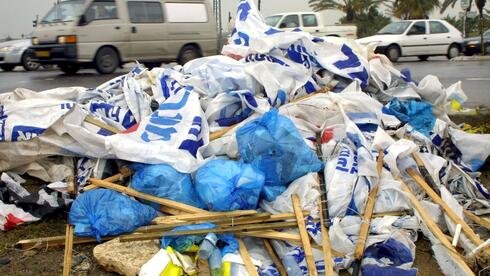
As Israeli citizens prepare to head to the polls later this month to exercise their democratic rights, a significant environmental cost is being paid that rarely enters public discourse. While the Knesset elections are a vital democratic process, the campaign period acts as an engine for massive, short-term waste production, ranging from billboards and plastic-coated flyers to discarded ballot papers and campaign equipment that clutter streets and landfills within hours of the polls closing.
Although no organization currently tracks the precise volume of debris generated, it is estimated that Israeli elections produce thousands of tons of waste. Much of this material is used for only a few days—or even minutes—before becoming an environmental liability.
“There is no ‘polluter pays’ mechanism in Israel, meaning that those who generated this waste are not required to deal with it or remove it,” explains Attorney Meirav Abadi, director of regulation at Adam Teva V’Din (The Israel Union for Environmental Defense). “Currently, the burden falls almost entirely on local authorities, who are responsible for cleaning up the aftermath. The cost of this cleanup is then passed on directly to the public through municipal taxes.”
Abadi argues that the lack of regulation is the primary driver of this systemic issue. Because political parties face no financial or legal responsibility for the materials they distribute, there is little incentive to prioritize sustainable alternatives or to implement post-campaign cleanup strategies.
The digital revolution has offered some reprieve, as parties increasingly pivot toward social media, AI-generated content, and viral video campaigns to reach millions of voters. While this shift reduces the need for physical flyers and traditional posters, experts warn that “digitalization” is not an environmental panacea. The computational power required to store, process, and stream massive volumes of political content—especially with the energy-intensive demands of artificial intelligence—carries its own significant carbon footprint.
“Digitalization is a positive development, but it comes with a hidden cost,” says Abadi. “Data centers require immense amounts of electricity and water to operate. Because this footprint is invisible, unlike the piles of plastic waste on our street corners, we tend to overlook it. However, in the high-stakes world of politics, parties rarely choose one medium over the other; they ‘go all in’ on both digital and physical campaigning, effectively doubling the environmental impact.”
The urgency of the situation is compounded by Israel’s waste management crisis. With approximately 80% of the country’s waste currently funneled into landfills, space is becoming increasingly scarce. The influx of seasonal campaign refuse only accelerates the degradation of these sites.
To combat this, environmental advocates are calling for a shift toward “green elections.” This would involve enforcing standards that require political parties to account for their physical footprint, mandating the use of recyclable or biodegradable materials, and potentially introducing a legislative requirement for parties to fund the cleanup of their own promotional materials.
Ultimately, the responsibility may also lie with the electorate. Environmental issues are rarely central to voter priorities, yet the persistence of election-related pollution is a reflection of society’s broader consumption patterns.
“I would like to encourage every voter to consider the environment when they think about the political process,” Abadi concludes. “We must realize that waste isn’t just an issue to be managed after the fact; it is something we need to prevent from the outset. Our democratic process should be something we are proud of, but it should not come at the expense of the landscape we live in.”
As voters head to the booths, the call to action is clear: the health of the country’s democracy and the health of its environment should be viewed as one and the same. Establishing clear, mandatory procedures for campaign waste management would be a crucial first step in ensuring that the future of Israeli elections is as sustainable as it is democratic.
Prepared by Zavit, the news agency of the Israeli Society of Ecology and Environmental Sciences.
Disclaimer: This content is auto-generated for informational purposes only.
Source: Read Original News