




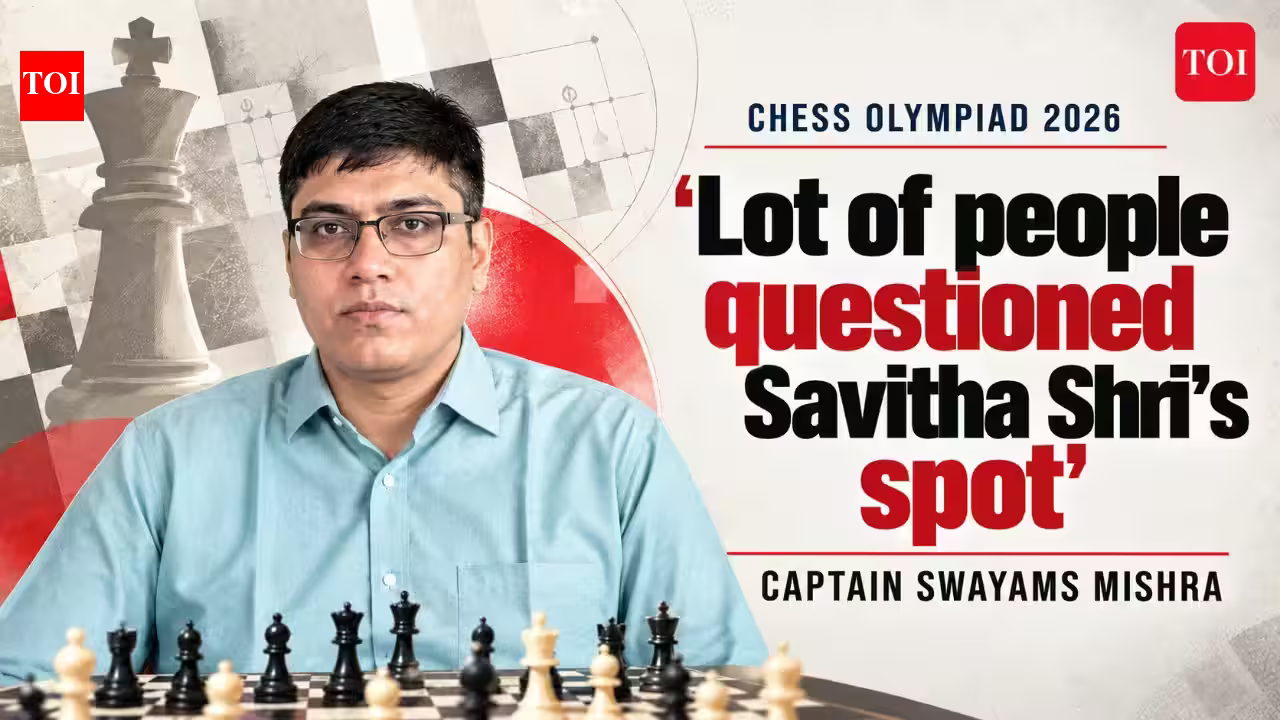
SAMARKAND — In the high-stakes arena of the 2026 Chess Olympiad, India’s path to a bronze medal was paved not just with brilliant tactical maneuvers on the board, but with quiet, tireless support from the sidelines. As the dust settles in Uzbekistan, the focus shifts to the unsung heroics that sustained the team during a grueling campaign, specifically the role of captain Swayams Mishra, whose management style proved as vital as any opening variation.
While the headlines will inevitably focus on the final standings, the narrative within the Indian camp was defined by a collective grit, anchored by 19-year-old sensation Savitha Shri Baskar. As the only Indian player to secure an individual gold medal across both the open and women’s sections, Baskar became the team’s lifeline in moments of dire pressure. Yet, Baskar is quick to point out that her performance was powered by her captain.
“If we wanted something, he was always there, giving us everything—water, bananas, and for me, he was bringing endless coffees because I played till the last moment, making sure that I ate properly and got energy,” Baskar said, reflecting on Mishra’s impact. She didn’t hesitate to label him the “best captain ever,” citing his dedication to ensuring her focus remained exclusively on the 64 squares.
The coffee, the bananas, and the weight of the sidelines
For Mishra, stepping into the captain’s chair for a full tournament was a baptism by fire. Having assisted in previous years, the 2026 Olympiad marked his first time leading the squad in every match. “The emotions are completely different compared to when you are outside,” Mishra admitted in an exclusive interview with TimesofIndia.com. “You see a player making a mistake, and you want to do something, but you cannot; you just have to wait for it to unfold naturally.”
Mishra’s philosophy was built on removing the logistical friction that plagues elite athletes. By managing the minutiae of nutrition and energy, he allowed his players to enter a “flow state” without the distraction of physical exhaustion. Viewers watching the live broadcasts were often treated to glimpses of this, as water bottles and snacks materialized exactly when the tension on the board reached its peak.
Virtual camps and logistical hurdles
The road to Samarkand was anything but smooth. Before a single move was made, Mishra and the All India Chess Federation (AICF) faced the immense challenge of coordinating a team with disparate, high-pressure schedules. With in-person training impossible, the team transitioned to an intensive series of virtual camps.
“It was a project in itself,” Mishra noted. “We had to organize camps where we could find common timing for everyone.” Even after arriving in Uzbekistan, the team was forced to navigate the unpredictable landscape of a major international event, dealing with accommodation issues and suboptimal food options. According to Mishra, the intervention of AICF president Nitin Narang and HOD Abhijit Kunte proved decisive, ensuring the squad maintained its routine and morale through the persistent support of familiar, home-style food.
The Vaishali decision and team management
A captain’s mettle is truly tested by the difficult choices, and none were harder than the rotation of the squad. Mishra faced intense scrutiny regarding his usage of R. Vaishali, the Women’s World Championship challenger, who struggled to find her rhythm, finishing with a 2.5/6 score.
“It was a very hard call,” Mishra explained. “When one of your top players isn’t in form, but others are performing very well, you have to prioritize the match results.” Despite her form, Mishra remained a staunch defender of Vaishali’s professionalism. “We had a discussion, and she wasn’t thinking about the World Championship; she wanted to give her best for India. I think she is strong enough to bounce back.”
Board-by-board resilience
Mishra provided a candid breakdown of the team’s performance, highlighting the milestones and the heartbreaks:
- Humpy Koneru: “Her best Olympiad,” according to Mishra. Her undefeated run on the top board and bronze medal performance provided the bedrock of stability India needed.
- Divya Deshmukh: Emerging as a pillar of strength, Deshmukh rebounded from a difficult pre-tournament stretch to become an engine of efficiency, often delivering critical early wins.
- Savitha Shri Baskar: Despite outside criticism regarding her selection, Baskar proved the doubters wrong. Mishra noted that while her consistency fluctuated in later rounds, her ability to flip the script in the final hour of play was the defining factor in India’s medal run.
Looking ahead: The standard is gold
As the team departs Samarkand with bronze in their luggage, the prevailing mood in the Indian camp is one of quiet dissatisfaction—not because they failed, but because they know they are capable of more.
“We are not satisfied,” Mishra admitted bluntly. “The color of the medal would have been different, and we would have been much happier.” He views this campaign as a wake-up call for the state of women’s chess globally, pointing to the rise of underdog nations like Mongolia and Greece as evidence that the “smooth sailing” of past years is over.
For India, the 2026 Olympiad was a test of character. It was a tournament where they were often on the back foot, relying on the persistence of a 19-year-old prodigy and the constant, caffeine-fueled vigil of their captain. They may have walked away with bronze, but the message from the team is clear: next year, they aim for the top of the podium.
Disclaimer: This content is auto-generated for informational purposes only.
Source: Read Original News