







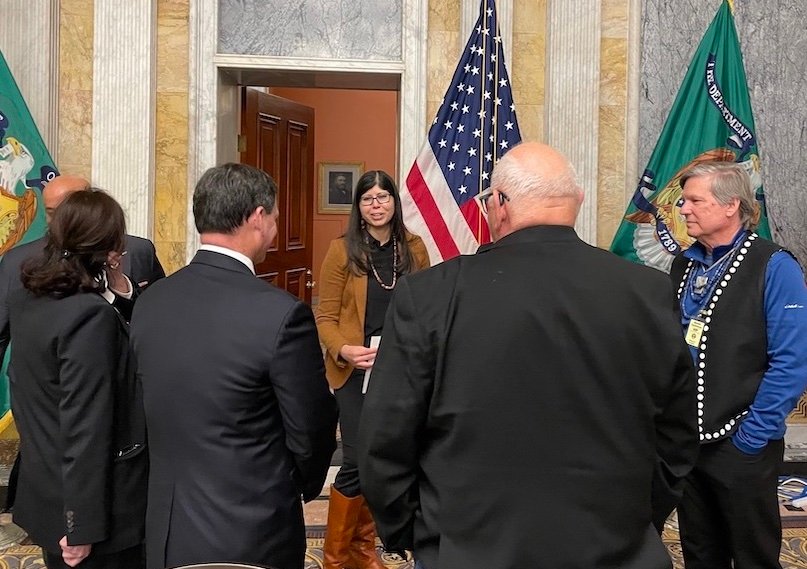
Fatima Abbas, a prominent figure in federal-tribal relations, has officially departed the U.S. Treasury Department to join the Federal Government Affairs Practice Group at the global law firm Holland & Knight. Based in the firm’s Washington, D.C. office, Abbas brings an extensive background in policy and economic development to the private sector, signaling a significant shift in the landscape of tribal advocacy.
Abbas, a citizen of the Haliwa-Saponi Indian Tribe, served as the inaugural director of the Treasury’s Office of Tribal and Native Affairs. During her five-year tenure at the department, she played a critical role in bridging the gap between federal administrative goals and the specific economic needs of sovereign tribal nations.
## A Legacy of Policy Innovation and Implementation
Abbas’ time at the Treasury was marked by major milestones in fiscal policy and federal oversight. Notably, she managed the implementation of $30 billion in critical funding allocated for tribes and Alaska Native corporations. Her efforts extended to complex regulatory landscapes, where she was instrumental in finalizing two landmark tribal tax regulations in 2025—rules that provided much-needed clarity on tax-exempt bonds and the tax treatment of tribal entities.
Her work, which spanned the latter portion of the Trump administration and the entirety of the Biden administration, was noted for providing rare institutional continuity. As former U.S. Treasurer Marilynn “Many Hearts” Malerba observed, Abbas was pivotal in ensuring that tribal feedback did not merely stay in the consultation phase but was successfully woven into the actual rulemaking process.
## Modernizing Tribal Engagement with Digital Tools
While the Treasury’s work remains deeply rooted in traditional legislative and tax processes, the office’s function increasingly intersects with the tech-forward demands of modern governance. Tribal governments today rely on sophisticated data analytics, secure digital infrastructure, and AI-driven insights to manage federal funding and regulatory compliance.
The transition toward digital-first government services is reshaping how the Office of Tribal and Native Affairs operates. As the Treasury continues to manage the complexities of tribal tax and financing issues, the integration of advanced software—potentially incorporating AI-assisted data processing for auditing and grant reporting—has become a priority. Tech-forward approaches are being used to streamline the way tribes interact with the Treasury, reducing the administrative burden that has historically hindered tribal economic development.
Holland & Knight’s decision to bring Abbas into their fold highlights the growing demand for expertise that merges traditional law with modern policy implementation. As companies and governments increasingly utilize AI to navigate tax codes and federal funding programs, Abbas’ expertise will likely serve as a bridge for tribal entities looking to leverage emerging technologies to bolster their fiscal sovereignty.
## Continuity and Future Leadership
With Abbas’ departure, the Treasury has initiated a transition plan to maintain the momentum of the Office of Tribal and Native Affairs. Jennifer Parisien, a citizen of the Turtle Mountain Band of Chippewa Indians, has been appointed as the acting director. She will work alongside James Colombe, a citizen of the Rosebud Sioux Tribe, to ensure that ongoing projects—such as navigating the evolving tax treatment of tribal entities—remain on track.
The Treasury is reportedly looking to fill the leadership vacancy permanently as it continues to refine its approach to tribal consultation. As these government offices update their digital infrastructure and internal processes to meet the demands of the modern economy, the leadership in this space will be tasked with balancing legislative compliance with the rapid pace of technological change. For tribes and Native organizations, the shift represents a critical period of adaptation, where both legal representation and the mastery of modern financial tools will define their success in the federal landscape.
Disclaimer: This content is auto-generated for informational purposes only.
Source: Read Original News