









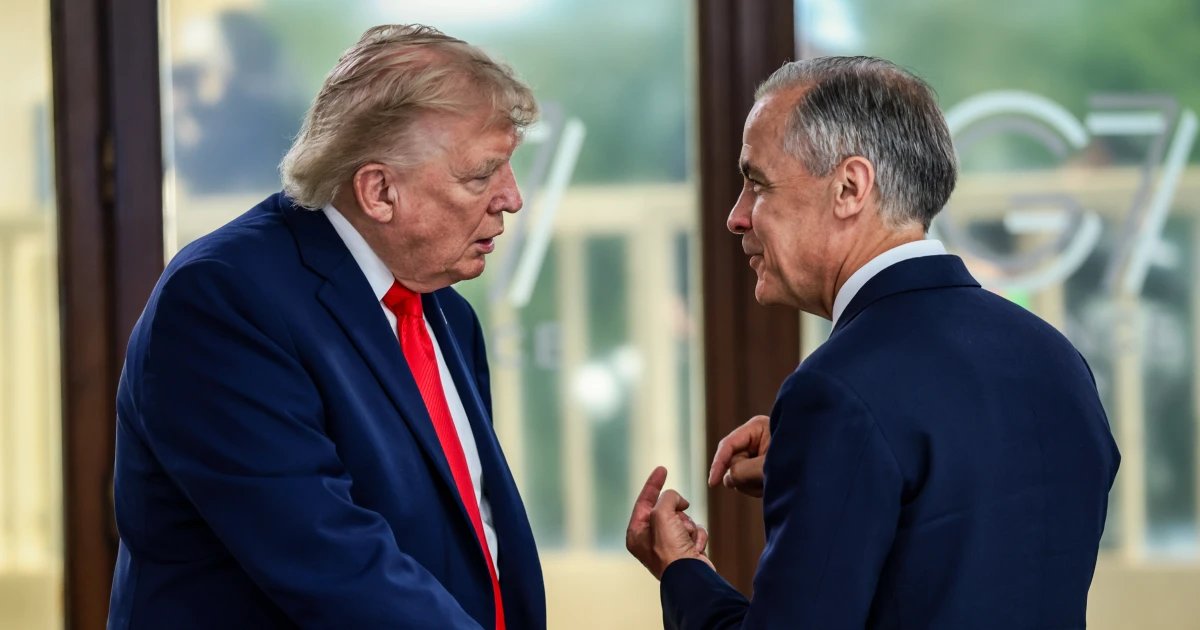
Trump Halts Imminent Canada Tariffs, Citing "DEAL!" and Keystone XL Revival
WASHINGTON D.C. – In a dramatic late-night development, President Donald Trump has temporarily suspended a wave of steep tariffs that were poised to impact an estimated $20 billion worth of U.S. imports from Canada, just hours before they were scheduled to take effect. The eleventh-hour reprieve comes as both nations announce a provisional trade agreement, with the President hinting at a surprising revival of the controversial Keystone XL pipeline project.
Taking to social media on Tuesday evening, President Trump declared: “I have paused the 50% Tariffs against Canada, that were scheduled to kick in tomorrow morning for a three day period, based on the fact that Canada and the U.S.A., subject to the finalization of documents, have a DEAL!” While specific details remained scant from the President, he notably referenced the Keystone XL pipeline, stating it "may be awoken from the grave!"
The Office of the U.S. Trade Representative (USTR) corroborated the news in a separate social media post, offering a glimpse into the agreement’s scope. The USTR stated that the deal "will include comprehensive market access for all American goods, economic security commitments, digital trade alignment, and many important provisions that will continue to protect our market and American workers, along with our Canadian partners."
Canadian Prime Minister Mark Carney confirmed the tariff postponement, specifying that the suspension would last until the end of Friday. In a statement, Carney acknowledged that "Substantial progress has been made, although there is important work still to be done." He emphasized that the intensive discussions were aimed at "deliver[ing] greater certainty and real benefits for Canadian businesses, workers, farmers and families."
The threatened 50% duties, which would have represented the first application of Section 338 of the Tariff Act of 1930, were set to impact a wide array of Canadian products. From hockey sticks and certain building materials to liquors and various clothing items, the import taxes were designed to exert significant economic pressure. This rarely used provision empowers the White House to impose duties of up to 50% on any foreign trading partner deemed to be "discriminating" against U.S. commerce.
The breakthrough follows more than a week of intense, often fraught, negotiations between the two neighboring nations. Prime Minister Carney had characterized the talks with the Trump administration as "very delicate and intense" just a day prior, with both leaders engaging in discussions late Monday and again on Tuesday evening.
Previously, Carney had staunchly argued that the proposed tariffs constituted a "direct violation" of the U.S.-Canada-Mexico Agreement (USMCA), a trade pact championed and signed by President Trump during his initial term. The U.S. Chamber of Commerce had also sounded the alarm, warning that a failure to reach an agreement would "damage both economies, drive up costs for U.S. families, further disrupt critical supply chains, and risk the 13 million American jobs that depend on" the North American trade alliance.
Beyond seeking the complete rescission of the Section 338 tariffs, Canadian officials were reportedly pushing for a reduction in existing Section 232 tariffs on industrial products like steel and aluminum, according to reports from CBC News and Bloomberg. The Chamber of Commerce echoed this sentiment, asserting that lower duties on Canada would be "a boon to U.S. consumers, producers, farmers and manufacturers."
A key sticking point in the recent negotiations appeared to be the contentious issue of automobile duties. While reports from Bloomberg and Reuters indicated that U.S. officials were unwilling to reduce the current 25% tariffs on that sector below 15%, President Trump’s brief social media announcement did not clarify whether such duties would be lowered in the new agreement.
U.S. Trade Representative Jamieson Greer had previously articulated that the rationale behind the threatened 50% duties was a direct response to Canada’s retaliatory measures against previous tranches of Trump’s tariffs. Greer stated last week, “I’ve got two countries in the world that have retaliated against the United States for trade measures: the People’s Republic of China and Canada. That’s not the kind of company you really want to be running in.”
This incident is not the first time President Trump has aimed his trade-related ire at Canada. In a notable past instance, he became enraged by an advertisement run by the province of Ontario during the 2025 World Series telecasts. The ad, which utilized edited clips of former President Ronald Reagan to criticize Trump’s trade policies, led to a halt in trade talks and accusations of interference in Supreme Court deliberations, a ruling that ultimately found he had overstepped his legal authority. Although Trump threatened an additional 10% tariff on Canada following the ad, he never followed through, and Ontario subsequently pulled the advertisement.
As both nations work to finalize the details of the agreement over the coming days, the temporary halt in tariffs offers a glimmer of hope for stability in the often-turbulent trade relationship between the United States and Canada. The mention of the Keystone XL pipeline, a project fiercely opposed by environmental groups but championed by some as a symbol of energy independence, adds another intriguing dimension to this evolving geopolitical landscape.