







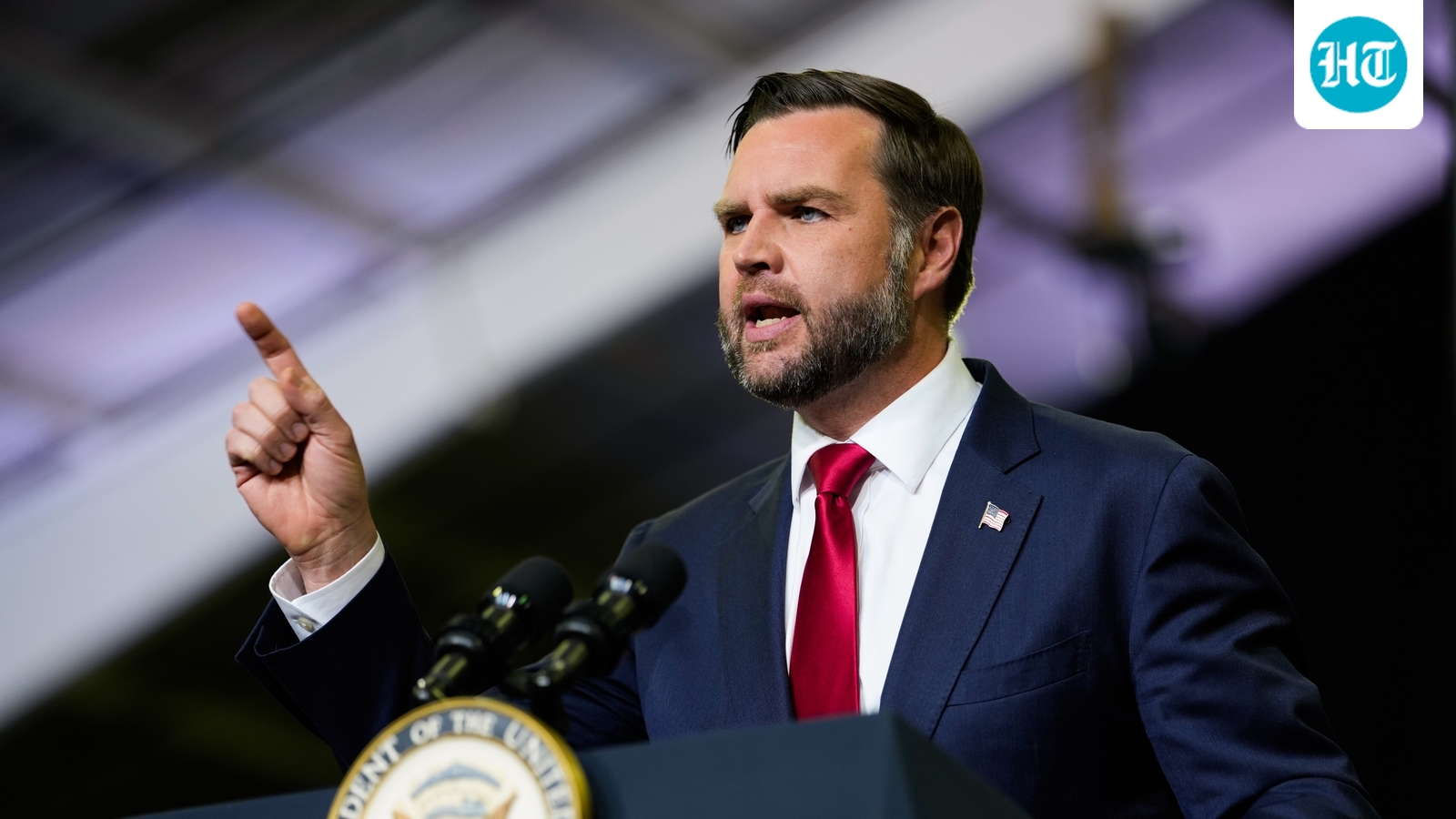
US Vice President JD Vance Clarifies ‘Indentured Servants’ Remark Amid Growing Tension Over Green Card Curbs
US Vice-President JD Vance has sought to temper the controversy surrounding his recent characterization of H-1B visa holders as “foreign indentured servants.” Facing widespread backlash—including official condemnation from New Delhi—Vance attempted to recalibrate his stance by emphasizing the importance of balancing American economic interests with a welcoming immigration policy.
The clarification follows a period of heightened friction between the Trump administration and major global tech firms. Earlier this month, the administration imposed a suspension on several high-profile companies, including industry giants like Microsoft, Infosys, TCS, Wipro, HCL, and Cognizant, from the Permanent Labor Certification Program (PERM). As the initial hurdle for obtaining a green card, the suspension effectively halts a critical pathway for thousands of skilled professionals to transition into legal permanent residency.
Personal Ties and Political Rhetoric
Addressing the firestorm created by his choice of words, Vance invoked his personal life to bridge the divide. He spoke fondly of his in-laws, who emigrated to the United States from South India, and highlighted his marriage to Usha Vance, the current Second Lady.
“You know where my family comes from, and I love my mother-in-law and father-in-law,” Vance stated during his address. By grounding his defense in his own familial experiences, the Vice President attempted to distance his policy agenda from personal animus toward immigrant communities. He acknowledged that his previous rhetoric might have been “imperfect,” yet insisted that his primary goal remains the protection of the American labor market.
The Push for a Balanced System
Vance articulated that the current immigration framework requires a structural adjustment to prioritize domestic workers. He argued that large, trillion-dollar corporations should not utilize visa programs to displace local talent.
“If you are a major corporation and you bring in someone, perhaps an accountant, and claim you cannot find that skill set within your existing labor pool, while simultaneously firing an accountant already on the payroll, that is not fairness,” Vance explained. He contended that such practices disadvantage both the immigrant worker, who is tied to a specific firm, and the American worker, whose job security is compromised.
For Vance, the objective is to cultivate an environment that respects global talent while ensuring that immigration does not come at the expense of local employment stability.
India’s Stance on the Policy Shift
The rhetoric employed by the Trump administration has been met with firm resistance from the Indian government. New Delhi has officially labeled the “indentured servants” comparison as deeply offensive and factually inaccurate, noting that it ignores the massive contributions Indian professionals have made to the US innovation ecosystem.
The Indian Ministry of External Affairs emphasized that Indian professionals in the United States are highly skilled, educated contributors who have been instrumental in driving the US economy. Officials in New Delhi further expressed concerns that the freeze on PERM filings contradicts the long-term, mutually beneficial strategic goals shared by the two nations.
As the debate continues, the Biden-Trump administration’s move has cast a shadow of uncertainty over the IT sector, which relies heavily on the mobility of global talent. While Vance seeks to frame this as a “fairness” issue, the diplomatic and economic ramifications suggest that the path toward a balanced immigration system remains complex and fraught with tension.
Disclaimer: This content is auto-generated for informational purposes only.
Source: Read Original News