






Viral Video Falsely Claims Quran Burning by Hindu Activists in India
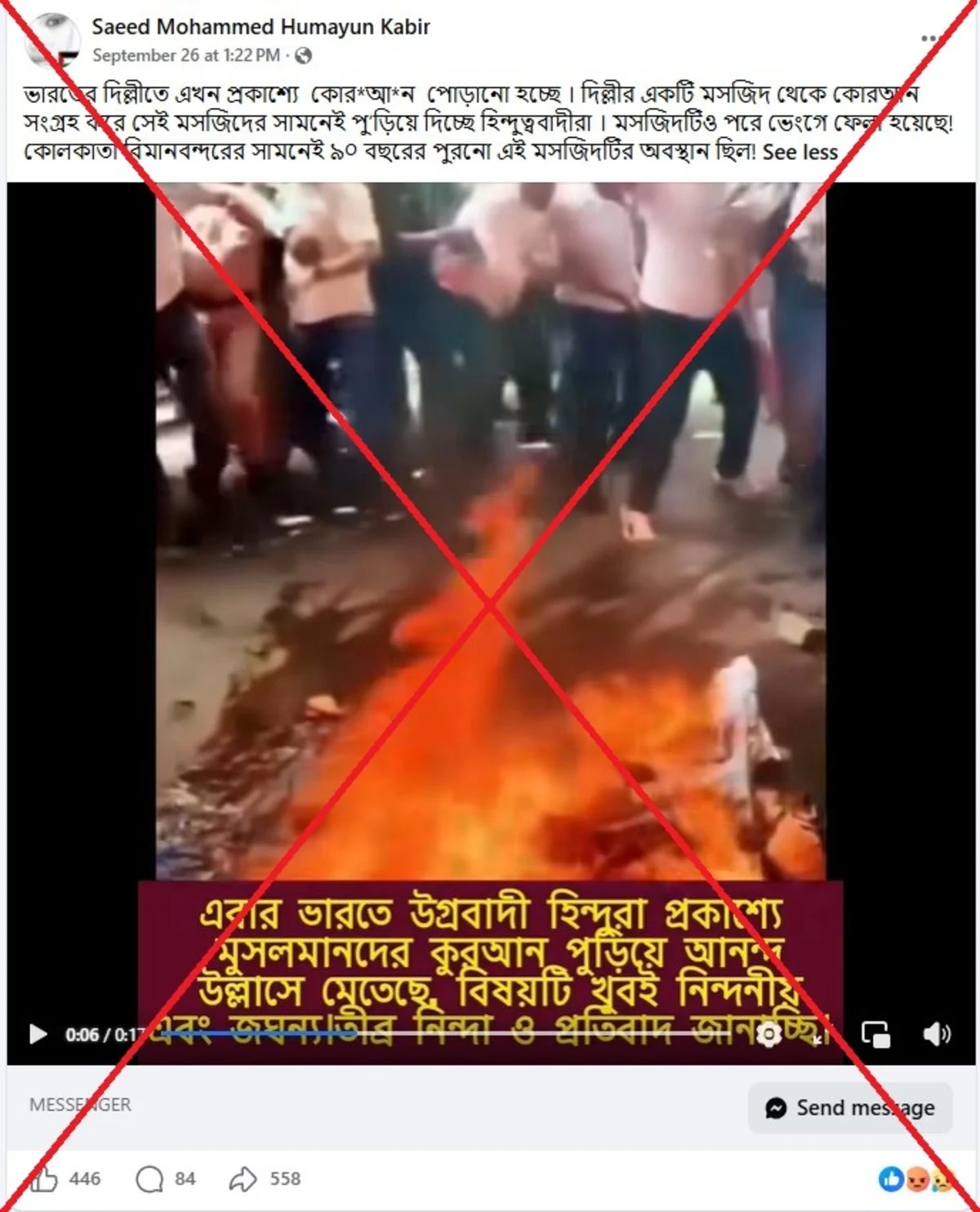
A misleading video circulating on social media in Bangladesh has ignited false claims regarding religious intolerance in India. The footage, which spread rapidly in late September 2026, purports to show Hindu activists burning a copy of the Quran outside a mosque in Delhi. The inflammatory post suggested that the act of desecration was followed by the demolition of the religious site, fueling anger across digital platforms.
However, fact-check investigations have confirmed that the video is entirely unrelated to any act of religious hatred. The footage, in reality, captures a political protest in the state of Himachal Pradesh, where members of the Bharatiya Janata Party’s (BJP) youth wing were burning an effigy of the state’s Chief Minister, Sukhvinder Singh Sukhu.
Deceptive Narrative Amid Communal Tensions
The false narrative gained traction during a sensitive period in India, occurring shortly after the demolition of several mosques across different states. In late September 2026, the Medina Mosque in Delhi’s Shalimar Bagh was torn down as part of a local road-widening project. The incident drew significant criticism from political figures, with some labeling the action unconstitutional and expressing outrage that the mosque’s management was denied time to secure religious artifacts, including copies of the Quran.
Capitalizing on these genuine grievances, social media users manipulated the existing political video, superimposing Bengali-language text that accused “extreme Hindus” of burning the Quran. The video features individuals wearing saffron scarves—a color often associated with the BJP—cheering around a bonfire, a sight that was mischaracterized as an act of communal violence.
Exposing the Truth Behind the Footage
A technical analysis using reverse image searches revealed that the clip originated from an August 25, 2026, protest in the city of Mandi, Himachal Pradesh. The original footage, shared by local leaders of the Bharatiya Janata Yuva Morcha (BJYM), shows activists protesting against the Congress-led state government. The demonstrators were specifically expressing their dissatisfaction with the Chief Minister over unmet election promises, particularly regarding youth employment.
Yograj Dogra, the district president of the BJYM in Mandi, confirmed that the demonstration involved the burning of an effigy of the Chief Minister to signify political dissent. He explicitly stated that there was no incident of religious literature being burned during the protest. Visual comparisons between the viral video and the original footage clearly show the same individuals in both clips, further debunking the malicious claim.
The rapid spread of this misinformation highlights the ongoing challenge of digital propaganda in South Asia. By repurposing political protest footage to simulate religious conflict, malicious actors have sought to exploit existing communal fractures. This incident serves as a stark reminder of how decontextualized imagery can be used to incite instability, as verified reports continue to emphasize that the burning of a Quran did not occur at the protest in question. As authorities and fact-checkers work to stem the tide of such misinformation, the event underscores the necessity for caution when encountering inflammatory viral content.
Disclaimer: This content is auto-generated for informational purposes only.
Source: Read Original News