



There’s another cultural aspect to this, which I think one should pay attention to. The B.J.P.’s mother ship is the Rashtriya Swayamsevak Sangh (R.S.S.), a Hindu nationalist organization. Shaping the nation is a very important ideological goal, and they’ve always felt that they’ve lost out to the secularists, the post-independence leaders who set India on this secular path.
Right, the R.S.S. is the ideological backbone of the B.J.P. and Modi himself, and of the Hindu right in India going back all the way to before independence.
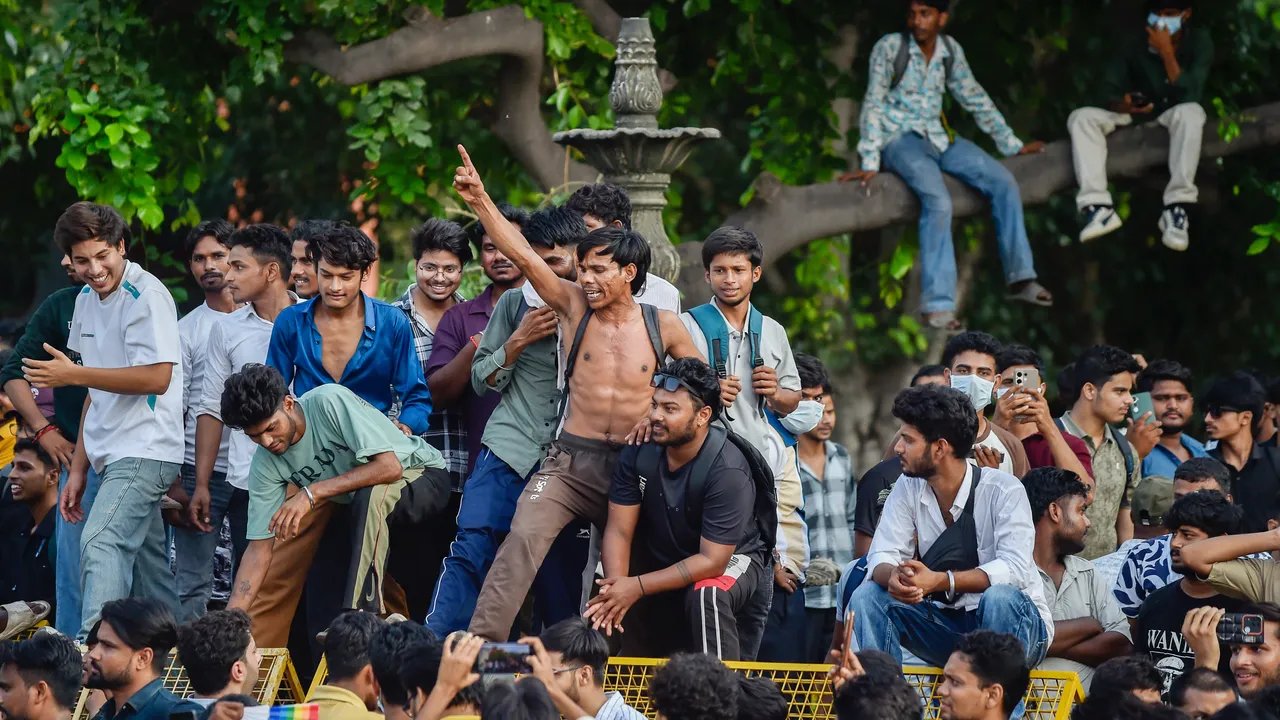
Exactly. And while the R.S.S. say they cannot have any formal power in the government, because they say that they’re an N.G.O., what they want is to shape India in the way that they see fit, which is to make it more Hindu, and the way to do that is to shape education. So you’ve had the B.J.P. allegedly appoint several R.S.S. functionaries within higher education. You’ve had this whole push to change textbooks, and dictate what can and can’t be taught in schools, and as a result what you’ve seen on campuses in India is a massive crackdown on dissent, on free speech, on progressive thought. It is so ironic that these protests came to Delhi, because for the last year or two my news site has been extensively covering a complete crackdown on dissent on campuses. So I think you also have to look at this moment, in part, being about young people not having the space to do basic things.
Some of the news coverage here in the West has implied that the protests mean Modi is increasingly unpopular or weak. We don’t have a lot of polling data. But from the polling data we do have it seems Modi is in fact popular. When you look at state elections in India, even in places that historically have been very inhospitable to the Hindu right, Modi’s party is doing extremely well. Now, some of these elections have “irregularities,” which should be noted, but I’m trying to understand the paradox, because it does seem to me that the way these protests have taken off suggests discontent about the government, but, electorally, the B.J.P. still seems strong.
In the 2019 general election, the B.J.P. won three hundred and three out of five hundred and forty-two seats in the lower house of Parliament. The number of people who voted for his party, percentage-wise, was around thirty-seven per cent. So you still have a vast segment of India that did not vote for Modi’s party, right?
Now, typically, what should happen is that the people who have not chosen Modi should have an outlet to share their views. But in India we’ve seen a systematic breakdown of that outlet. Mainstream media played that role very well for a very long time in India, and could mirror the dissatisfaction that people had. But lately the people who didn’t vote for the B.J.P. don’t hear their voices anywhere. If you switch on the mainstream television news in India, it’s just about how great everything is, how amazing Modi is, and anyone who thinks otherwise is called anti-national. Any sort of protest is shown as evil, or it’s a plot by the C.I.A., or it’s a plot by Pakistan. So I think one of the ways to understand this outburst is that the portions of the country that did not vote for Modi have not had outlets for a very long time that allow them to come out and express themselves. When I went to the protest site, sure, there were students who were really concerned about exams and their future, but there were also a lot of people who came out just to say that, Hey, it’s O.K. to protest. You know, we can say we don’t like this government. Why are we demonized by the mainstream media, and why are opposition M.P.s routinely demonized on mainstream news?
So this became, like, a collective therapy session for everyone unhappy with the government. Because they haven’t had that space anywhere else. You don’t even have any debates in Parliament anymore.
Donald Trump got forty-six per cent of the vote the first time, which is more than Modi won, but I don’t want people thinking that Modi is as unpopular as Donald Trump is, because I don’t think that that’s true, even if he gets a smaller percentage of the vote. I do think that it’s fair to say that Modi has been a pretty popular leader, and his party’s been enormously successful over the past dozen years.
For sure. And the issue of education unites everyone—I met a lot of B.J.P. supporters in these protests, too. They would say they voted B.J.P., and worked for the Party, and support Modi, but also think the situation is really hard for kids. I don’t think we can look at this and say everyone hates Modi, or that he’s unpopular, or that he is going to lose upcoming elections. But there really has been such a crackdown on voicing anger with the government, and the result is that young people have spilled onto the streets.
Yeah, an Indian friend suggested to me that there was also something about how, over Modi’s tenure, the degree to which the media has gotten so tightly controlled means that this level of protest, when it became visible, shocks people and leads to even more excitement. Do you think this is also a media story?
Yes, exactly. I think the traditional role for the media has been to show some of the anger that people feel, and, because it’s failed to do that, you’ve had this explosion of anger onto the streets. If you look at the coverage of this protest itself, when there was a very intense police crackdown, you had police using tear gas and pellet guns. But you didn’t see any of that on television news. It was a complete blackout. The only news that channels were running was that mobs and rioters had taken over the streets, and attacked the police.
I’ve been covering the media for a very long time, and I see increasingly, even among B.J.P. supporters, that they are very unhappy with the media coverage, because they feel as if it doesn’t tally with their real life. So you could be a B.J.P. supporter, but it’s becoming increasingly difficult for you to run your household on the money that you’re making. And that concern is not shown anywhere in the media. The channels you switch on, you’re told everywhere that India is a world leader, America loves Modi, Modi’s making us the strongest nation in the world: everything is great. So I think there is this sense among people that pain points aren’t being reflected enough in the media. And now that irritation has been transferred to the government, because I think people, today, see television media and government as part of the same arm. They see the media as an extension of the government, of the establishment. You have had anchors getting heckled because they became the faces of an uncaring establishment.