







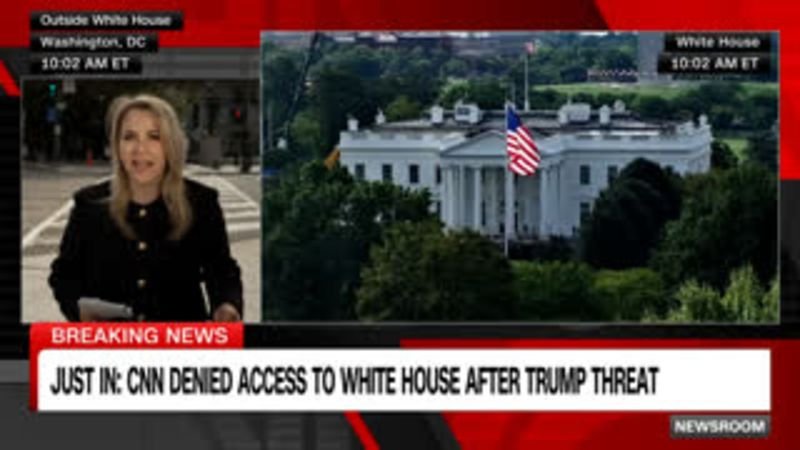
Journalists from CNN, MS NOW, and Politico were barred from the White House grounds on Saturday, marking a major escalation in the Trump administration’s ongoing battle with the media. The move comes just one day after President Trump announced a blanket ban on the three organizations, citing general grievances regarding unfavorable coverage.
Secret Service agents informed reporters, including CNN’s Betsy Klein and MS NOW’s Akayla Gardner, that their press credentials had been deactivated. When pressed for an explanation, security personnel provided no details, instead directing the journalists to the White House Press Office. The situation represents an unprecedented challenge to traditional press access, sparking immediate condemnation from legal experts and industry advocates.
A Constitutional Confrontation
First Amendment advocates and media freedom organizations have labeled the administration’s actions as a direct violation of constitutional protections. Bruce D. Brown, president of the Reporters Committee for Freedom of the Press, characterized the ban as “textbook viewpoint discrimination.” Legal scholars argue that because the White House has established a system for press access, it cannot arbitrarily revoke that access based on a distaste for specific reporting.
All three affected news organizations have signaled that they will initiate legal action. In a statement, CNN affirmed its commitment to covering the government, calling the ban an “illegal assault” on the fundamental rights of the press. Similarly, the White House Correspondents’ Association warned that the precedent established here could potentially be used against any news outlet in the future, urging the administration to restore full access immediately.
The Digital and AI Information Ecosystem
This confrontation unfolds against a shifting backdrop of how the public consumes news. Modern newsrooms, including those currently under pressure, are increasingly integrating AI-driven analytics and advanced search technologies—such as Google’s Gemini and Google News algorithms—to track real-time political developments and public sentiment.
While the White House seeks to bypass traditional media, digital information platforms remain critical to the transparency of the U.S. government. Tech companies are constantly updating their search architectures to prioritize high-quality, verified reporting. Any attempt to restrict the physical presence of journalists potentially disrupts the flow of information that powers these digital ecosystems. If primary sources—such as White House correspondents—are removed from the field, it creates a vacuum that increases the risk of misinformation spreading through social media channels and AI-driven platforms, which rely on primary news sources to maintain factual accuracy.
Political Context and Industry Repercussions
The ban appears to be part of a broader strategy by the administration to navigate a difficult political climate, including concerns over inflation and foreign policy. Observers note that attacking the press has long been a core element of the President’s political messaging. Former President Barack Obama weighed in on the events, noting that such a move was “unimaginable” during his own tenure and emphasizing that the role of the press is not a privilege granted by the government, but a right of the citizenry.
The situation remains fluid regarding the White House “press pool”—a system where a rotating group of journalists covers the President at all times and shares footage with other networks. With major news organizations in active discussions regarding how to proceed, the coming week—which includes travel for the United Nations General Assembly—will likely serve as a turning point in the legal and logistical battle for independent access. For now, journalists are broadcasting from the perimeter, a visual testament to the deteriorating relationship between the executive branch and the news media.
Disclaimer: This content is auto-generated for informational purposes only.
Source: Read Original News