







Operation Economic Outcast: The US Bid to Systematically Isolate Iran
By [Author Name]
Published: August 25, 2026
In a sweeping move to recalibrate global geopolitical dynamics, United States Treasury Secretary Scott Bessent has announced “Operation Economic Outcast,” an aggressive new sanctions regime designed to sever Iran’s remaining lifelines to the global financial system.
The initiative targets nearly 60 individuals, entities, and vessels, significantly expanding the scope of secondary sanctions to encompass shipping, gold, aviation, advanced technology, and digital assets. According to Secretary Bessent, the objective is absolute: to insulate the Iranian economy from the world stage until the government in Tehran is left without the resources to sustain its current trajectory.
As President Donald Trump engages in high-level diplomacy to pressure world leaders into cutting ties with the Islamic Republic, the global community is grappling with the reality of what such an isolation strategy entails. To understand the stakes, one must look at the trading partners that have historically sustained Iran’s economy.
Export Dependencies: The Asian Pivot
Following two decades of Western sanctions, Iran has pivoted its export economy toward Asian and regional markets. In 2024, official customs data indicated that Iran exported $56 billion in goods to 112 countries.
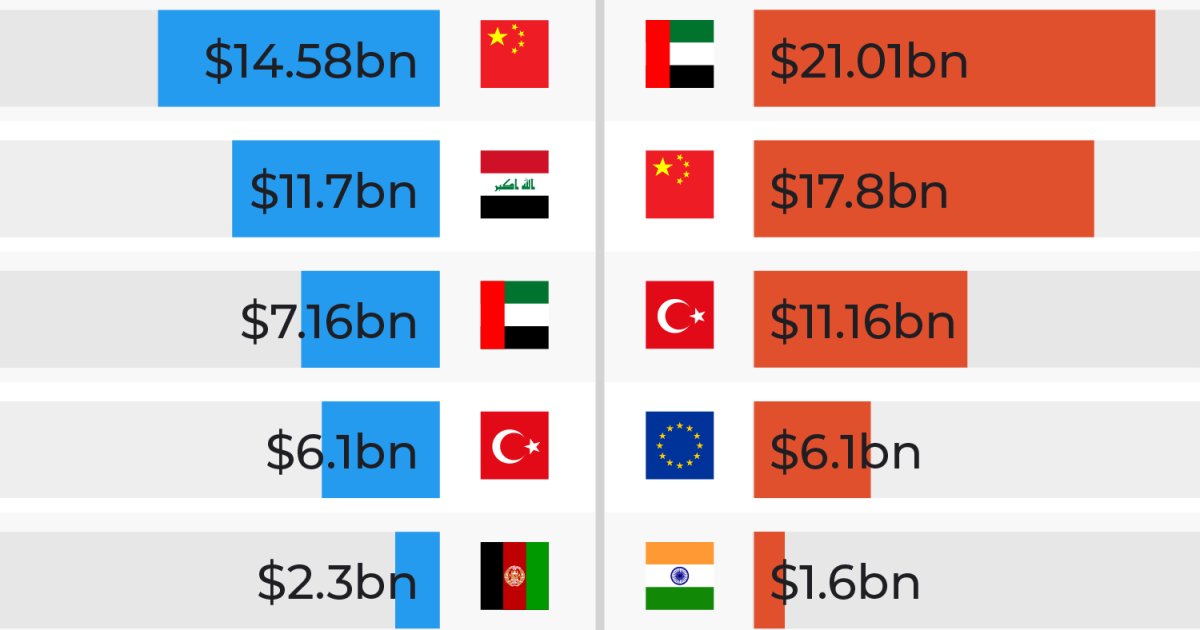
- China ($14.58bn): As the primary purchaser of Iranian crude, China remains Tehran’s most critical economic pillar. Much of this trade occurs via a “shadow fleet” of tankers, allowing the movement of discounted oil that remains largely invisible to formal customs reporting.
- Iraq ($11.7bn): A vital regional partner, Iraq relies on Iranian gas for electricity generation. Iran also serves as a key supplier of food, building materials, and manufactured goods to its neighbor.
- UAE ($7.16bn): Long acting as a regional hub for re-exports, the UAE has served as a critical financial gateway. However, this relationship has recently suffered a major rupture following a sudden, indefinite trade embargo imposed by Abu Dhabi last week in response to alleged Iranian missile attacks.
- Turkiye and Afghanistan: Both nations remain essential partners for the export of energy and consumer goods, relying on established pipeline infrastructure and overland supply routes.
Import Vulnerabilities: Losing the Lifeline
Iran’s import sector, totaling $68.5 billion in 2024, reflects the extent to which the country has been forced to rely on intermediaries to access global technology and consumer goods.
The UAE previously stood as Iran’s largest source of imports, accounting for over 30 percent of the total. By re-exporting Western-made machinery, electronics, and technology, the UAE provided Tehran with an indirect link to global markets. With the imposition of the new trade embargo, this vital conduit has effectively been severed.
China has stepped into the void as the primary supplier of industrial components, vehicles, and electronics, while Turkiye remains a critical overland conduit for machinery and chemicals. Meanwhile, European Union trade—once a robust partner—has dwindled to a fraction of its pre-2018 levels, now limited largely to essential items like pharmaceuticals and medical equipment.
The Path Ahead
The effectiveness of “Operation Economic Outcast” depends largely on the success of the US diplomatic offensive. With the UAE already implementing a trade freeze and China serving as the primary buyer of otherwise sanctioned crude oil, the global economic map is being redrawn in real-time.
As Secretary Bessent pushes for the complete isolation of Tehran, the cost to regional stability and the future of global supply chains remains a subject of intense concern for analysts and policymakers alike. For now, the world waits to see which nations will bow to US pressure and which will attempt to maintain the fragile, often clandestine, trade relationships that keep Iran’s economy afloat.