








Reliving a Legend: Driving Top Gear’s Indestructible Arctic Toyota Hilux
Published: 20 Aug 2026
Not all heroes wear capes; some are clad in balloon tyres and a veneer of gaffer tape. But what happens when you finally come face-to-face with such an automotive legend? Top Gear recently delved into this question, taking the wheel of a truly iconic vehicle: the Toyota Hilux that conquered the magnetic North Pole.
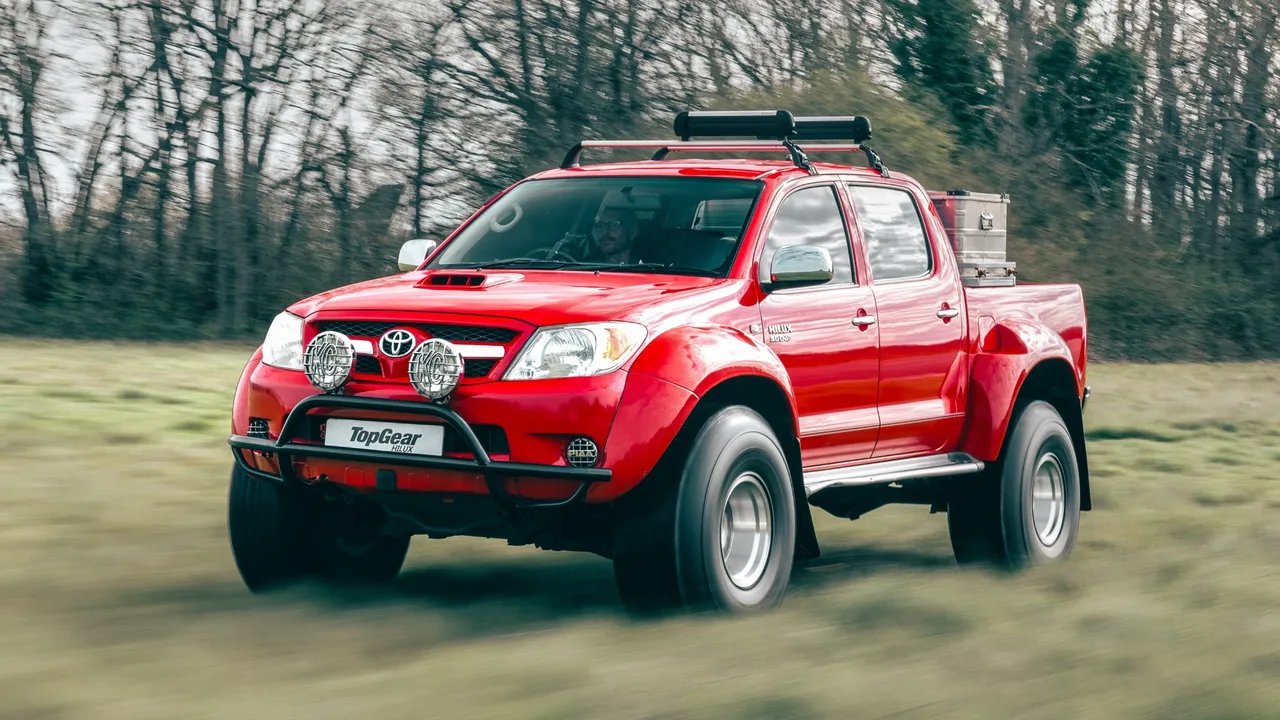
At its core, it’s "just a Hilux," a statement that belies its extraordinary achievements. While its current guise sports imposing balloon tyres and a gun case – mere surface dressing – these are not the source of its legendary strength. The Hilux was inherently tough; it simply awaited the opportunity to prove it.
And prove it, it did, repeatedly, on the globally adored Top Gear TV show throughout the 2000s. Viewers will recall its impossible resilience: surviving an explosion on top of a 23-story building, venturing across the English Channel with an outboard motor, and even attempting to drive into an active volcano. Each time, the Hilux emerged victorious.
However, this particular Hilux holds a unique place in automotive history. It wasn’t just a survivor; it was a record-breaker. It became the first car ever to reach the magnetic North Pole, an accomplishment it wears with understated humility. There’s no glowing aura or grizzled explorer’s gaze; it remains, at its heart, a Hilux performing its inherent duty.
This trailblazing journey involved a significant modification by Icelandic expedition specialists, Arctic Trucks. Their task was to prepare the vehicle for a grueling 450-mile trek across the Polar ice cap, originating from Resolute in Northern Canada. The modifications were extensive yet judicious: reinforced suspension, front double wishbones subtly repositioned to accommodate colossal 38-inch tyres (a cool £2,500 each), heavy-duty differentials, a robust sump guard, an auxiliary fuel tank, and freeze-resistant fuel.
Crucially, the foundational elements of the Hilux remained untouched. The 3.0-litre diesel engine, paired with a four-speed automatic transmission, the chassis, heating system, seats, and virtually everything else, were entirely standard. As Jeremy Clarkson famously highlighted in the televised adventure, while radios, microphones, cameras, batteries, and even the human crew faltered in the extreme conditions, the Hilux persevered.
Encountering this historical vehicle today evokes a complex mix of emotions. Reflecting on the footage (Season 9, Episode 7, available on iPlayer) of it bulldozing through snowdrifts and powering across ice fields, seemingly unstoppable against the Arctic’s relentless challenges, one might feel a pang of sympathy for its current, less-heroic existence.
Yet, the bittersweet feeling extends further. There are heroes one should undoubtedly meet, and then there are those best left in the realm of legend. This particular piece of television history falls into the latter category. The stark realization dawns almost immediately upon starting the engine: it truly is just a Hilux. Of course, that inherent simplicity is its superpower, but its monumental achievement instills an expectation of something more, an intangible aura. Instead, it relies on the lingering cabin accoutrements to whisper tales of its past: dark tinted windows for Arctic glare reduction, auxiliary lights on the doors to illuminate Jeremy and James for the cameras, extra mounts, a marine navigation system, and, inevitably, gaffer tape everywhere.
On the move, the hero becomes a slug. The diesel engine rattles with an uncouth, aged quality, the gearbox sluggishly slurs through changes, and the entire drivetrain feels weary and uninspired. Acceleration is a chore, braking is hesitant, and turning is a considerable undertaking. Yet, in the context of its original mission, none of this mattered. Its sole imperative was to keep moving, a vibe it still emanates – point it in a direction, and it will relentlessly pursue its goal until completion.
Perhaps most ironically, its current road manners suggest a distinct lack of directional precision. Despite the tyres being properly inflated (not at the 4psi required for delicate ice crawling), the vehicle wanders with a disconcerting vagueness. The ride is jarring, and as speed increases, the massive tyres exert a powerful gyroscopic effect, dictating the car’s direction, leaving the driver sawing at the wheel in a futile attempt to impose their will.
What this Hilux accomplished remains unequivocally heroic. Even after nearly two decades, only a handful of vehicles – seven in total – have ever reached the magnetic North Pole, with two of those being support Hiluxes from the very same Top Gear expedition. Its continued existence, in its unrestored glory, is a testament to its legend. It serves as a tangible snapshot of television history, irrefutable proof of Top Gear’s ability to forge icons. For those prone to anthropomorphizing, there’s a poignant note of sympathy for this mighty explorer, forever enshrined in a singular triumph, never to embark on a second grand expedition.