








Environmental Groups Threaten Lawsuit Against Federal Government Over Gray Whale Population Crisis
A coalition of environmental organizations has issued a formal notice of intent to sue the Trump administration, citing a federal failure to address the dire population collapse of Eastern North Pacific gray whales.
The Center for Biological Diversity, the International Marine Mammal Project, and Oasis Earth filed the notice on Tuesday, challenging the National Oceanic and Atmospheric Administration (NOAA) for its inaction regarding the species’ precarious status. The legal action follows a year of silence from federal regulators after a petition was filed seeking to reinstate Endangered Species Act (ESA) protections for the whales.
A Decade of Decline
The Eastern North Pacific gray whale population has endured a volatile decade. After reaching an estimated peak of 27,000 individuals in 2016, the population plummeted to roughly 12,890 by last year—marking one of the lowest counts since the late 1960s. While a recent count suggested a slight rebound to approximately 17,750, conservationists argue that the species remains in a state of crisis that demands immediate federal oversight.
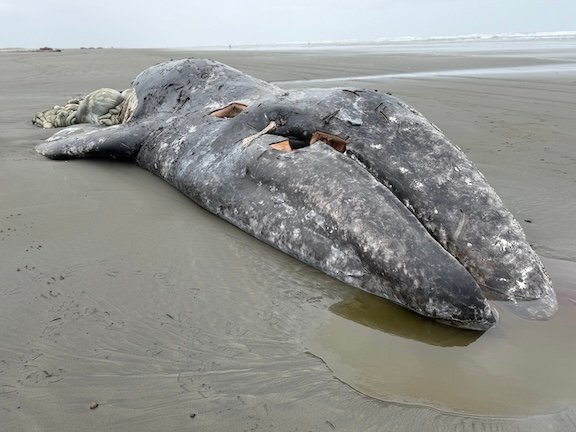
Between 2018 and 2023, NOAA declared an “unusual mortality event” as nearly 700 whales were found stranded along the coast, stretching from Mexico to Alaska. Despite a temporary lull, the death toll has surged once more. As of late August, 187 gray whale deaths have been documented this year alone, already surpassing the 179 recorded throughout the entirety of 2023.
Climate Change and Human Threats
Scientific evidence suggests that climate change is the primary driver of the mortality events. As sea ice disappears and temperatures rise in the Arctic and subarctic feeding grounds, the whales are losing access to the high-fat prey essential for their survival. Consequently, many of the whales discovered on beaches were found in a state of severe emaciation.
Beyond environmental shifts, the groups emphasize that anthropogenic factors—including ship strikes and entanglements in fishing gear—continue to claim lives. A recent NOAA report documented 31 cases of gray whale entanglements in Alaskan waters alone between 1990 and 2024.
The Push for ESA Reinstatement
Eastern North Pacific gray whales were previously protected under the Endangered Species Act but were removed from the list in 1994 following a recovery credited to the end of commercial whaling. Advocacy groups now argue that this delisting was premature and that the current population trajectory proves the species is once again in need of federal intervention.
“We’ve lost half of these Pacific gray whales in just a decade,” said Miyoko Sakashita, oceans director at the Center for Biological Diversity. “It couldn’t be clearer that the population needs protections, but we’re just getting silence from the Trump administration as the crisis unfolds.”
The notice of intent to sue is a mandatory precursor to litigation, requiring the government to be notified at least 90 days before a formal complaint is filed. By initiating this process, the coalition hopes to compel NOAA to issue long-overdue 90-day and 12-month findings on the status of the population.
When reached for comment, NOAA spokesman Michael Milstein declined to discuss the legal notice, citing the agency’s policy regarding pending litigation. As environmental groups take steps to sue to compel new protections for gray whales, the coming months will be critical in determining whether the federal government will shift its stance before the population reaches a point of no return.