






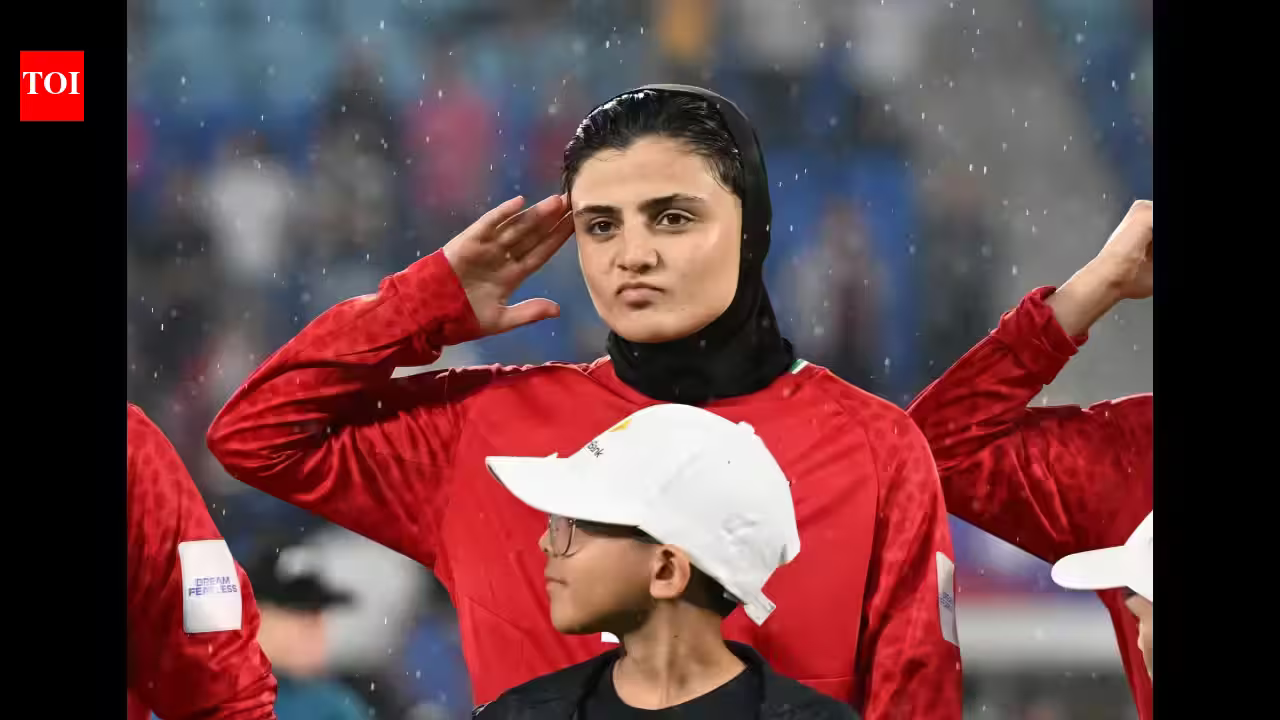
Defiance on the pitch has transitioned into a new life of freedom for two Iranian footballers, as Atefeh Ramezanisadeh and Fatemeh Pasandideh have finally broken their silence regarding the act of protest that fundamentally altered their lives. The two athletes, who sought asylum in Australia after the Women’s Asian Cup, have confirmed that their decision to refuse to sing the Iranian national anthem was not a gesture of grief, but a calculated and courageous act of rebellion against the regime in Tehran.
The confirmation comes following a candid interview on Australia’s 60 Minutes broadcast this past Sunday, providing the first definitive account of the tension-filled moments that occurred on March 2. As the Iranian squad took the field against South Korea, the silence from the players during the anthem became an international focal point, sparking heated debates and leading to accusations of treason from state-aligned media outlets back home.
‘We just wanted to stand with our people’
For the players, the gravity of the situation was immense. Ramezanisadeh, 34, and Pasandideh, 22, were well aware that their refusal to perform the anthem could have dire consequences. Ramezanisadeh, speaking through an interpreter, laid bare the internal conflict she faced in those moments.
“I was scared at times, but I just tried to do what was right and say that no one should be killed just for protesting,” Ramezanisadeh explained. She confessed that, at the time, she understood her silence “could have meant any form of torture” upon her potential return. “But at that moment, the only thing that gave me peace and a clear conscience was not singing it. I wanted to sing the anthem with pride and from my heart. But because of the situation in Iran, I really couldn’t do it.”
Pasandideh mirrored this sentiment, emphasizing that the gesture was a bare-minimum acknowledgment of the suffering occurring within Iran’s borders. “My people put their lives on the line and they were killed,” she said. “Doing that was the absolute least we could do for them.”
Silence becomes a political flashpoint
The impact of their silent protest rippled far beyond the confines of the football pitch. As activists and demonstrators in Australia rallied in support of the squad, the incident drew the attention of high-level government officials. Australian Immigration Minister Tony Burke acknowledged the gravity of the protest, noting that it became a “volcanic moment” that shifted international focus.
The diplomatic stakes were further heightened by the involvement of global political figures, including then-U.S. President Donald Trump, who intervened to advocate for the players’ safety. Conversations between the U.S. leadership and Australian Prime Minister Anthony Albanese accelerated the process of offering humanitarian visas to members of the delegation. While seven members of the Iranian delegation initially accepted the offer of asylum, the majority eventually chose to return home, leaving Ramezanisadeh and Pasandideh as the only two to commit to a new life in Australia.
The high cost of choosing freedom
The journey to stability in Australia has come at an excruciating personal cost. Ramezanisadeh revealed that she faced intense pressure from her parents, who were under directive from Iranian authorities to persuade her to return. “They tried to reassure me, saying: ‘Nothing will happen to you. This is your home. You must return home,'” she recalled. “But I told them my mind was made up and I was not coming back.”
The separation from family remains the deepest wound. For months, communication has been sporadic, and the prospect of never seeing their loved ones again hangs heavy. “Thinking that I might never be able to see my family again was heartbreaking, but I couldn’t allow myself to be indifferent while so many young people were being killed by this regime,” Ramezanisadeh said.
Despite the fear for their families back home, the duo has successfully integrated into the Australian sporting landscape. Both have found a home with the semi-professional club Wynnum Wolves in Brisbane, and they officially became Australian citizens in August of this year.
A dream for a changed nation
Even as they embrace their new status as Australian citizens, the bond with their homeland remains unbroken. The pair maintains a protective silence regarding their former teammates, refusing to disclose whether those who returned home felt forced to do so. “We decided not to talk because I don’t want to put their lives in danger,” Pasandideh noted.
Ultimately, both women hold onto the hope that their exile is not permanent, but rather a temporary sacrifice for a future they can currently only imagine. “One of my biggest dreams is to be able to go back to Iran, but in different circumstances—when the situation in Iran has changed and the people of Iran are happy and thriving,” Pasandideh said. “Then I will go back and see my family.”
For now, the two athletes continue to ply their trade on the pitch in Brisbane, their professional lives in Australia serving as a testament to the fact that sometimes, silence speaks louder than any anthem ever could.
Disclaimer: This content is auto-generated and paraphrased.
Source: Read Original News