







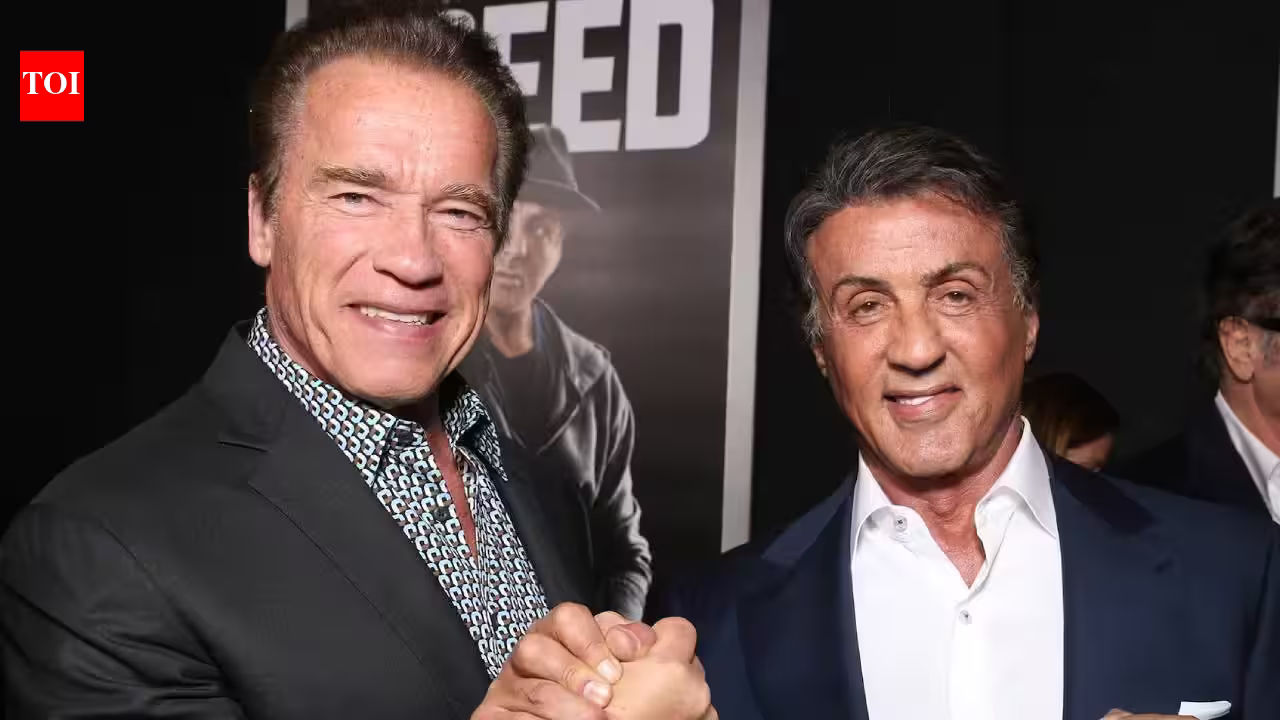
In the golden age of 1980s cinema, there were only two gods on Mount Olympus, and they were constantly trying to throw each other off the summit. For decades, the public watched the escalating arms race between Sylvester Stallone and Arnold Schwarzenegger—a battle of biceps, box office receipts, and sheer screen presence that defined an entire generation of action filmmaking. While they are now elder statesmen of the industry, regularly exchanging social media pleasantries and popping up in each other’s documentaries, Stallone has recently pulled back the curtain on just how volatile that era truly was, likening their historic standoff to the cutthroat, high-stakes maneuvering of modern tech giants.
The Coliseum of Cinema: A Rivalry Forged in Fire
Speaking with The Sunday Times Magazine, the man behind Rocky Balboa didn’t mince words. He characterized the friction between himself and the Austrian Oak as “life and death.” In an era before the internet could turn every celebrity slight into a viral scandal, Stallone and Schwarzenegger operated in a vacuum of professional paranoia. They weren’t just colleagues competing for billing; they were titans in a zero-sum game.
Stallone’s comparison to the current legal and corporate warfare surrounding Elon Musk and his Tesla ventures is telling. He identifies a “ferocity” in Musk that mirrors the mindset he held in the mid-80s—a singular, almost monomaniacal focus on besting the competition. “We were at each other’s throats, big time,” Stallone admitted. “It wasn’t a joke.” For two men whose brand was built on physical invincibility, there was no room for second place. To hear Stallone tell it, they essentially should have been gladiators in the Roman Colosseum, fighting for the literal survival of their careers.
The Art of the Sabotage: Psychological Warfare
The rivalry wasn’t just fought through box office numbers; it was a complex game of psychological manipulation. As Stallone has confessed in previous interviews, the “Arnold tactic” was often more sophisticated than just working out harder at the gym. Schwarzenegger, he claims, was a master of the “red herring.”
The tactic was simple yet brilliant: Schwarzenegger would loudly express profound interest in a script he had no intention of making. Seeing his rival salivating over a project, Stallone would immediately instruct his agents to swoop in and steal it. It wasn’t until Stallone was locked into a contract for what often turned out to be a substandard film—like the infamous flop Stop! Or My Mom Will Shoot—that he would realize the setup. Schwarzenegger would be waiting on the sidelines, laughing, having successfully saddled his competitor with a dud while he cleared the path for his own superior projects. It was a high-stakes chess match played out in boardrooms across Hollywood, and for a long time, the Terminator was winning.
From Mortal Enemies to Mutual Admiration
Stallone’s candor about how much they “truly loathed” each other provides a fascinating counter-narrative to the polished, buddy-buddy image the two icons project today. For twenty years, the industry was divided into two camps: the Stallone loyalists and the Schwarzenegger devotees. There was no middle ground. You were either cheering for the grit and underdog spirit of Rambo, or the machine-like, unstoppable force of the T-800.
However, as is often the case with the greatest rivalries in history, time provided the necessary distance for perspective. Stallone now acknowledges that the animosity was the jet fuel that powered their careers. “We needed each other, absolutely,” he noted. It’s a classic competitive paradigm: when one fighter insults or outperforms the other, the victim of that slight is pushed to train harder, push further, and achieve more. Stallone acknowledges that Schwarzenegger’s physical superiority and unwavering, almost robotic, confidence acted as a mirror that forced Stallone to constantly evolve his own screen persona.
The Evolution of the Expendable Friendship
The shift from rivals to colleagues, and eventually to friends, reached its zenith with the Expendables franchise. Seeing these two on screen together—trading bullets and one-liners—was a form of closure for an entire generation of filmgoers. It marked the end of an era where “muscle” was the primary currency of Hollywood fame.
Stallone’s appearance in the 2023 Netflix documentary on Schwarzenegger was the final nail in the coffin of their feud. Gone was the talk of “loathing,” replaced by a candid admission of respect. Stallone famously conceded, “He was superior. He just had all the answers. He had the body. He had the strength.” It was a moment of rare vulnerability from a man who spent his career playing the unshakeable underdog.
Why We Still Care About the “Muscle War”
Why do we remain so fascinated by this 40-year-old feud? Perhaps it’s because it represents a time when stardom felt tangible and physical. In the age of CGI and green screens, the idea that two men could build their entire legacies on the physical effort they put into their bodies—and the intensity they brought to a set—feels like a lost art.
Stallone comparing their past to the cold, calculating battles of Silicon Valley highlights how much the “fame” game has changed. Today, beefs are played out on X (formerly Twitter) for engagement metrics; back then, the rivalry was a quiet, grinding, internal motivation that forced both men to define the action genre for decades. They may have started as adversaries fighting for the same sliver of the spotlight, but they ended as the two architects who built the house that all modern action stars currently live in. We didn’t just get great movies; we got the greatest show in Hollywood history, a grudge match that lasted long enough to turn into a legacy.
Disclaimer: This content is auto-generated for informational purposes only.
Source: Read Original News