





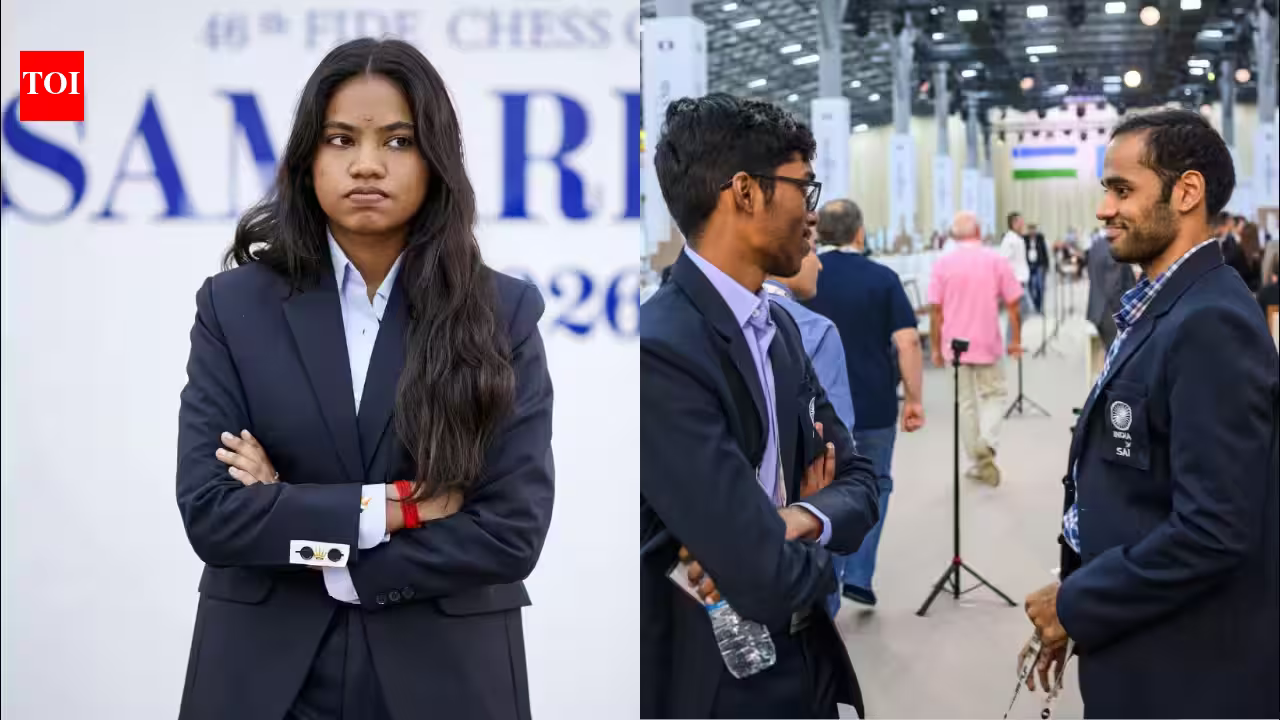
SAMARKAND — The echoes of clashing pieces and hushed intensity in the Samarkand tournament hall will long resonate in the annals of Indian chess. In a display of grit, tactical brilliance, and sheer resilience, India’s chess contingent has solidified its status as a global powerhouse, securing both silver and bronze medals in the Open and Women’s sections, respectively, while hoisting the prestigious Gaprindashvili Cup.
For many, the triumph is the culmination of years of quiet, often painful, sacrifice. No story reflects this journey better than that of Savitha Shri, whose path to the podium began not in the spotlight, but in a small household where a family had to choose which child’s dream to fund.
Savitha’s Clutch Draw Saves the Day
The road to the women’s bronze medal was far from straightforward. Heading into the final Round 11, the Indian women’s team found themselves walking a razor’s edge. While legend Koneru Humpy delivered a masterclass in a 24-move victory, the match balance tipped precariously when Divya Deshmukh suffered a loss and Vantika Agrawal was held to a draw. The weight of the team’s collective ambition rested squarely on the shoulders of Savitha Shri.
Playing with the black pieces in a grueling Queen’s Gambit-inspired structure against Georgia’s Meri Arabidze, Savitha faced a moment that defines a career. Under sustained pressure and with her king forced into a defensive dance across the board, the young phenom displayed maturity well beyond her years. For 83 agonizing moves, Savitha navigated the tactical labyrinth, finding the precise defensive maneuvers required to neutralize Arabidze’s aggressive endgame.
As the rook-and-pawn ending stabilized into a draw, the weight of the moment became palpable. That single, hard-fought half-point locked India into a final tally of 17 points, securing third place. For the Baskar household, it was the ultimate vindication. Decades earlier, Baskar—then an electrician in Singapore—had returned to India and even pawned the family’s gold jewelry to fuel his daughter’s training under coach RB Ramesh. In Samarkand, the gold pawned years ago finally returned as a bronze medal for their nation.
Erigaisi Turns Hero, India Survive on Tiebreak
While the women’s team fought for redemption, the Open section witnessed a performance of sheer redemption from Arjun Erigaisi. After a torrid start to the tournament—including a surprising opening-day loss—Erigaisi had struggled to find his rhythm, tallying six straight draws. Questions were mounting regarding his form, but the final round against veteran Peter Leko provided the perfect stage for a reversal.
In a long, grinding Ruy Lopez encounter, Erigaisi refused to be hurried. As the pieces drifted off the board, the contest evolved into a strategic stalemate that seemed destined for a draw. However, Erigaisi found a late-game spark, maneuvering his queen and bishop into the heart of Leko’s defenses. A daring rook sacrifice—trading his rook for Leko’s on the h2 square—shattered the Hungarian’s structure. With no sanctuary left for his king, Leko resigned, handing Erigaisi a critical win.
This victory proved vital. Despite Gukesh, who had been on an impeccable unbeaten streak, falling to Hungary’s Gleb Dudin, the team held firm to secure a 2-2 draw. Finishing with 18 points, India edged out Germany on a superior tiebreak score, claiming the silver medal behind a dominant Uzbekistan side.
The Supremacy of the Gaprindashvili Cup
The final tally confirms that India has emerged as the most consistent nation in the sport. By securing a combined rank sum of 5—the best across both the Open and Women’s divisions—India claimed the Gaprindashvili Cup. This trophy, awarded to the federation with the best collective performance, serves as a testament to the depth of talent currently emerging from the subcontinent.
The individual accolades were equally impressive. In the Women’s section, Savitha Shri captured gold on Board 5, while Divya Deshmukh (silver, Board 3), Koneru Humpy (bronze, Board 1), and Vantika Agrawal (bronze, Board 4) were all honored for their excellence. On the Open side, the stars continued to align: D. Gukesh earned a well-deserved silver on Board 4, and R. Praggnanandhaa walked away with bronze on the top board.
As the dust settles in Samarkand, it is clear that India is no longer just participating in the global chess conversation—they are steering it. From the humble sacrifices of families in Chennai to the high-pressure endgames played on the world stage, India’s golden generation has arrived, and they have brought home the hardware to prove it.
Disclaimer: This content is auto-generated for informational purposes only.
Source: Read Original News