






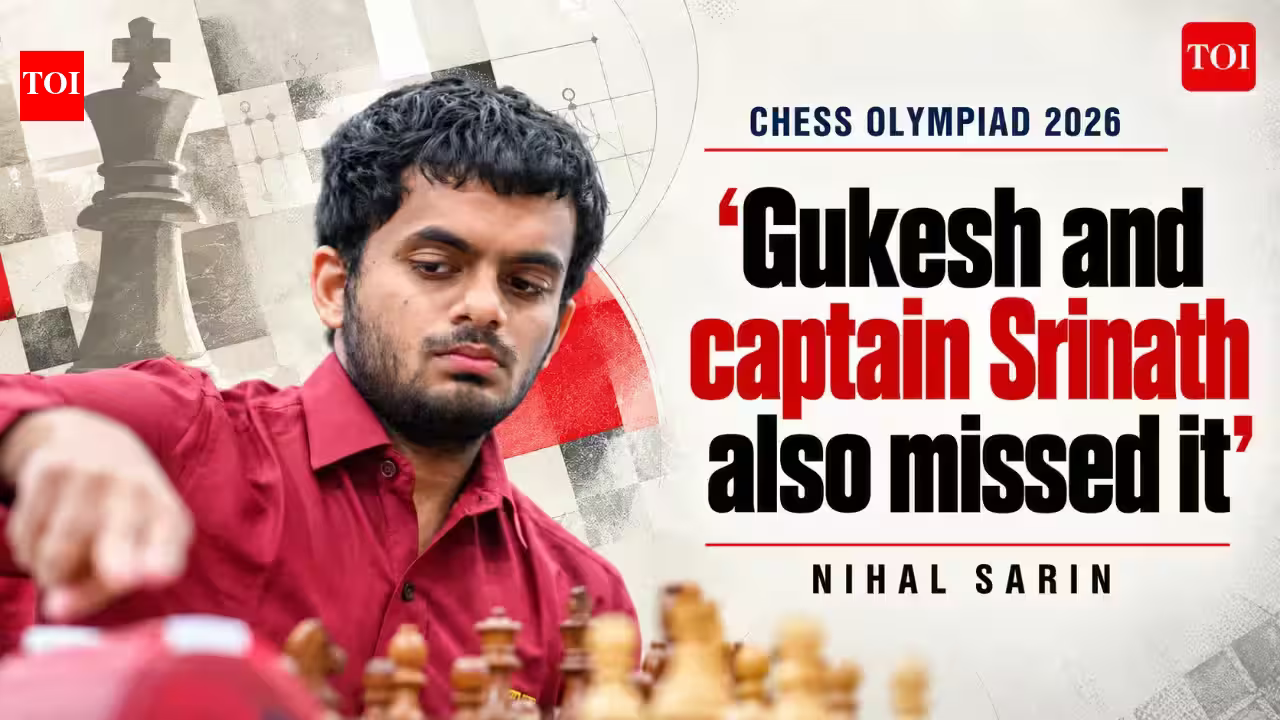
“Sometimes in chess there are just these blind spots.” That is the haunting realization of Grandmaster Nihal Sarin, who, nearly two weeks after the conclusion of the 2026 Chess Olympiad in Samarkand, remains reflective about the singular moment that altered India’s trajectory in the tournament.
In a high-stakes Round 6 showdown against Uzbekistan, the atmosphere was electric. World Champion Dommaraju Gukesh, having already secured a draw against Shamsiddin Vokhidov, stood as a silent spectator alongside the other boards. With the rest of the matches resulting in draws, the burden of the entire tie—and India’s push for the top of the standings—fell squarely onto the shoulders of 22-year-old Nihal Sarin.
For 35 moves, Sarin had outplayed Nodirbek Yakubboev, steering Black into a position that promised much. Then, in a blink of an eye, the game turned. A momentary lapse in judgment led to a blunder that surrendered his queen, shifting the momentum irrevocably toward the host nation. Gukesh, witnessing the collapse from the sidelines, was visibly shaken, his head buried in his hands as he walked away, stunned by the sudden reversal of fortune. India eventually lost the match, and Uzbekistan marched on to secure the tournament title.
The Anatomy of a Blind Spot
Speaking exclusively from India, Sarin dissected the incident with the calm, analytical detachment of a top-tier professional, even while admitting the confusion that surrounded it.
“Against Uzbekistan, it was really unfortunate,” Sarin recalled. “I was playing a really good game, but I made a very unfortunate miss. It proved too costly.”
Perhaps the most unsettling aspect for the young prodigy was his total lack of awareness during the critical window. “Generally, when you miss something like this, at least after making the move, you spot it,” he admitted. “But I was completely oblivious to it until he made the move, which is quite uncharacteristic.”
It was only when Yakubboev responded with 38.Ne6 that the reality of the blunder crashed down upon him. Even then, the move was objectively straightforward—a simple tactic that had somehow escaped the notice of everyone involved.
Collective Invisibility
The mystery deepens when considering that Sarin was not the only one at the table—or even in the room—to overlook the danger. “The funny thing was that Gukesh was watching the game. He was in the hall. Apparently, he had also missed it completely. Our captain, Srinath (Narayanan), had missed it as well,” Sarin revealed.
The blindness extended even to the digital masters. Elite Grandmaster Vidit Gujrathi, who was providing commentary at the time, confessed to Sarin that the move had been missed in the studio as well, only surfacing once the computer engines flagged the variation.
“Not many people saw it coming,” Sarin noted. “Sometimes in chess there are just these blind spots. It’s very hard to explain, but it happens. We are all quite strong grandmasters, and almost all of us missed something.”
Rising Above the What-Ifs
While the weight of the result against Uzbekistan felt heavy, the camaraderie within the Indian camp served as a buffer against self-recrimination. The team quickly rallied around Sarin, reminding him that chess, despite being an individual endeavor at the board, is a team pursuit in the Olympiad context.
“The team was very nice. All of them were telling me to keep my head up,” he said. “It’s also very hard not to feel responsible, but you have to remember that we win and lose as a team.”
When asked if he lies awake wondering if that one move cost India the gold medal, Sarin remains pragmatic. He refuses to indulge in the “what-ifs” that plague so many athletes.
“There are just no what-ifs in sport,” he asserted. “Against Indonesia, we could have easily lost the match. Against Germany, we were honestly completely cooked. These what-ifs are very easy to fantasize about… but ultimately I don’t think everything happens by accident—the pressure is what creates these moments.”
Looking Ahead
For Sarin, this was his first experience representing the main Indian squad at the Olympiad. Despite the heartbreak in Samarkand, the takeaway is one of pride and professional growth. Coming away with a silver medal, he is already looking forward to future iterations of the event.
“I think the team performance was very good. We all played pretty good chess,” he said. “I don’t think any of us were at our best, for sure. But we still managed to play some really good games, and everyone stepped up when it mattered most.”
The life of a world-class chess player offers little time for mourning. With the European Club Cup in Montenegro on the horizon, Sarin is preparing to shift his focus back to the board. To clear his mind, he has turned to a grounded routine: daily sessions at a local tennis club. For a man whose mind is constantly calculating complex geometric possibilities, the simple, physical act of hitting a tennis ball provides the necessary clarity to reset before his next international challenge.
Disclaimer: This content is auto-generated for informational purposes only.
Source: Read Original News