








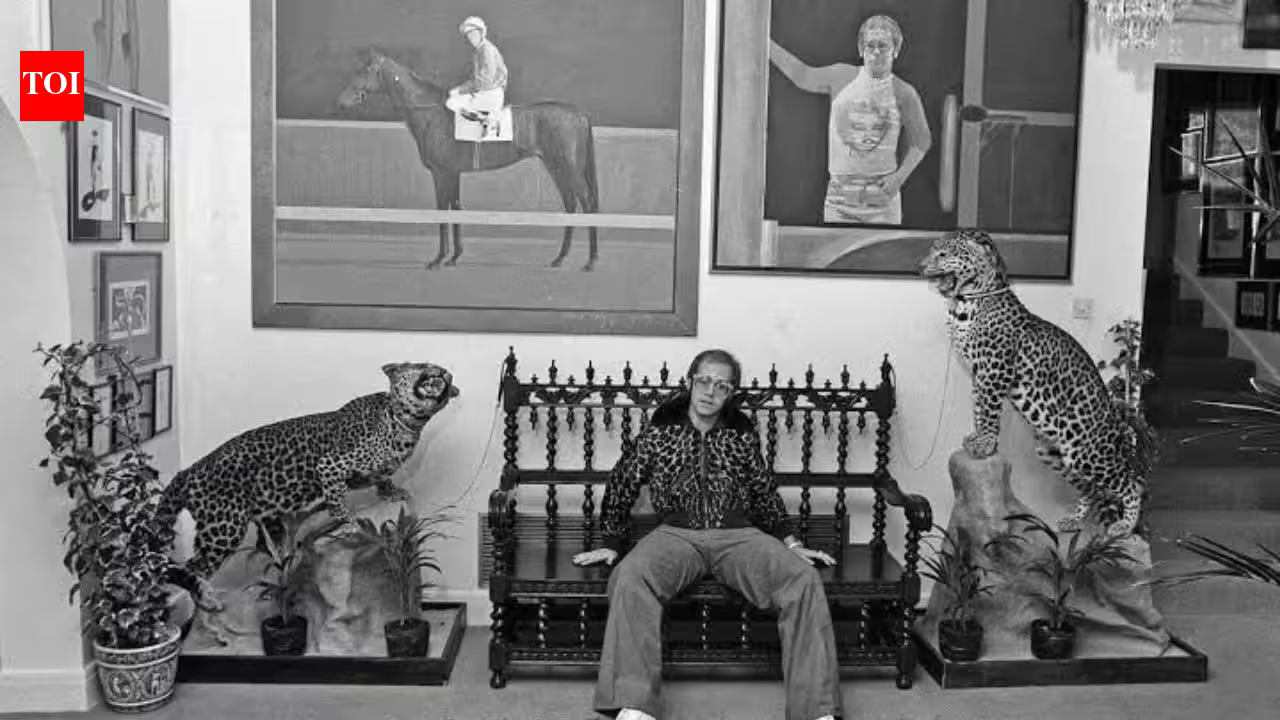
If you were to walk into the homes of Sir Elton John throughout the decades, you wouldn’t just be entering a celebrity estate; you would be stepping inside the psyche of a man who treats life as a high-stakes, high-art performance. From the exuberant, borderline-chaotic “Aladdin’s cave” aesthetic of his early years to the tightly curated, museum-quality galleries he maintains today, the Rocket Man’s relationship with his living spaces is a masterclass in evolution.
For an artist whose stage persona is defined by blinding sequins, oversized eyewear, and a disregard for the understated, it’s no surprise that his domestic life has historically been a mirror of that maximalist impulse. Yet, as the world learned through his monumental 2024 auction at Christie’s, the man behind the music is far more than a collector of trinkets. He is a curator of culture.
Woodside became the heart of his English life
In 1974, at the height of his initial meteoric rise, John purchased Woodside, a sprawling country estate near Windsor. It was here that the transition from a young pop star to a global icon truly manifested within four walls. If you look at photos of Woodside during the late 1980s, you see a house practically bursting at the seams. It wasn’t just furniture; it was a physical inventory of a lifestyle—vintage pinball machines, endless rows of stage costumes, and an ocean of memorabilia that made the halls feel like a labyrinth.
John himself later famously described this era of his life at Woodside as an “Aladdin’s cave.” It was the physical manifestation of a career moving at a breakneck speed, with no time to sort, only time to acquire. However, the turning point came in 1990. Following his journey toward sobriety, John sought a shift in his environment. He didn’t want to discard his passion for objects, but he desperately needed to find a sense of peace. Bringing in designers Adrian Cooper-Grigg and Andrew Protheroe, he began the process of taming the beast, transforming the cluttered estate into a sophisticated, traditional English sanctuary.
His maximalism became more carefully curated
The beauty of Elton John’s interior design journey is that he never truly “grew up” into minimalism. Instead, he grew into curated maximalism. He traded the frantic density of his early years for a more deliberate arrangement where, despite the volume of items, everything felt as though it had a rightful place.
Consider the library at Woodside. By repurposing a former squash court—a space once dedicated to physical exertion—he turned it into a temple of intellect and reflection. Similarly, his restoration of an 18th-century orangery proved that his heart remained tethered to classic elegance. He mastered the art of juxtaposition: a 19th-century porcelain vase sitting comfortably next to a contemporary photograph, proving that beauty doesn’t require a unified theme. His homes became personal narratives, defying the rigid trends of interior design magazines in favor of a look that screamed “Elton.”
His love for collecting went far beyond furniture
While the furniture often grabbed the headlines, it was John’s obsession with photography that truly cemented his legacy as a serious collector. Post-1990, photography became his primary creative outlet outside of music. Alongside his husband, David Furnish, John built what is arguably one of the most significant private photography collections in the world.
This wasn’t about status; it was about the frame. He sought out the masters—Irving Penn, Herb Ritts, and countless others—treating the medium with the same reverence one might show for an old master’s oil painting. By the time the V&A Museum hosted Fragile Beauty in 2024, the world could see that John’s domestic collection was never just decor. It was a rigorous, scholarly pursuit of art history that happened to be hanging in his hallway.
Atlanta became another canvas for his collections
If Woodside was his English roots, his Atlanta duplex at Park Place was his American playground. Acquired in 1991, this residence wasn’t just a home; it was a 13,500-square-foot laboratory for his changing tastes. Over three decades, he knocked down walls and expanded, treating the residence as a massive, living gallery.
In Atlanta, the atmosphere was distinctly modern. It was a place of work and creation, where the music for hits like Billy Elliot and Aida was born amidst the backdrop of his ever-expanding art collection. The apartment was the physical proof that Atlanta wasn’t just a tour stop for John—it was his creative home base.
The Atlanta collection eventually went under the hammer
The 2024 Christie’s auction, Goodbye Peachtree Road, served as the ultimate punctuation mark on this era. Watching the sale of over 900 items—from his iconic platform boots to his personal Bentley—was bittersweet. It represented the shedding of a skin. When the hammer fell on the final lot, the total sale amounted to a staggering $20.5 million, a sum that reflected not just the value of the items, but the sheer cultural gravity of the man who owned them.
The auction was a rare peek behind the curtain. It wasn’t just a fire sale; it was an invitation for the public to own a piece of the “Rocket Man” mythology. For collectors, it was an opportunity to acquire a slice of history; for fans, it was the final act of a long, glittering show.
A home that mirrors an extraordinary career
Looking back at the trajectory of Elton John’s homes, we see the evolution of the man himself. We see the young, impulsive pop star filling a house called “Hercules” with records and posters, and we see the seasoned, sober icon who understands that his surroundings are a reflection of his internal state.
His interiors evolved from disorganized passion to intentional genius. Whether it was a room packed with pinball machines or a pristine gallery wall of Irving Penn photographs, John always understood that his home was the one place where he could be exactly who he wanted to be. He lived large, he collected deeply, and he left us with a blueprint for how to live a life that is, in every sense, art.
Disclaimer: This content is auto-generated for informational purposes only.
Source: Read Original News