




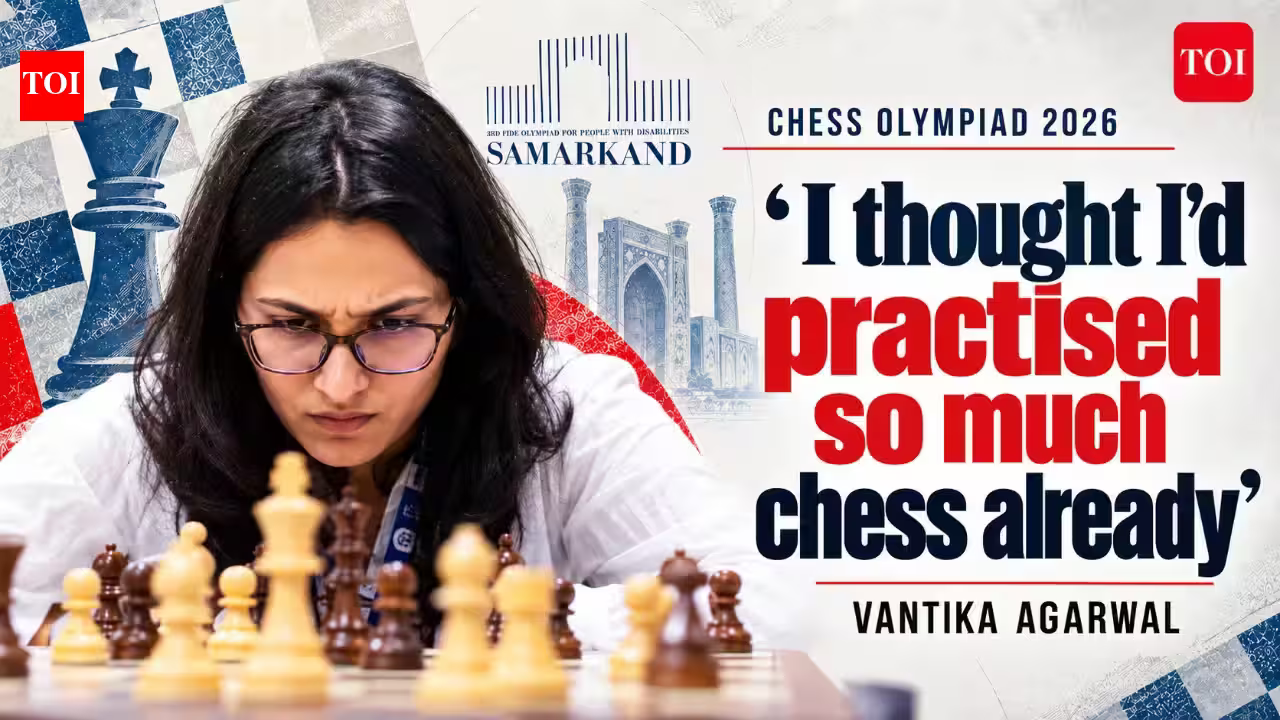
SAMARKAND — For the elite chess professional, the rhythm of a tournament like the 46th Chess Olympiad is a grueling cycle of engine-backed preparation, high-stakes tactical battles, and the relentless mental fatigue that follows six hours at the board. For Vantika Agrawal, however, the path to a bronze medal in Uzbekistan required a detour into an unexpected sanctuary: the world of Indian stand-up comedy.
The 24-year-old International Master, who provided a vital anchor for the Indian team on Board 3, found herself in a unique position following a dominant victory over U.S. legend Irina Krush in Round 6. With a mandatory rest day followed by two rounds on the sidelines as captain Swayams Mishra rotated his lineup, Agrawal suddenly found herself with an unusual three-day hiatus from the board.
“Usually, you don’t get the time,” Agrawal explained in an exclusive sit-down. “You prepare in the morning, analyze at night, and then prepare again. By the time you get to the board, you’re exhausted. But with this extra time, I had practiced so much chess already; I decided to relax a bit.”
Her choice of relaxation? Binge-watching Samay Raina’s popular show, India’s Got Latent. The comedic reprieve proved to be the perfect palate cleanser. Recharged, Agrawal returned to the fray in Round 9 to dispatch Uzbekistan’s Nilufarkhon Imomkuzieva, capping off a stellar campaign that saw her finish with a 6/8 score and an individual bronze medal.
The “What If” of Round 10
While the team ultimately secured a podium finish, Agrawal remains candid about the one result that still stings: the Round 10 draw against China that effectively extinguished India’s gold-medal aspirations. Agrawal, playing on Board 3, suffered a tough loss to Lu Miaoyi.
“I was especially very upset about that game,” she admitted. “I was playing quite well, and after 40 moves, it was very drawish. There were many ways to split the point, but I decided to play for a win. I wasn’t aware of the situation on the fourth board—had I known we were winning there, I would have forced a draw.”
The loss served as a harsh lesson in the volatility of team chess, where individual ambition must often be tempered by the needs of the collective. Despite the setback, Agrawal maintains that the team’s spirit never wavered. “Before that loss, I was on 5.5 out of 6. If not for that one game, I would have had an individual gold. But that is the nature of this sport.”
A Culture of Resilience
Agrawal was quick to praise the leadership of captain Swayams Mishra, whose influence helped the team weather the early disappointment of a loss to Poland. Drawing parallels to last year’s Olympiad, where the team faced a similar setback, Agrawal noted that the culture of the squad is built on a “fight-together” mentality.
The conversation inevitably shifted to the internal team dynamics, specifically the fluctuating form of world-class contender Rameshbabu Vaishali. Despite the media chatter surrounding the World Championship challenger’s form, Agrawal shielded her teammate, noting that the team focuses purely on the objective reality of the pairings. “She is so strong,” Agrawal said. “If she had been at full form, we would have crushed everyone. But the difficult part of the tournament was accepting that you can’t crush everyone, every single time. That acceptance is part of the game.”
The Perception Gap
Perhaps the most revealing part of Agrawal’s outlook is her frustration with the “quiet” narrative surrounding her career. While media outlets often focus on the elite invitational circuit, Agrawal argues that her grind in open tournaments—often away from the cameras—has been just as demanding.
“I’m not invited to the same top-tier tournaments as Humpy or Divya,” she pointed out. “But I am active. If you check my profile, I’ve played more games than any of them. I beat Aditya Mittal, who is over 2600 and hadn’t lost a game all year. I tied for first place in the Tata Steel Rapid and Blitz in January. People just don’t cover those tournaments.”
Despite the lack of mainstream spotlight, her trajectory is clear. As an Arjuna Awardee, her sights are set firmly on the Grandmaster (GM) title. With her academic pursuits—a B.Com Honors degree from Delhi University’s prestigious SRCC—largely settled, Agrawal has shifted her full focus to the 64 squares.
Looking toward 2027, the plan remains steadfast: keep playing, keep grinding, and keep ignoring the noise. “I don’t think much about the coverage or the perception,” she concluded. “I’m focused on my goals. I’ll keep playing more tournaments, trying to improve my skills, and seeing where the level takes me.”
If the composure she showed in Samarkand is any indication, Vantika Agrawal is not just playing for the current cycle; she is playing for a future where her name is at the top of the leaderboard, regardless of whether the cameras are watching.
Disclaimer: This content is auto-generated for informational purposes only.
Source: Read Original News