





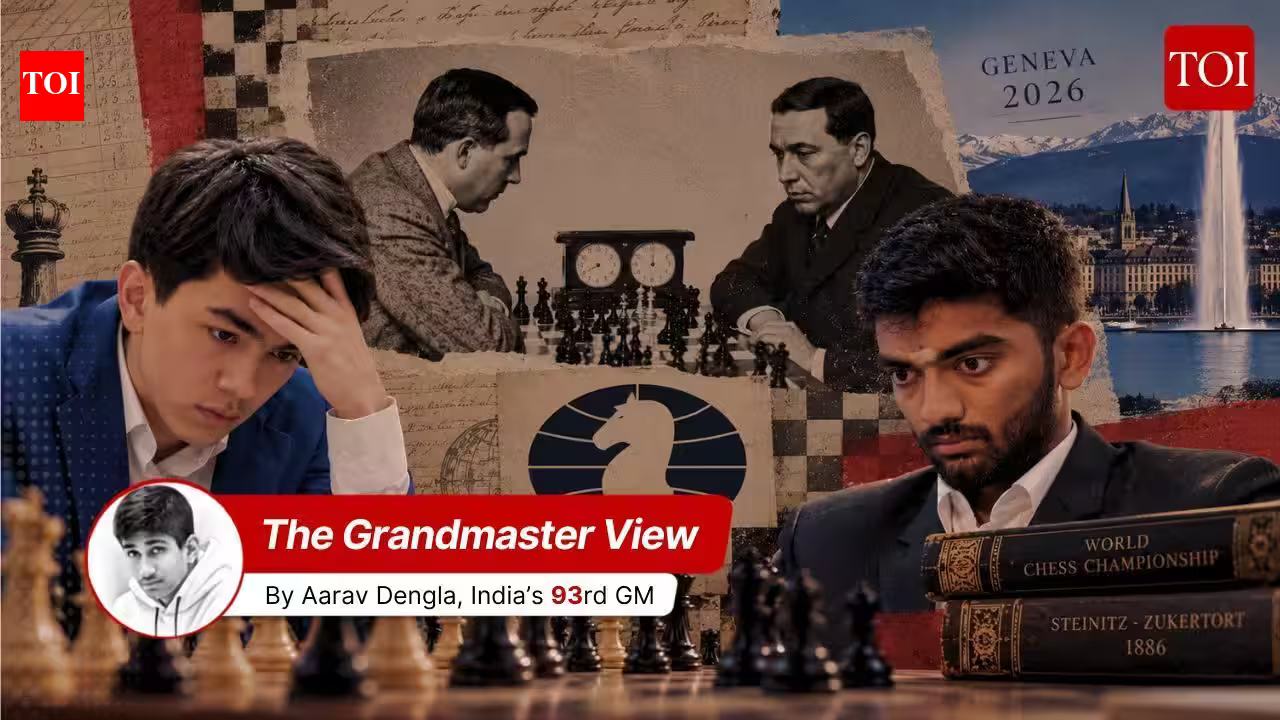

Geneva is set to become the epicenter of the chess world this November as defending champion D Gukesh of India prepares to face challenger Javokhir Sindarov of Uzbekistan. The match, running from November 22 to December 12 under the oversight of FIDE, features a staggering prize fund of USD 2.5 million. While the world watches two modern titans compete in a structured, high-stakes environment, the history of this prestigious title reveals a much darker, often chaotic era—one where a challenger’s ability to compete was dictated not by his skill, but by the weight of his purse.
When the Best Player Could Not Buy His Shot
To understand the evolution of the world championship, one must look back 140 years to the inaugural 1886 match between Wilhelm Steinitz and Johannes Zukertort. That contest was a private, bilateral affair held across three American cities with a total purse of just USD 4,000. In that era, the champion held all the cards. There were no FIDE rankings or qualifying cycles; the incumbent essentially functioned as a gatekeeper who could decide if, when, and under what conditions they would defend their title.
This system was inherently flawed, often preventing the most talented players from reaching the summit of the sport. Consider the case of Akiba Rubinstein, the Polish master who dominated the international circuit in 1912 with five consecutive tournament victories. Despite his clear supremacy, Rubinstein was denied a chance at the world title simply because he could not meet the exorbitant financial demands set by the then-champion, Emanuel Lasker. Rubinstein’s tragic reality was that being the best player in the world was irrelevant if he could not find wealthy patrons to subsidize the champion’s lifestyle. The outbreak of World War I in 1914 ultimately extinguished his chances entirely, leaving one of history’s greatest talents without a crown.
Lasker, Capablanca and a Battle Over Conditions
The volatility of the early 20th-century chess scene is best exemplified by the icy relationship between Emanuel Lasker and José Raúl Capablanca. When Capablanca issued a challenge in 1911, Lasker responded with seventeen conditions, including a clause that required the challenger to win by a margin of at least two games—effectively rigging the match in the champion’s favor.
The ensuing diplomatic standoff lasted years. Even when a match was finally arranged in Havana in 1921, the financial undertones were inescapable; the match featured a USD 20,000 purse, with Lasker guaranteed a larger share than the challenger. Although Capablanca ultimately dominated to take the title, he soon entrenched the very system that had frustrated him. He implemented the “London Rules,” which mandated that a champion could refuse any challenge that did not meet a USD 10,000 minimum purse. This created a cycle of financial gatekeeping so restrictive that it took Alexander Alekhine five years of intense fundraising just to secure his 1927 match against Capablanca.
How the Champion–Challenger System Hit Its Limits
The death of Alekhine in 1946 effectively brought the era of private, bilateral contracts to a close. With no champion left to dictate terms, the international governing body, FIDE, finally stepped into the vacuum. The Soviet Union’s decision to join the organization in 1947 paved the way for the 1948 World Championship tournament, which saw Mikhail Botvinnik crowned champion. This marked the beginning of a modern, meritocratic cycle where the challenger’s path to the title was paved with tournament results rather than bank statements.
Chess was by no means alone in this transition; other “champion-challenger” sports like real tennis and professional boxing have grappled with similar growing pains. Boxing, in particular, maintained the model while introducing sanctioning bodies and “purse bids” to prevent champions from avoiding top contenders. However, the contrast between the 1886 model and the modern era is striking.
As Gukesh and Sindarov prepare for their Geneva showdown, the focus is entirely on strategy, calculation, and athletic endurance. Javokhir Sindarov does not need to beg for funding from aristocrats or negotiate unfair win-margins with the incumbent. He has earned his seat through rigorous qualification, demonstrating the maturation of a sport that has finally prioritized the integrity of the game over the leverage of the titleholder. While the prize money has exploded from the thousands to the millions, the true progress of the World Chess Championship lies in the fact that a player’s destiny is now decided in the heart of the game—the 64 squares—rather than the coffers of a private patron.
Disclaimer: This content is auto-generated for informational purposes only.
Source: Read Original News