









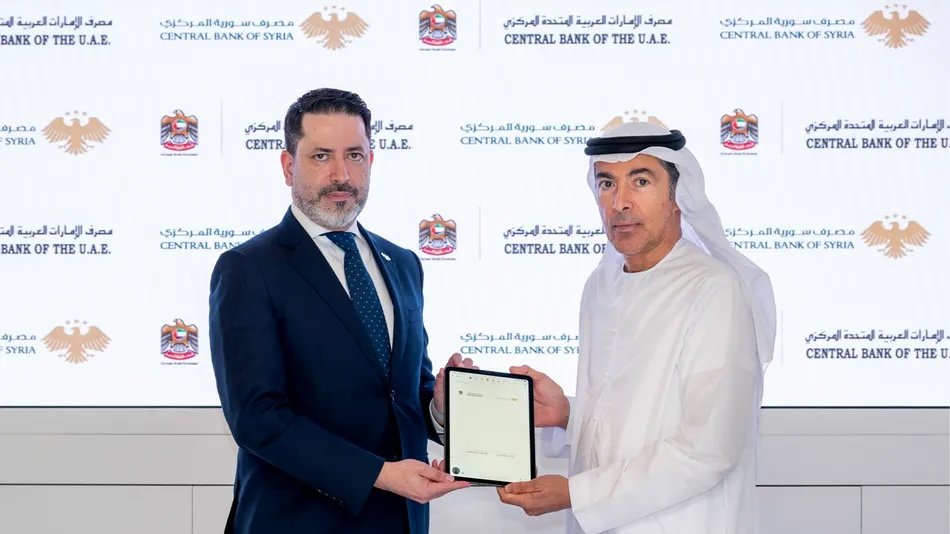
ABU DHABI — The Central Bank of the United Arab Emirates (CBUAE) and the Central Bank of Syria have officially formalized a strategic partnership, signing a Memorandum of Understanding (MoU) aimed at bolstering financial cooperation, enhancing regulatory frameworks, and fostering stability between the two nations. While the agreement centers on traditional monetary policy and banking supervision, the scope of the collaboration highlights an increasing regional push toward the digitization of national financial architectures.
Digital Transformation and FinTech Integration
At the core of the newly signed agreement is a commitment to share expertise regarding modern financial infrastructure. As global markets transition toward cashless economies and central bank digital currencies (CBDCs), the CBUAE has established itself as a frontrunner in the Gulf region’s digital evolution. By sharing insights with its Syrian counterpart, the UAE aims to provide a blueprint for financial modernization that includes robust cybersecurity protocols and the integration of advanced banking technologies.
Industry analysts suggest that this partnership will likely accelerate the adoption of cloud-based banking solutions in the region. The UAE’s sophisticated regulatory sandbox—often utilized to test AI-driven risk assessment models and blockchain-based transaction systems—serves as a primary reference point for this cooperation. Both central banks are expected to prioritize the development of secure digital gateways, leveraging high-speed data architecture to streamline cross-border financial surveillance and anti-money laundering (AML) processes.
Harnessing Artificial Intelligence for Regulatory Oversight
A significant pillar of the MoU involves the integration of artificial intelligence (AI) to improve regulatory compliance. With the surge in sophisticated cyber threats targeting financial sectors, the CBUAE has been heavily investing in AI-powered monitoring systems. These tools are designed to detect anomalous patterns in real-time, providing predictive insights that manual audits cannot match.
By extending this technological dialogue to the Central Bank of Syria, the CBUAE is fostering a regional ecosystem where AI-driven oversight becomes the standard. This approach mirrors global shifts within the tech industry, where companies like Google are increasingly deploying AI and machine learning to refine search-based financial insights and security infrastructure. The collaboration is expected to emphasize the importance of data sovereignty and the ethical application of AI in managing national economic stability, ensuring that both nations can navigate the complexities of a data-centric global economy.
Modernizing the Regional Financial Landscape
The move is seen as part of a broader strategy by the UAE to serve as a hub for financial innovation in the Middle East. Beyond the immediate bilateral benefits, the agreement signals a shift toward collaborative tech governance. As the UAE continues to push its “UAE Strategy for Artificial Intelligence,” it is positioning itself as a technology mentor for neighboring states, focusing on scalability and secure interoperability.
For the regional banking sector, this agreement could act as a catalyst for a surge in tech-driven investment. By aligning their technical standards and regulatory requirements with UAE’s international benchmarks, Syrian financial institutions may find it easier to plug into the global digital economy. As stakeholders look toward the future, the influence of Big Tech’s operating models—specifically in how they handle large-scale data sets and consumer protection—will likely play an increasing role in the implementation of this MoU.
Ultimately, this partnership represents more than just a diplomatic exchange; it is a pragmatic embrace of 21st-century technology. By aligning their monetary strategies with digital-first priorities, the two central banks are reinforcing the notion that the future of economic resilience lies in the successful synthesis of traditional banking expertise and the cutting-edge capabilities of the modern digital tech landscape.
Disclaimer: This content is auto-generated for informational purposes only.
Source: Read Original News