








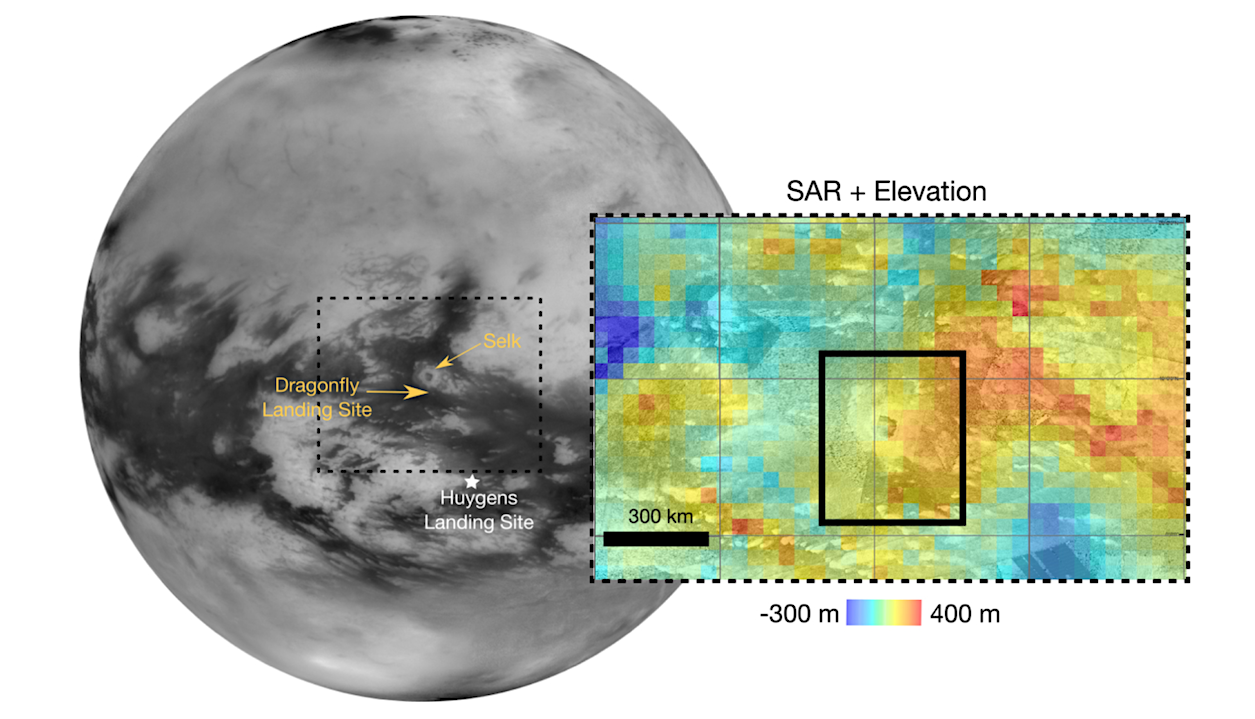
Titan, Saturn’s largest moon, has long captivated the scientific community as a premier laboratory for prebiotic chemistry. Among its diverse landscapes, Selk crater stands out as the primary objective for NASA’s upcoming Dragonfly mission. A recent study published in the journal Astrobiology synthesizes current knowledge of this site, providing a critical framework for interpreting the data the rotorcraft lander is expected to collect once it arrives in the mid-2030s.
Selk crater is not merely a geological feature; it is an ideal “natural laboratory” where the ingredients necessary for life—liquid water, organic molecules, and energy—are theorized to have intersected. The crater was formed by a bolide impact into the icy crust of Titan, a violent event that briefly melted the moon’s surface, creating a temporary pool of liquid water. Scientists are now focused on understanding the geochemical evolution of this “impact melt” and the potential for complex organic molecules to have formed within it.
The research details the crustal composition of the Selk region, which is dominated by water ice mixed with complex hydrocarbons derived from Titan’s thick, nitrogen-rich atmosphere. When the impactor struck the surface, it triggered an aqueous chemistry process that persisted until the melt eventually cooled and froze. During this period of liquid water existence, the interaction between surface-deposited organics and the subterranean interior provided a unique window for prebiotic reactions.
To maximize the mission’s scientific return, the study breaks down the environmental factors that governed the crater’s formation and subsequent evolution. It examines the chemical pathways that likely occurred as the melt deposit cooled, focusing on the reactants—such as simple nitriles and hydrocarbons—that were present during the transition from a molten state to a frozen, stable surface. By modeling these chemical interactions, researchers have identified specific “chemical signatures” that Dragonfly’s onboard suite of instruments, including the Dragonfly Mass Spectrometer (DraMS), should prioritize during its sampling campaigns.
The article provides actionable recommendations for the Dragonfly team, highlighting the most promising locations within the crater to conduct high-fidelity analysis. Rather than sampling at random, the researchers suggest targeting areas where impact melt products have been protected from long-term exposure to Titan’s harsh surface conditions. These areas are most likely to harbor the best-preserved evidence of the chemical processing that occurred post-impact.
Characterizing these deposits is central to the mission’s broader goal: determining the limits of prebiotic chemistry on a planetary scale. If the Dragonfly mission can identify complex organic compounds within Selk crater that resulted from impact-induced aqueous processing, it would provide a transformative perspective on how life-essential chemistry might emerge on icy worlds across the solar system and beyond.
As the Dragonfly mission prepares for its voyage, this synthesis of Selk crater’s environment serves as a roadmap for discovery. By integrating geological context with chemical modeling, the scientific community is positioning itself to not only land on the surface of an alien moon but to interpret the complex history written into its craters. The data gathered at Selk will not only enhance our understanding of Titan’s past but will likely reshape our theories regarding the potential for habitability in the outer solar system.
As Titan continues to reveal its secrets, the focus on Selk crater remains an exercise in planetary detective work. With the logistical complexities of landing a rotorcraft in an unexplored landscape, the clarity provided by this study ensures that when Dragonfly touches down, it will be prepared to identify the most significant chemical clues in the quest to understand the origins of life.
Disclaimer: This content is auto-generated for informational purposes only.
Source: Read Original News