








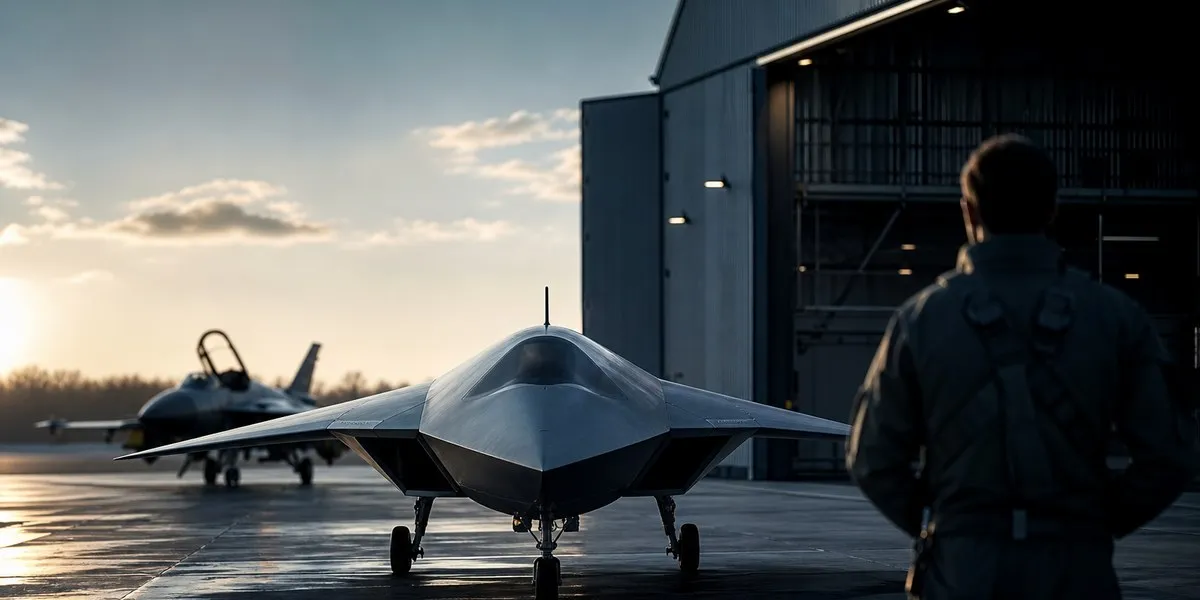
BERLIN — The German Ministry of Defence has officially informed Boeing that it no longer intends to proceed with a direct procurement of the MQ-28 Ghost Bat unmanned aerial vehicle. The decision, which marks a significant shift in Germany’s strategy for fielding advanced “loyal wingman” technology, was confirmed by a company representative to Breaking Defense.
The Ghost Bat, a sophisticated autonomous drone designed to operate alongside crewed fighter jets, was previously viewed as a frontrunner in Berlin’s push to modernize its air combat capabilities. However, the German government’s pivot now leaves the future of its Collaborative Combat Aircraft (CCA) program in a state of flux.
When pressed for comment on the rationale behind the cancellation, the German Ministry of Defence remained tight-lipped. Citing strict government procurement regulations and the necessity of parliamentary oversight, ministry officials declined to elaborate on why the Boeing platform was discarded. They noted only that all potential acquisition projects are subject to rigorous internal and legislative review processes.
The move carries broader implications for Germany’s defense timeline. Berlin had initially set an ambitious target to integrate unmanned wingmen into its fleet by 2029. With the Boeing deal off the table, industry analysts suggest that this objective is increasingly unattainable. According to reports from Politico, the acquisition and full implementation of such a capability may now be pushed back to the early 2030s, with flight testing for whichever platform is eventually selected not expected to begin until 2027.
Despite the setback, Boeing has indicated it remains open to assisting the German government as it weighs alternative paths. “We are ready to support the German customer regarding further steps,” the Boeing representative stated.
The void left by the Ghost Bat has immediately intensified competition among other defense contractors vying to equip the Luftwaffe with next-generation autonomous strike assets. Potential candidates for the re-opened selection process include Germany’s own Helsing, which is promoting its AI-driven CA-1 Europa, and a collaborative effort between Airbus and Kratos involving the U740-Valkyrie. Additionally, General Atomics remains a strong contender, offering its versatile line of unmanned aircraft from the “Gambit” family.
As the German Ministry of Defence recalibrates its procurement strategy, the focus shifts to how these alternative platforms can meet the high technical requirements originally intended for the Ghost Bat. For now, the German government appears committed to a more thorough vetting process, even at the cost of a delayed entry into the era of autonomous aerial warfare. The outcome of the next round of tenders will likely define the technological trajectory of the German Air Force for the next decade.
Disclaimer: This content is auto-generated for informational purposes only.
Source: Read Original News