






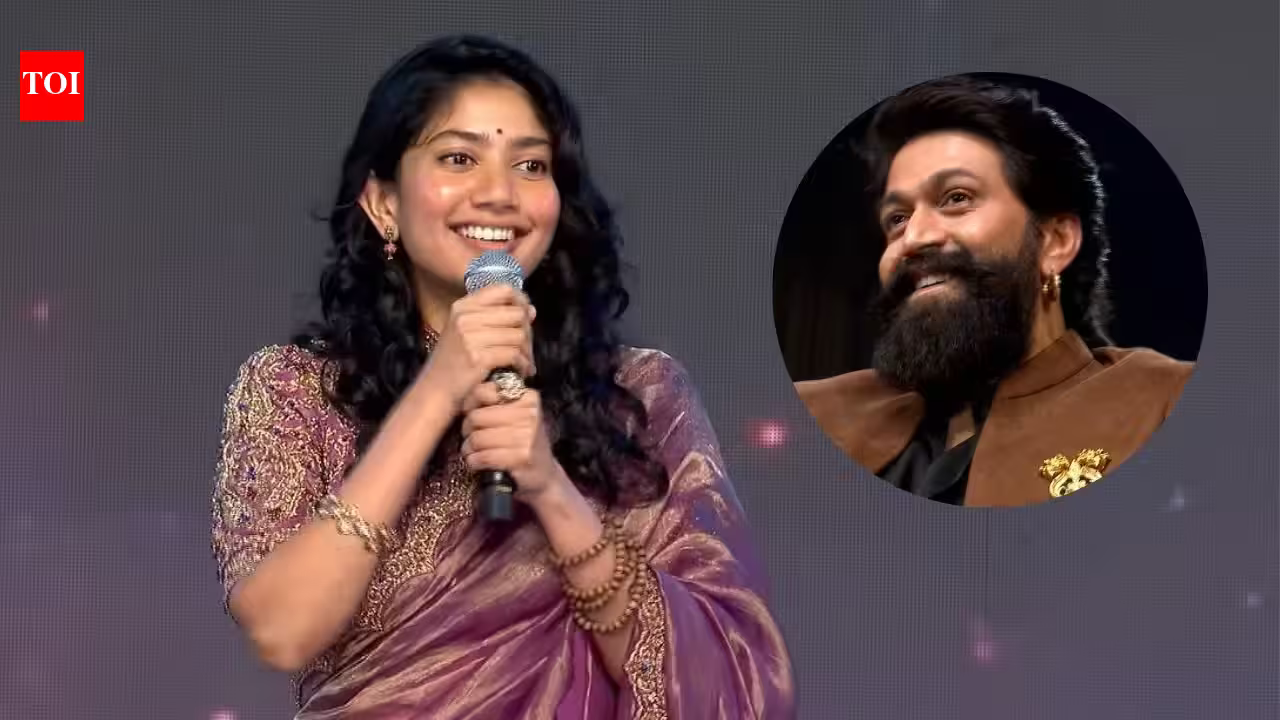
The collision of two worlds—the grounded, emotive sincerity of Sai Pallavi and the thunderous, high-octane ambition of Yash—has created a buzz that is vibrating far beyond the sets of Nitesh Tiwari’s Ramayana. In a recent exchange that feels like a dialogue between the past and future of Indian cinema, the two stars found common ground on a topic that has been on the minds of fans for years: whatever happened to the “romantic hero” phase of the man who conquered the box office as Rocky Bhai?
During a promotional event in Hyderabad, Sai Pallavi, who steps into the iconic role of Sita, shared a candid moment of curiosity. She turned to her co-star—who portrays the formidable Ravana in the upcoming epic—with a question many of his early fans have whispered: Would he ever return to the smaller, intimate, “cute” love stories that defined his formative years in Kannada cinema?
It is a question that cuts to the heart of the “Pan-Indian” transition. For those who remember Yash from the days of Googly or Mr. and Mrs. Ramachari, that iteration of the actor—charming, relatable, and deeply invested in the cadence of a simple romantic arc—feels a world away from the gritty, gold-laden violence of KGF. Yash’s response, however, was not one of nostalgia, but of profound, calculated mission.
The Evolution of a Cinematic Titan
Yash’s trajectory is perhaps the most audacious success story in modern Indian entertainment. He didn’t just grow; he pivoted with such seismic force that he dragged the entire Kannada film industry into the global spotlight. Before the KGF phenomenon, Yash was the quintessential romantic lead, balancing charisma with the kind of grounded performance that makes a regional film resonate within its own cultural borders.
Then came the Prashanth Neel-directed KGF: Chapter 1 and Chapter 2. The numbers alone tell a story of cultural displacement: moving from regional hits to a combined worldwide box office gross exceeding 1,400 crore rupees. But more importantly, Yash stopped being just a Kannada star and became a brand of “maximalist” Indian cinema. When Sai Pallavi asked him if he would consider going back to the roots of the boy-next-door romance, Yash’s answer was a masterclass in professional focus. He articulated a vision of legacy that prioritizes the “big screen” experience over the comfort of the familiar. He is no longer making movies for a locality; he is making them for the world stage.
The ‘Ramayana’ Gamble: A Grand Stage
If Yash’s ambition is the engine, Nitesh Tiwari’s Ramayana is the vehicle designed to carry it to the stratosphere. This isn’t just another film; it is a gargantuan undertaking, a two-part saga reportedly mounting a budget north of 4,000 crore rupees. By casting Ranbir Kapoor as Lord Ram, Sai Pallavi as Sita, and Yash as the complex, multifaceted Ravana, the production is effectively assembling the Avengers of Indian cinema.
Yash’s involvement goes deeper than a paycheck; he is serving as a co-producer alongside Namit Malhotra. This suggests that his obsession with “bigger” films isn’t just about being in front of the camera—it’s about the infrastructure of the industry itself. He wants to leverage this epic to demonstrate that Indian cinema can hold its own against any global competitor, not just in terms of VFX, but in narrative scale and sonic immersion. The inclusion of A.R. Rahman and Hans Zimmer, a duo that sounds more like a dream than a press release, confirms that this production is aiming for a level of prestige that transcends borders.
Can Romance and Spectacle Coexist?
There is a subtle melancholy in Sai Pallavi’s question. Pallavi herself is an artist defined by her ability to elevate smaller, high-concept, or emotionally nuanced films. She represents the “soul” of cinema, whereas Yash, in his current avatar, represents the “spectacle.”
Yet, the magic of this collaboration lies in the friction between these two approaches. Can a star as big as Yash ever go back to the small, intimate story? Perhaps the question shouldn’t be “will he,” but “why would he?” When an actor has successfully proven that he can hold the attention of a global audience with a sledgehammer, picking up a pen and a guitar for a light romance feels, at best, like a holiday. Yash’s refusal to turn back isn’t a rejection of his past; it is an acknowledgment of the platform he has earned. He believes he has the “opportunity” to change the perception of Indian cinema—and he is unwilling to squander it on the small when the world is finally watching.
The Horizon: November 2026 and Beyond
As the industry looks toward the November 5, 2026, release date for the first part of Ramayana, the excitement is tempered only by the sheer scale of the wait. There are rumors of the second installment shifting to 2028, a sign that the makers are prioritizing quality and craft over the rush of a seasonal release.
For the fans, the prospect of seeing Yash—a man who has defined himself through intensity—play the ultimate antagonist in a mythological frame is the primary draw. But for the purists who miss the Googly days, there is a lesson to be learned from his trajectory: the small stories paved the way for the big ones, but they never meant to be the final destination.
Sai Pallavi and Yash represent two distinct, yet vital, currents in our film industry. One pulls us in with raw, human-centered storytelling, and the other pulls us upward with the gravity-defying weight of pure spectacle. In Ramayana, we get both. And for a moment, in an interview suite in Hyderabad, it was a reminder that even the biggest stars in the world sometimes wonder about the paths they left behind—even if they’re much too busy building the future to ever turn back.
Disclaimer: This content is auto-generated for informational purposes only.
Source: Read Original News