









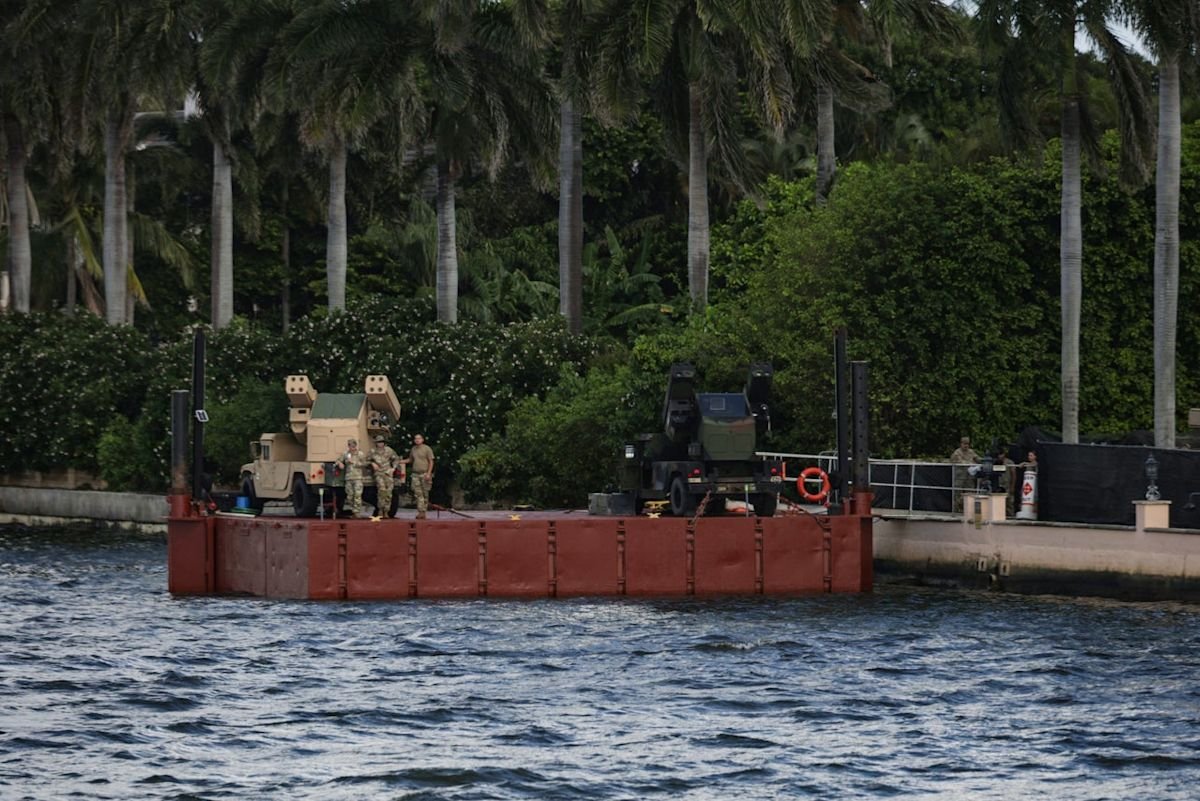
The deployment of heavy military-grade defense systems in Palm Beach, Florida, has drawn public attention to the intersection of national security and the sensitive local environment. The U.S. Secret Service, citing a “heightened threat environment” leading up to the midterm elections, has installed AN/TWQ-1 Avenger Air Defense Systems near Mar-a-Lago and the recently renamed Donald J. Trump International Airport.
The installation of these mobile, surface-to-air missile platforms—designed to engage low-altitude aerial threats—is an uncommon sight in the coastal community. Photos captured last week revealed two of these units mounted on a barge stationed in the Lake Worth Lagoon, just off the shoreline of the former president’s estate. A similar system was deployed on the south side of the local airport.
The presence of these military assets in the ecologically sensitive lagoon and the surrounding area has highlighted the intensifying security measures surrounding the residence. The Secret Service confirmed that the equipment was deployed at their request, with the North American Aerospace Defense Command (NORAD) and U.S. Northern Command providing the necessary “Counter-Unmanned Aircraft System” capabilities to bolster protective operations.
The move comes as the skies over Palm Beach have seen a significant increase in security activity. According to data from NORAD, there have been more than 60 incidents since January where unauthorized aircraft violated established flight restrictions in the vicinity of the resort, necessitating military intercepts. Most recently, a fighter jet was deployed to conduct a “headbutt” maneuver—a standard procedure used to gain a pilot’s attention—after a civilian aircraft drifted into protected airspace. While such intercepts are intended to enforce safety, they underscore the density of aerial traffic in a region where high-profile protective security and civilian aviation frequently collide.
The deployment of the Avenger systems—which use FIM-92 Stinger missiles—adds a new layer of permanence to the restricted airspace and maritime zones surrounding the properties. While these measures are framed as essential for protecting the former president following several security incidents, including an armed intruder discovered at his nearby golf club and a lethal security breach at the gate of Mar-a-Lago earlier this year, the militarization of the local shoreline remains a notable shift for the area.
As the midterm elections approach, the combination of military hardware and the ongoing volatility of the political climate has transformed the immediate environment of Palm Beach into a high-security zone. While the Secret Service maintains that it is adapting its protective operations to incorporate “cutting-edge tools and technology,” the visibility of missile systems in a residential and coastal setting serves as a stark reminder of the current national climate.
The former president, who continues to maintain a busy schedule of rallies across the country despite the reported threats, is expected to continue utilizing his Palm Beach estate as a primary residence. As both law enforcement and military agencies calibrate their responses to emerging security threats, the community and its natural surroundings remain at the center of a complex security apparatus that continues to evolve in real-time.
Disclaimer: This content is auto-generated for informational purposes only.
Source: Read Original News